A New Case of the Danbury Shakes

When John Oliver badmouthed Danbury, I donned my best Mad Hatter attitude, pulled out my Danbury Historic Booklet Series, and climbed my family tree. Ron caught wind of my indignation. It got his dander going.

See, I’m from Danbury. Although I was born in Bridgeport, Connecticut, I escaped to Danbury when I started college. At the time, Western Connecticut State University was called Danbury State College. One of my literature professors was my mother’s high school English teacher. She confided that the blue-haired professor was old even then.

My mother’s family lived in Danbury for generations. The homestead abuts the Hearthstone Castle, where cousins and siblings played as kids. Gramp was a union leader in the hat industry. Uncle Steve started working at the Danbury News Times in the 1920s; 52 years later he retired as the editorial page manager. One uncle owned a small stationery store. Another worked at the local Kimberly Clark factory. Aunt Jeanne was a lifelong member of Saint Peter’s Church. That’s where I taught English and later yoga when I was with the local Integral Yoga Institute.  

The city has a 300-year-old quirky profile. First known as Pahquioque by its namesake tribe, it evolved into the 19th century Mad Hatter City. The moniker refers to erethism merculialis, a neurological disorder also known as the Danbury Shakes, which workers developed from inhaling mercury fumes associated with hat manufacturing. Around that same time, danburite—a quartz-like mineral reputed to have spiritual powers that activate enlightenment—was discovered. About 150 years later, a local teacher found evidence of Druid chambers in nearby woodlands.

Against this curious backdrop, the Age of Aquarius dawned in the 1970s, giving Danbury a new set of shakes. Just an hour from New York City, the small-town ambiance and rolling hills drew scores of musicians, artistes, and virtuosos. I was Padma, my boyfriend Krishna; we studied yoga at the feet of Swami Satchidananda, the guru who opened the Woodstock Music Festival and lived in a secluded pagoda on Zinn Road. I cleaned his house.

A friend owned Nature’s Cupboard, the only health-food store for miles around. Another ran the Royal Embassy of Ooh-Ah Land. These businesses were the nexus of an eclectic crowd of meditating macrobiotic vegans, Catholic teachers, Buddhist dancers, kosher pot smokers, massage therapists, agnostic filmmakers, songwriters, poets, séance mediums, a Native American shaman, disciples of esoteric gurus, and truth-seekers of every shape and color.

I also know a seedy side of Danbury. My chemistry professor was convicted of pedophilia in 2014. That was a few years after Saint Peter’s Father (later Monsignor) Kevin Wallin got involved in meth. Who would have thought that the chemistry teacher would become a pedophile and the priest a drug dealer? It was really too bad, because they were both involved with the Dorothy Day Hospitality House, which provides food and shelter for the homeless.

So I’m delighted that Danbury Mayor Mark Boughton announced that the city will rename its sewage plant after the John Oliver. The so-called comedian gave me a new case of the Danbury Shakes.

What Yuki is Reading

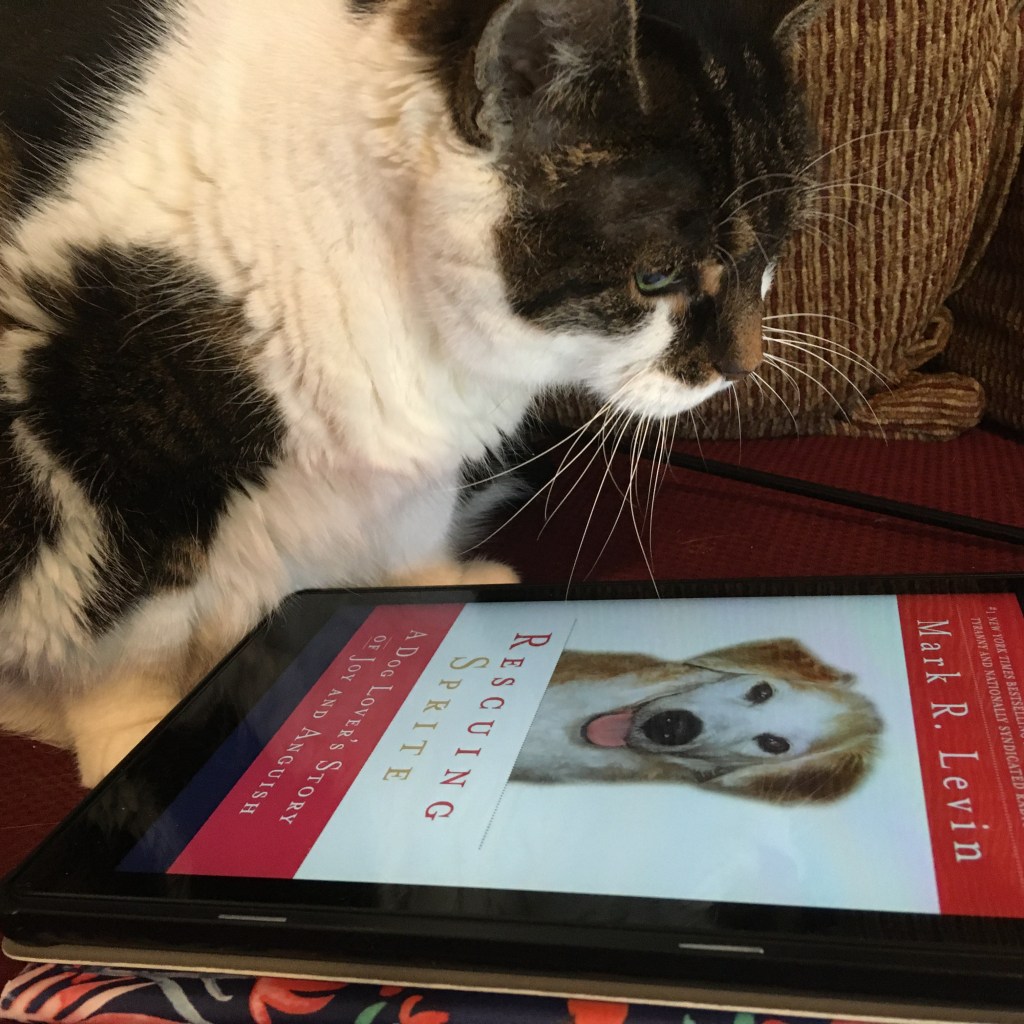
The first picture is me, Yuki. JJ was the surrogate human in the days when my own humans used to travel. It was always better when my own humans took Princess Charlotte, the dog, with them. In the second photo is Chairman Meow, who feuds with Princess Charlotte.

I’d rather read than fight, so I’ve been enjoying, While Standing on One Foot: Puzzle Stories and Wisdom Tales From the Jewish Tradition, by Nina Jaffe and Steve Zeitlin. This is a series of short folk tales, each with a “What would you do?” option and a peaceful solution to often life-threatening problems.

One of my favorites is: “The Court Jester’s Last Wish.” It’s the story about the resident stand-up comedian, who angered his boss, the King, and was sentenced to death. The King gave the Jester 24 hours to choose the manner in which he would die. What do you think the Jester said? Hint: My old granny cat used to say, “If you live, you get old.”

Unmasqued

Too pooped to plop, Bob merely crumpled into the nearest chair to monitor the cats as they emerged from their drug-induced stupors. Having finally arrived at an airport hotel after a 15-hour endurance test, we were emerging from our own moving-induced stupor. Our relocation gymnastics that day had ranged from a broken elevator to a quarter-mile footslog through Dulles International Airport like berserkers on a raid—eyes agog, hair amok, tongues distended, clothes saturated with dirt, sweat, and fears—lugging two cats, two carry-ons, and a bag to be checked. Now it was nearly 10 p.m., and none of us had eaten since last night. Like a deflated berserker, I scavenged for food.

Food. The word echoed like a mantra through my guts and drove me past hotel-lobby snacks. I stumbled out the door and into the unknown avenue of airport lodgings. From an Uber, I had seen a 7-Eleven. Not what I had in mind, but a source of food nonetheless. And a Denny’s a few blocks farther. Should I walk that far? Could I walk that far? Before contemplating such complexities, the implausible ruckus and neon-blue allure of a boisterous bar enticed me across the cul-de-sac. Implausible because I was inured by ubiquitous lockdowns. Ruckus because the DJ had pumped up the noise. Boisterous because it was Friday night and people (real people, not Zoom avatars) clumped around tables, clinking glasses, feasting on entrees (not groceries or takeout) and laughing.

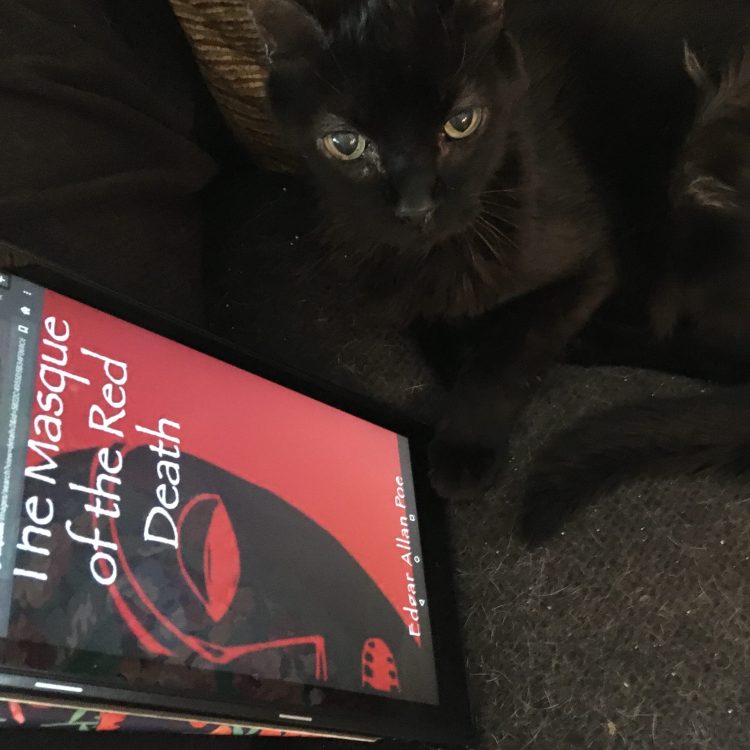
Laughing—the incantation either mocked the Zombie Apocalypse or caricatured Edgar Allen Poe’s Masque of the Red Death. Granted, the COVID pandemic is no match for Poe’s pestilence, and the Oyster Bar and Grille—though amply provisioned—was hardly Prospero’s castle. Yet merrymakers reveled with the same quintessential abandon of a non-infected safe haven.

Threading my way along the boundary of orange concrete parking curbs, my senses were piqued by the bar, yet my sensibilities restrained them. Teetering between disjointed realities, and knowing I could not dwell in both, I pondered my alternatives—a masked convenience store promising pre-packaged predictability, or the unmasqued pub pulsing with perfumed provisions and people-rich tang. Stomach raged against intellect. Food, I chanted. Food. Food. Food. A portal appeared and in a death-defying leap of hunger, I tore through the veil that separated me from epicurean debauchery.

Food! I ordered two grouper specials. The bartender, who doubled as my waiter, sized me up as such professions are wont to do.

“From up north?”

I nodded. “Just moved here. Just. Got off the plane an hour ago. I’m staying across the street.”

It was his turn to nod. “Florida is in Phase One of reopening.”

Ah, the party scene now made sense. Virginia seemed like more than five hours and a thousand miles away. Not only had it been a long day, it had been a long week, starting with Bob driving our car down here. After cramming a butt-load of administrative details into two days, he parked the car in our new garage, flew back to Virginia, and rented the car that we loaded with cats and baggage when the movers left.

Based on our vet’s advice, we decided to fly with Ron and Nina rather than subject them to a three-day road trip. Get everything over at once, she suggested—sort of like ripping off a band-aid. We dosed them with gabapentin, restricted food and water to prevent smelly incidents, and packed them into their airline-approved in-cabin carriers. That was the easy part.

As organized as I had prided myself in being, last minute details had cascaded into eleventh-hour foibles. The cleaning crew arrived too early; the movers left too late. The airport shuttle driver unapologetically dumped us as far away as possible from the special accommodations counter where we needed to check in. After presenting the requisite health certificates, we hauled ass to TSA, where we requested a private screening—no way did we want to chance escaped cats on drugs running loose around the airport. After regrouping and rehydrating, we made it to the gate with enough time to dose the cats again. Three hours later, we checked into a pet-friendly airport hotel. The movers would arrive two day later. Tomorrow, we would retrieve the car, run errands, and have dinner with friends.

Dinner. Food. Food! The aroma of fresh seafood restored me to the present moment. The bartender handed me two orders of local grouper. Real food. Still take-out. But the clientele promised otherwise.  

“Thanks,” I said.

“Welcome to Florida,” he smiled.

Right, Write Sentence

Hot damn. I can write a good sentence. At least according to the editors at WRITERS DIGEST. Nina enjoyed reading this one, which placed fourth in the journal’s May/June 2020 Your Story contest:

Ensconced in a pretentious lair and camouflaged among imposters, Roseate Spoonbill surrendered without incident, but not without deceit.

According to Jenny Davidson, writing at aeon.co, sentences are comparable to the tiny components of a house. Some are mostly functional while others are the decorative details we remember. You need both to preserve architectural integrity and individuality. So writing a sentence word by word is easy—no more difficult than building a house by laying one brick upon another. Subject, predicate. Subject, predicate. Roseate Spoonbill, ensconced, camouflaged, surrendered, deceit.

That works, but how do you write well, creating style and substance? William Strunk, in the ageless Elements of Style, advises that, “A sentence should contain no unnecessary words, a paragraph no unnecessary sentences, for the same reason that a drawing should have no unnecessary lines and a machine no unnecessary parts.”

Assuming the modifiers are integral to the sentence, they have their own rules structure, too. Mark Forsyth, author of The Elements of Eloquence: How to Turn the Perfect English Phrase, notes that adjectives must follow a certain order: opinion-size-age-shape-color-origin-material-purpose noun. For example, he says, “you can have a lovely little old rectangular green French silver whittling knife. But if you mess with that order in the slightest you’ll sound like a maniac.”

Now you get to build that sentence. Writing for The Guardian, professor and author Joe Moran says that a good sentence imposes a logic on the world’s weirdness. If you make each sentence worth reading, something in it will lead the reader into the next one. Good writers write not just in sentences but with sentences. They write paragraphs.

I can do that, too. In November 2019, the opening to my debut middle-grade novel got thumbs up from the panel of judges at the Philadelphia Writing Workshop in a session of “Writers Got Talent.” It reads:

Puffs of forced air exploded in my face with each exhaled breath. I wanted everyone to think I was cold, not anxious, so I spewed a few more. Fingering the wristband that identified me as an unaccompanied minor, I waited and waited and waited in the bleak misery of a blustery train station. After nearly an hour of signing papers and answering questions, it was finally time to leave on my first solo trip anywhere. I blew again and shook off my hoodie. Dad replaced it.

It was as easy as stringing six simple sentences into one cohesive paragraph—simply laying one brick upon another. Using that logic, concatenating 5,000 paragraphs into one compelling story should be easy, right? Wrong. My award-winning sentence took about 20 hours to compose; the paragraph, about 20 years. I want each sentence, each paragraph, each story to be elegant.

Coco Chanel, my heroine of elegance, preached that simplicity is the key. Using her advice, I endeavor to write like I get dressed, starting with good underwear—subjects and predicates. My vocabulary reflects a wardrobe that runs from business to bohemian. Baubles and scarves are the adjectives and adverbs. Shoes move the look forward. Elegance, however, comes with a caveat—before leaving the house, remove one accessory. When writing, remove the superfluous.

Writing is not so simple after all. Yet somehow we intuitively manage to do it. Regardless of how long it takes, you know you got it right, though, when you appraise the final product—words, order, cadence, accessories, and grammar—and smile.

Good writing, after all, is like U.S. Supreme Court Justice Potter Stewart’s definition of pornography—we know it when we read it.

Right. Write on.

Simplicity or style: what makes a sentence a masterpiece?

Jenny Davidson

is a professor of English and comparative literature at Columbia University, where she specialises in 18th-century literature and culture, intellectual history and the contemporary novel in English. Her latest book is The Magic Circle (2013). 

A great sentence makes you want to chew it over slowly in your mouth the first time you read it. A great sentence compels you to rehearse it again in your mind’s ear, and then again later on. A sentence must have a certain distinction of style – the words come in an order that couldn’t have been assembled by any other writer. Here’s an elaborate, Latinate favourite, from Samuel Johnson’s preface to his Dictionary of the English Language (1755). We have to train ourselves to read complex sentences like this one, but if it’s read properly out loud by an actor or someone else who understands the way the subordination of clauses works, it may well be taken in more easily through the ear:

When we see men grow old and die at a certain time one after another, from century to century, we laugh at the elixir that promises to prolong life to a thousand years; and with equal justice may the lexicographer be derided, who being able to produce no example of a nation that has preserved their words and phrases from mutability, shall imagine that his dictionary can embalm his language, and secure it from corruption and decay, that it is in his power to change sublunary nature, and clear the world at once from folly, vanity, and affectation.

The sentence is elevated in its diction, but it is also motivated by an ironic sense of the vanity of human wishes. It is propelled forward by the momentum of clauses piling on top of one another.

Edward Gibbon is one of 18th century Britain’s other great prose stylists. The sentences of Gibbon that I love most come from his memoirs, which exist in a host of drafts braided together for publication after his death. As a young man, Gibbon fell in love and asked permission of his father to marry. But his spendthrift father had depleted the family’s resources so much that he told Gibbon not to. ‘I sighed as a lover, I obeyed as a son,’ Gibbon wrote. The aphoristic parallelism in that lovely sentence does some work of emotional self-protection. Also from Gibbon’s memoirs: ‘It was at Rome, on the fifteenth of October 1764, as I sat musing amidst the ruins of the Capitol, while the barefooted friars were singing vespers in the temple of Jupiter, that the idea of writing the decline and fall of the City first started to my mind.’ The precision of the place and time setting, the startling contrast effected by the juxtaposition of barefooted friars and the pagan temple, the fact that there is an exterior soundscape as well as an internal thoughtscape, the way the sentence builds to the magnitude of the project to come – all work to make the sentence great.

The first sentence of any novel works as an invitation into a new world. Sometimes that invitation is so powerful that the sentence itself takes on a life of its own. One example: the opening sentence of Orwell’s 1984: ‘It was a bright cold day in April, and the clocks were striking thirteen.’ The sentence is initially unassuming, simply descriptive, but in the startling final detail Orwell achieves estrangement, establishing the alternate nature of the novel’s historical reality with economy and force. Another opening line from near-future speculative fiction is that of William Gibson’s debut novel Neuromancer: ‘The sky above the port was the color of television, tuned to a dead channel.’ The startling metaphor seemed to speak with remarkable directness to a world in which new forms of media and mediation had come to define human consciousness. The passage of time has raised questions, however. Today, to a generation of readers who barely watch TV on ‘channels’ and don’t really know what a ‘dead’ one would look like, the metaphor will be nearly inscrutable.

Hasn’t the sentence become dated? Gibson himself commented on Twitter recently, about his 2003 novel Pattern Recognition, that it ‘was written with the assumption that the reader could and *would* Google unfamiliar terms and references’. It matters to Gibson that his fiction should be highly topical in ways that can also be inscrutable or dated, and that will provoke in the reader not simple incomprehension but rather an awareness of the layering of past and present in palimpsests of language and literature.

Some literary stylists bestow greatness on every sentence without tiring their readers. Many readers feel this way about Joyce, but I have always preferred the subtler beauty of the sentences in Dubliners to the obtrusive, slightly show-offy ingenuity that afflicts every sentence in Ulysses: individually each of those sentences may be small masterpieces, but an unrelenting sequence of such sentences is wearisome. Great minimalist sentences – those of the short-story writer Lydia Davis, for instance – may have a longer shelf life.

Over a lifetime of reading, people form their own individual canon of great sentences. My canon is full of Jane Austen, whose balance of aphoristic wit, psychological insight and narrative pacing is unique. The first sentence of Pride and Prejudice (1813) is probably her best-known line: ‘It is a truth universally acknowledged that a single man in possession of a good fortune, must be in want of a wife.’ However, I have always preferred the opening line of Emma written two years later: ‘Emma Woodhouse, handsome, clever, and rich, with a comfortable home and happy disposition, seemed to unite some of the best blessings of existence; and had lived nearly twenty-one years in the world with very little to distress or vex her.’ It has the cadence almost of a fairytale, only the verb ‘seemed’ and the ostentatiously positive sequence of traits (‘handsome, clever, and rich’) hint that the novel will go on to undermine its opening assertion.

If we think of a library as a city and a book as an individual house in that city, each sentence becomes one tiny component of that house. Some are mostly functional – the load-bearing wall, the grout between the bathroom tiles – while others are the details we remember and take away, perhaps recalling their texture and colour when we assemble our own verbal dwelling-place.

Jenny Davidson

This article was originally published at Aeon and has been republished under Creative Commons.

Big, Big, Little Richard

When I met Little Richard in the mid-nineties, he was huge. Not tall, although he seemed much heftier than his official 5´10˝, 160 pounds. Not flamboyant, either. His trademark pompadour was cropped to a tight Afro and his makeup was subtle. And certainly not entertaining. No, wearing a stylish white suit, minus the glitters, he sat quietly with a few associates in the hushed lobby of the Hyatt Hotel in downtown New Orleans.

What made Little Richard huge was the knock-your-socks-off gusto with which he welcomed my colleague.

Brenda and I had arrived to tour the hotel’s facilities for a conference. Spotting him across the expansive lobby, she traded her unflappable businesswoman demeanor and for that of an enamored fan. “That’s Little Richard,” she gushed, looking at me with her eyes agog. “Come on!” Before I could respond, she made herself as tall as her five-foot frame would allow and marched right up to him. As soon as she introduced herself as Reginald Ball’s daughter, his brand of grandeur was unleashed.

“Brenda, Brenda, Brenda!” He jumped up and his eyes widened with memories of a venue that had been significant in his rise to fame. Her father had owned Ball’s Auditorium, a stop on the Chitlin’ Circuit in Lake Charles, Louisiana. The strong arms she attributed to years of lifting platters of fried chicken at the family business went limp as Little Richard wrapped his presence around her. They talked warmly about her family for several minutes. Everything about him spewed gratitude for the role her father had played in his career.

During the 1950s and 1960s, Lake Charles was a crossroads—literally and figuratively—for Little Richard and others who were paving the way for black entertainers revolutionizing the music scene. They passed through the small city in southwest Louisiana from New York, Chicago, Atlanta, Memphis—all points east and north—on their way to and from Texas. It was a crossroads of musical styles, too, for everything from blues and country, to swing and zydeco, and of course, rock ’n’ roll.  Ball’s Auditorium hosted a slew of entertainers, and Brenda knew many of them—James Brown, Ruth Brown, Ray Charles, Sam Cooke, Fats Domino, Etta James, B.B. King, Otis Redding, Jackie Wilson, Sam and Dave, and the Temptations.

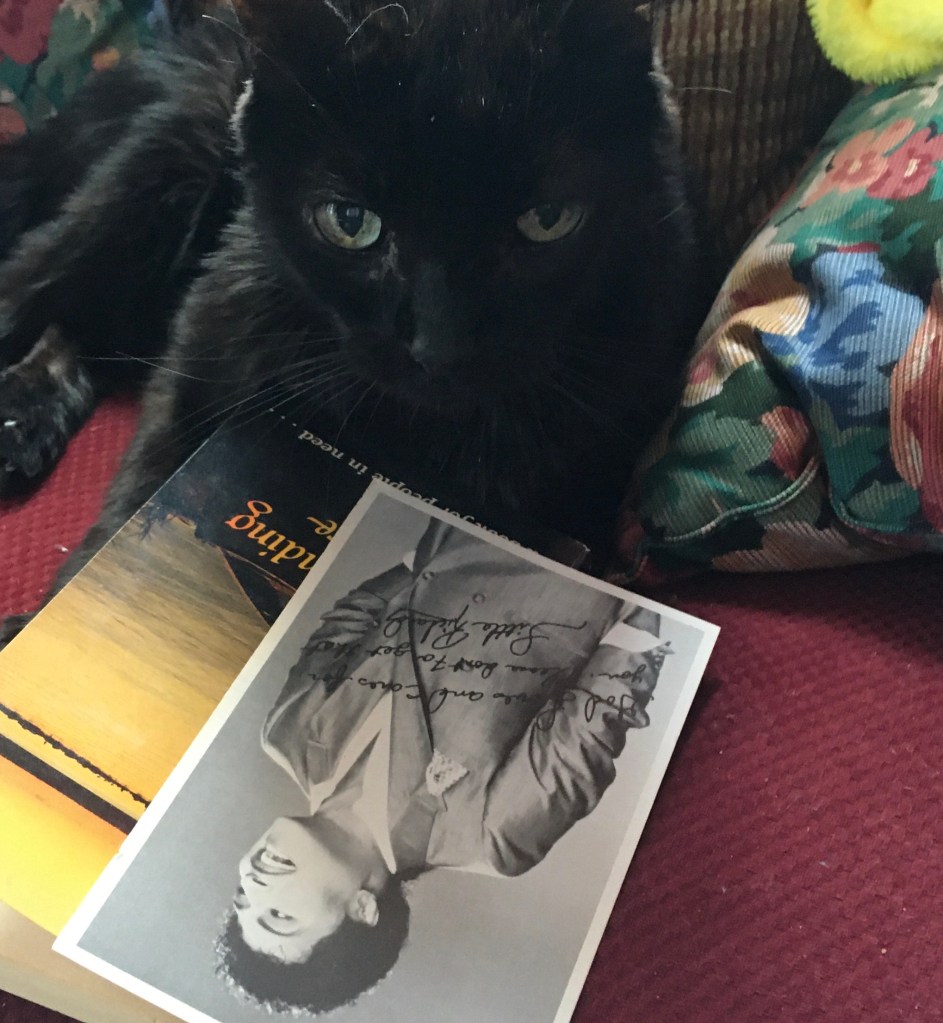
When I met Little Richard, however, he had traded the Chitlin’ Circuit for Jesus. He was in New Orleans to promote Finding Peace Within, A Book for People in Need, which comes with a print of Little Richard inscribed with, “God loves and cares for you. Please don’t forget that.” I won’t. Nor will I forget that the big Little Richard signed copies of the book for Brenda and me. As you can see, Ron was quite impressed with the signed copy.

Then Little Richard hugged me. That’s when he became huge.

First Word

When Tom Davis recently solicited poems and vignettes related to reading, writing, or public speaking for the Webster’s Reading Room, A Poetry and Prose Anthology, he stirred this memory. At four years old, I was an aspiring writer. Many decades later, I remain fascinated by the alchemy of transforming thoughts into words. It seems Ron and Nina are, too.

Dust danced across
single diamond-shafted western sunbeam
filtered through ochre and absinthe stained glass,
its fleur-de-lis daunted by decades
dignifying mid-century
first-floor flat life.
 
Sprawled beneath,
on nearly threadbare davenport puce,
pigtails pinched neath buster brown bang,
squinty eyes, skewered lips, crumpled nose,
chubby fingers fisting chubbier pencil,
she huffed, puffed, scuffed magic
 
Of scrawled bars,
curls, dots, dashes—random flukes—
guiding archetypal fantasies,
kneading scraps of freckled worth
to timeless, nameless worlds
beyond setting suns.
 
In quietude,
no child—not one of six—resounded.
Alone at home was she, a mere four years?
Or so rapt was the chronicle of
whispered chatters, stylus to skin
that she heard but no one, save her muse?
 
Ribbons plaiting her wake
in flight, she swooped
breathless, waving scrawls midair,
bestowed upon aproned augur,
a gift—my first—of woken ardor.
“Mom,” I prayed the alchemy alive, “Is this a word?”

—Patti M. Walsh  


Ailurophiles

My friend Ron enjoys many aspects of our friendship. From time to time, we have our own book club.  Unlike many others, we don’t simply meet to discuss a book  we’d finished reading independently. As this picture reflects, we actually sit and read it together, discussing it as we go along.

The book we were reading here is Reflections on Judging by Richard A. Posner. Peculiarly well-qualified to pen such a book, Posner was, for 36 years (1981-2017), a highly regarded appellate judge on the U.S. Court of Appeals for the Seventh Circuit. Before his judicial appointment, he was a popular professor at the University of Chicago Law School.  Many consider him the most influential judge of the late 20th and early 21st centuries not to have sat on the Supreme Court.

Having been an appellate lawyer for many years, I maintain an interest in all things appellate, and, in particular, what appellate judges have to say about appellate practice, in particular, and the law more generally. By osmosis over the years, Ron has gravitated toward my job interests, often serving as a both colleague and muse on days when I worked from home.

 This book was particularly appropriate for Ron and me to read for an additional reason—both Judge Posner and I have long been ailurophiles, i.e., cat lovers. Posner and his Maine Coon, Pixie, have a long-lasting relationship similar to Ron’s and mine. Posner has said on more than one occasion that Pixie is his writing muse. 

Hence, Ron and I, as two ailurophiles, thought it would be fun to see what a fellow ailurophile had to say. And it was fun, indeed. Posner discussed judicial philosophy (Posner and Pixie are legal realists while Ron and I are formalists) and methods of interpretation, as well as a slew of perceived problems with both judges and advocates. But we chose to focus on Posner’s discussion of legal writing.

If you’re like most people who aren’t in the law biz, you probably consider the term “good legal writing” an oxymoron. With good reason. So many lawyers—judges, too—see it as their mission to justify their high fees by producing legal documents that are impenetrable.  So much of it, regardless of the area of law or purpose of the document, is repetitive, monotonous, and verbose. The driving principle seems to be “why say in 10 words what I can say in 150? People won’t think I’m smart unless I fill the page with archaisms, Latinisms, sentences consisting of two subordinate clauses each, and as much hyperbole and passive voice as I can possibly squeeze in.”  Ron, in particular, is put off by passive-voice constructions—so much so that, when we finished our reading one evening, he told me, “Hey Bob, the chicken-based food I was given by you last night was strongly preferred by me over Tuesday night’s pork.” What a joker!

Ron especially liked Posner’s demonstration of the brevity-is-the-soul-of-wit philosophy. Posner took a 3350-word judicial opinion and rewrote it so it said the same thing, much more clearly, in 602 words.

We both agreed that this segment of the book is best summed up by the KISS principle—“keep it simple, stupid.”

Aloha Quarantine

All this talk of quarantine brings me back to sipping Kona coffee with my husband on a Pacific-facing lanai along Hawaii’s Kohala Coast. Lulled by pounding surf and sultry trade winds, Bob suggested we adopt a simple life: quit our jobs, abandon our belongings, and have the pet sitter ship our cats to us.

Such a move would not be unheard of in his family. Uncle Bill, whom we had visited days before in Honolulu, did just that (minus the cats) in the 1960s. A recent college graduate, he sat for a federal civil service exam in western Massachusetts, where ice pellets echoed off the windows of a vaulted auditorium. Those pings prompted him to select the newly admitted 50th state as a desired location. He moved, met and married Aunt Lydia, and never looked back. He did, however, visit the mainland often.

Among the many considerations Toni Polancy lays out in her book, So You Want to Live in Hawaii, is budgeting for off-island mobility. Island Fever is real, Uncle Bill would say. It’s a form of claustrophobia. Loneliness and isolation, however, are only a couple of the negative aspects of moving to, and living, in Hawaii.

Cost of living is another. Hawaii is expensive—very expensive. According to the Family Support Center at Joint Base Pearl Harbor, it’s at least 35% higher than on the mainland. Despite that, you will live longer—four years longer, statistically speaking. Baked into the state’s cultural luau is a healthy outdoor lifestyle, low incidence of obesity and tobacco use, and high respect for the elderly.

Conversely, those same elderly face expensive housing, high food and medical costs, limited public transportation, and scarce assisted-living options. Yet they enjoy substantial benefits. Pension and Social Security income are exempt from state income taxes, and senior homeowners enjoy ironically low property taxes. On the other hand, many properties are held in trust for Native Hawaiians, so rentals are a good option for retirees.

Many rentals, however,  don’t allow pets—if you can even get your pet into the island state. Strict quarantines keep Hawaii rabies-free. Our tabby, Nina, cringed at the mere thought of a quarantine. Her disdain for change includes seething and ignoring us when we return home from a vacation.

You may want to move to Hawaii,” she glared when Polancy’s book arrived. Nina reminded us that of our three cats, she alone yowled her way through the airport terminal upon her arrival from Louisiana 14 years ago. Like us, she had lost her home in New Orleans to Katrina and then bounced between Houston and Baton Rouge. Having heard that a pet could be subject to a 30- to 120-day confinement, she glowered.

While the law does allow a five-day quarantine or even direct release after inspection, Bob and I then cringed when we read that between vaccinations, travel containers, and quarantine fees, the process can cost well over a thousand dollars—per cat.

Nonetheless, we looked at houses on the Big Island and Oahu. In the mountains overlooking Waikiki, I jumped out of the car to take a jaw-dropping, postcard-worthy picture of a quiet neighborhood. Golden ‘illima papa popped against the dazzling fetches of the vast Pacific, dotted with catamarans and surfers. Deep purple awikiwiki spilled like leis over neat fences, and puffy white hoawa bushes mounded themselves like cotton into manicured lawns.

While loulu palms beckoned, chords from the London Bach Choir drifted from someone’s lanai. “You can’t always get what you want,” the voices chanted as a karmic typhoon hit my forehead. I sang along, “But if you try sometimes, you just might find, you get what you need.”

Thus we carefully and honestly scored Hawaii’s livability. In addition to the cost of living and isolation, Nina insisted that whatever move we make, it should involve minimum disruptions, a short flight, and no quarantines.

So we bid aloha to Hawaii. That complex greeting means far more than hello and good-bye. It encompasses affection, gratitude, and sadness. Aunt Lydia always says, aloha a hui hou, which means “so long, until we meet again.” That more accurately sums up our love of Hawaii. Our quest to find a place in the sun will lead elsewhere.

I think I’ll grab a cup of Kona, ponder those possibilities, and bid aloha to quarantines.

Snapshot Time

I’m sure you’ve noticed it. Today is easily confused with yesterday—or maybe it’s tomorrow. Every morning seems like Saturday—or is it Sunday? You’re hungry for dinner mid-afternoon, or not hungry at all until sometime after dark, when you want breakfast. Without the commute, book club, aerobics class, school activities, or any other mundane marker of daily life, all time has warped. It’s sensory deprivation, a Stephen King thriller, COVID Time.

Apropos of the warp and befitting a lifelong passion, I have been cataloging my life in photographs, the paper kind: cowgirl, prom date, world traveler, yoga hippie, swamp paddler, professional woman. The assemblage of real people doing real things and having real fun delineates a fascinating life. While you generally don’t realize until you are older that your life has been unique, I was blessed with the wisdom to capture its wonderful weirdness on film as I traipsed along.

Thus it was with profound respect that I hauled out my mother’s scrapbook and undertook the tedious process of transferring her memories from a portfolio of paper that disintegrated in my fingers to an archival-quality photo album. The tedious process transported me to a different time and space, much as COVID Time has done, granting me an insight into the woman I wish I knew.

Our tabby Nina seemed as fascinated with the pictures as I was. There are formal portraits of my paternal grandparents along with Dad, who was born in 1912, and his sisters. Mom and her twin brother were born in 1916, when the sartorial trend was nainsook gowns for boys and girls, with boys transitioning into frocks with box pleats and knickers. These photos are more than a hundred years old, yet they are in remarkably good shape.

Although the portraits were professionally shot, I’m sure that Gramp, my maternal grandfather, took the candid ones of my Nana and her babies with a Brownie camera. In fact, most of the pictures in the photo album were probably shot with Brownies. The original box camera sold for a dollar in 1900. According to the Brownie Camera Page, the device was the mass-marketing genius of film manufacturer George Eastman. He correctly predicted that an inexpensive camera in every home meant lots and lots of film would be sold and processed. He pretty much created the snapshot. Mom’s book is full of them.

Prior to being a harried and practical mother of six, she kicked loose, at least long enough to take a road trip with three girlfriends after graduating from nursing school. Lifelong friends, Noreen and Kay were also nurses; Rita, was a teacher. Sporting a broad grin, Rita drove what was obviously her pride and joy—a 1945-ish Chrysler. The pictures confirm what I remember of her. She bucked the shirtwaist dress style favored by Mom and the others in favor of Kathryn Hepburn–like trousers. She was always offbeat.

They drove from Connecticut to Washington, D.C, and then along Skyline Drive in Shenandoah National Park—routes I know well. Silly girls in hair curlers and sunglasses, they shot pictures of each other sleeping in the car, posing in front of landmarks, squinting into a mountain sun, and doing laundry in a forest cabin.

Giving equal treatment to my father’s career as a firefighter and Army Air Force sergeant in World War II, she compiled pictures of the trucks he drove—a prewar Seagrave Pumper and a postwar Seagrave Bickel Aerial as well as the airplanes he serviced while stationed in England. Writing on the back of a series of photos, he identified one plane as a BC-1A, which was nicknamed “The Duck.” He also modeled a leather fleece-lined jacket that he wore when it was cool. There’s also a hilarious photo of him sticking his head through a cut-out so that he appears to be dressed in full Scottish regalia.

With the same diligence, she compiled wedding snapshots and a honeymoon to Montreal and Quebec. She saved maps, receipts from posh hotels that cost $5 a night, even a napkin from what was probably the swankiest dinner of her life.

Then boom! The nurse and the fireman went on to raise six children. They lost more and more spontaneity with the birth of each baby, but Dad documented our childhoods with his Brownie. I wonder what happened to it. Mom probably threw it away as she did so many things. But I am so grateful she kept her collections of snapshots, and that somehow, I ended up with her photo album.

Nina agrees that reassembling it has been a good way to pass COVID Time.

COVID-19, Meet Godzilla

Cats, like dogs and other animals, pick up on anxiety and other stressors in their homes. So when I noticed Nina diligently studying the coronavirus online, I realized that this was an apt time to update our emergency preparedness, particularly our Godzilla bag. That’s what Bob calls the satchel we can grab and go if we need to get the hell out of Dodge. Okay, so I’m mixing movie metaphors, but you get the idea—pending doom that goes beyond toilet paper and water.

For a good overview of emergency preparation, I recommend www.ready.gov, the official website of the U.S. Department of Homeland Security. Its recommendations on preparing for, responding to, and mitigating natural and manmade disasters can be applied to anything from wildfires, blizzards, and floods to COVID-19, Chernobyl, and the Zombie Apocalypse. Think Godzilla!

I first became aware of emergency preparedness when we moved to New Orleans. The annual Hurricane Preparedness Week at the beginning of May caught my attention. Before the formal storm season began on June 1, we learned what to do if advised to hunker down or evacuate. During our 18 years there, we did both. Having a plan made them both easier.

In addition to annihilating buildings and roadways, Godzilla can destroy communication networks and electricity. We learned that the first sign of a pending hurricane is not the storm tracking lines in the Gulf, but the snaking lines at the gas pumps and ATMs. Bob still insists on keeping at least a half tank of gas in the car at all times, for convenience, maintenance, and unanticipated escapes.

For the same reasons, paper records are mandatory. Try proving you are who you say you are without digital backup. If you have pets, make sure each one has a separate carrier. If they sense panic, you don’t need them attacking each other. Our Godzilla bag does not include pet supplies or people food and medicines, but those items are easy to grab. Ready.gov recommends one gallon of water per person per day for a minimum of three days, at least a three-day supply of non-perishable food, and a battery-powered or hand-crank radio.

If you already have an emergency kit, this at-home time is a good occasion to update it. If you don’t, it’s a good time to start. To assemble your kit, store similar items in airtight plastic bags. Stash the assemblage into one or two easy-to-carry containers, like a Homer bucket or duffel bag. Because of personal and financial identification, your kit must be secured. While you don’t want to give anyone easy access to your entire life, you don’t want to be an undocumented refugee trying to withdraw money from your own bank account.

Our kit is in a fireproof, waterproof bag that is hidden in plain sight. Here’s what’s in it:

  • Cash
  • Bank account numbers
  • Copies of Social Security cards, birth and marriage certificates
  • Copies of our will, power of attorney, and advance medical directives
  • List of prescriptions
  • List of contacts
  • Pet photos and information
  • Whistle
  • Alcohol wipes
  • Small first-aid kit with pain reliever, bandages, and topical antibiotic
  • Tissues
  • Non-latex gloves
  • Water purification tablets (Ready.gov recommends bleach and medicine dropper to disinfect water)
  • Paper and pen/pencil
  • Matches in a waterproof container
  • Bandanas (in lieu of dust masks)
  • Toothbrushes, toothpaste, combs
  • Granola bars
  • Prepackaged eating utensils (the kind you get with take-out)
  • Small packets of Tabasco (with a tip of the hat to a Louisiana friend, who says you never know what you may have to eat.)

In the car we keep:

  • Blanket
  • Cell phone chargers
  • First aid kit
  • Flashlights
  • Needle-nosed pliers
  • Maps
  • Water

Whew.

Now that we are all sheltering in place, why not introduce COVID -19 to Godzilla. Never let a good crisis go to waste.