Scrubbing for Wildlife

Mickey Blanchett studies the Florida scrub-jay.
Photo by Patti M. Walsh

Mickey Blanchett takes after housemate Rick when it comes to observing birds.

On a recent bus trip organized by the Calusa Nature Center to the Archbold Biological Station in Venus, Florida, Rick spotted horned owls, swallow-tailed kites, and caracara when everyone else saw cows. His wife, Nancy, is accustomed to people gathering around Rick when he has his finger pointed in the air.

“What are we looking at?” Someone will say as a small crowd gathers to follow his gaze. “Chimney swift,” he might say. Or grasshopper sparrow. Or black skimmer. It doesn’t matter. It’s usually something most people have never heard of. And may not even see.

Closer to home, Mickey enjoys the crows, jays, and wrens—even a family of bald eagles—in the nature preserve behind his home. He’d love one day to see a Florida scrub-jay, he thought as he studied a brochure that Nancy brought home. But he’d have to travel about two hours north, and, well, he yawned, that’s not going to happen.

See, the Florida scrub-jay is found nowhere else in the world.

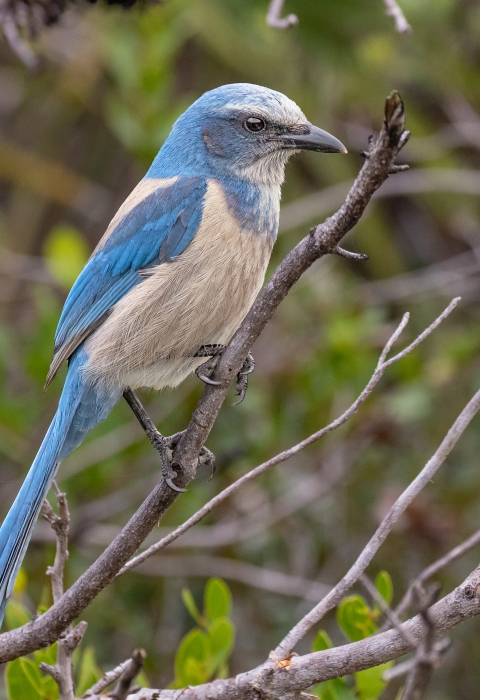
Scrub Jay (Aphelocoma coerulescens)
Courtesy of U.S. Fish & Wildlife Service

I joined Rick and Nancy at Archbold to learn more about the threatened bird and the station that studies it. Once endangered, the jay’s population has doubled since the 1990s, according to the Florida Fish and Wildlife Conservation Commission.

A member of the crow family, the scrub-jay’s name says it all. It lives in the short scrub oaks found in central Florida along the Lake Wales Ridge.  

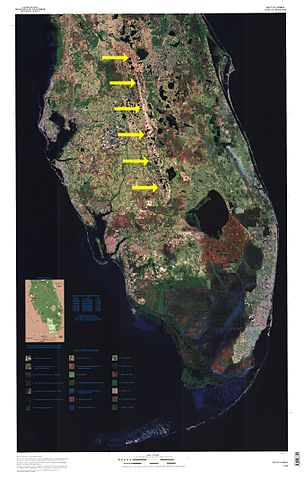
Sometimes referred to as the Mid-Florida Ridge and visible by satellite, the 100-mile spiny landmass is a relic beach dune, though it’s about 75 miles from the nearest shore. At 312 feet above sea level, the nearby Sugarloaf “Mountain” is the tallest formation in the area and one of the tallest hills in Florida.

Satellite image of the Florida peninsula with yellow arrows indicating the position of the Lake Wales Ridge.
Courtesy of U.S. States Geological Survey

Improbable as it seems, the white sands of central Florida are an extension of the Appalachians. Twenty million years ago (give or take a millennium or two), when tectonic activity lifted the mountains into existence, the same cataclysm heaved fine-grained sediments from the depths of the ocean to the top of the limestone that created the ridge that’s now home to the unique bird.

Beach sand, 75 miles from the nearest shoreline.
Time slips by, like 20-million-year-old sand.
Photos by Patti M. Walsh

A Florida native, Rick likes that about the scrub-jay. Averaging about 10 inches in length and weighing about 3 ounces, it’s an umbrella species. That means conservation efforts to protect it extend to other species that live among the short, scrubby oaks that grow in the sandy soil of the Lake Wales Ridge.

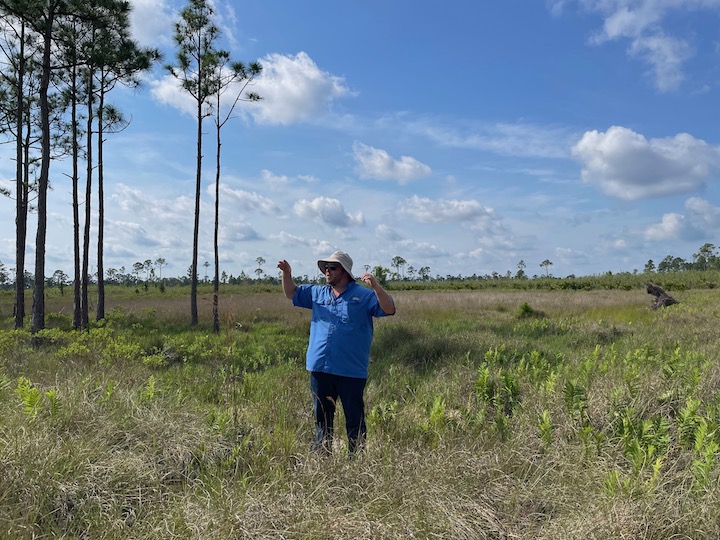
Our tour of the Archbold Biological Station was led by environmental education leader Dustin Angell. We learned that what looks like bare, sandy patches punctuated with scrub oaks, blueberries, and palmettos is really a very healthy habitat for these birds—and the things they eat.

Nancy, Patti, and Rick at Archbold Biological Station
Photo by Rick Blanchett

Their diet consists of caterpillars, insects, small lizards, and rodents. But the staple is scrub-oak acorns. A single scrub-jay can harvest and hide as many as 8,000 acorns a year. Remarkably, each jay remembers where it buried each corn. As an added benefit, acorns that are cached but not eaten become new oaks.

Four species of oak live here—sand live oak, scrub oak, myrtle oak, and Chapman’s oak. Related to mighty oaks that thrive in richer soil elsewhere, they reproduce by acorns as well as by clonal root systems. This backup system facilitates re-emergence after a fire. Controlled burns prevent the proliferation of pine trees that would otherwise turn a scrub habitat into a forest, as well as grasses that would cover the bare sand patches the jays need to hide their acorns.

Saw and scrub palmettos also benefit the jays. They use the scrub palmetto’s fibers to line their nests. Recently completed studies date the saw palmettos to be between 5,000 and 8,000 years old.

Scrub-jays are cooperative breeders. Each nesting territory is occupied by an adult pair and the pair’s offspring from previous years. Not only do the offspring babysit and help feed the nestlings, but they also watch for predators. If necessary, the family forms a mob—attacking the predator until it leaves. Rarely do scrub-jays travel more than two miles from where they hatched.

Environmental education leader Dustin Angell explains the importance of the Florida Wildlife Corridor.
Photo by Patti M. Walsh

Archbold Biological Station is a field station and natural laboratory for visiting biologists and students studying the region’s rare plants and animals. As such, it has played a crucial role in the campaign to conserve the Florida Wildlife Corridor.

Established in 2021 by unanimous, bipartisan support, the Florida Wildlife Corridor Act established a statewide network of nearly 18 million acres of contiguous land crucial to the survival of many of Florida’s 131 imperiled animals. It secures access to habitats for wide-ranging wildlife, including the endangered Florida panther, each of which needs 200 square miles. The black bear, incidentally, needs 60. Roads and other developments restrict the movement of these animals.

Mickey knows that when panthers, bears, and other animals have no access to natural prey, they turn to domesticated herds and human food. He also knows that feral and wild cats are a major threat to scrub-jays.

But he isn’t likely to pounce. He’s a fat cat, an armchair birder, who leaves the hard work to his housemates, Rick and Nancy.

Chick Stories

A memoir of adventures lived, laughter shared, and lessons learned with my girlfriends

Travesties, tragedies, and comical calamities abound
in a series of essays rich with historical and cultural context.

Learn More.

Buy Now.

Newsletter:
Come to Think of It

Stories are meant to be shared. So are fleeting thoughts, poetic musings, humorous anecdotes, and existential questions.

Come to Think of It is a forum to engage, inspire, and challenge. To gather with friends. Come to Think of It.

Subscribe at PattiMWalsh.com/newsletter.

Going Head-to-Head with Manatees

Photo by Martha Hustek

Pukka is not a people-friendly feline—unless, of course, he’s snuggling up with his housemates, Martha and Rick. Only then does he allow his true cat-onality to express itself. His prevalent feral spirit involves patrolling his environment, bringing home small rodents, and indulging a curiosity with another primitive mammal—the manatee.

Not that Pukka would actually jump into the waters of the nearby Blue Spring State Park, a designated manatee refuge. Heavens, no. One accidental dunk a few years ago in the backyard pool was enough of a water adventure for him. Instead, he sates his inquisitiveness by curling up with a good book and vicariously head-bumping the large, marine mammals sometimes known as sea cows.

During a recent visit to central Florida, Martha and Rick took my husband Bob and me to Blue Spring to see the manatees. But not without first getting some advice.

According to Pukka, who conveyed his knowledge through Martha, Blue Spring is the largest natural spring associated with Florida’s St. John’s River. The longest river in Florida, it is noteworthy for its lazy northward flow, commercial and recreational use, and manatees.

“The number of Florida’s West Indian manatees there is growing like snowbirds flocking to the Sunshine State,” he meowed, adding that the local marine mammals are bigger than their Amazonian and West African cousins. They can grow to 13 feet long and weigh as much as 1,300 pounds. They also have paddle-like tails and wrinkled skin.

While manatees look roly-poly, Pukka continued, they are really quite lean. With only about an inch of fat beneath their leathery skins and a very slow metabolism, water temperatures below 68°F bring on cold stress syndrome, a condition comparable to hypothermia. It can be deadly. So the manatees leave the colder waters of the St. Johns River for the safety and comfort of the 72° Blue Spring.

Pukka emphasized that point by strolling out to the lanai and plopping in the sunlight that poured into it.

Acknowledging that sanctuaries such as Blue Spring are vital for manatees’ survival, we took Pukka’s advice and headed over to the state park. There, we trekked a one-third-mile boardwalk that parallels Blue Springs Run. The trail meanders through a lush hammock from the parking lot at St. Johns River to the run’s headspring.  

Blue Spring is a misnomer. The waters are green—emerald, crystal clear, and transparent. Beneath the mosaic-like ripples that fracture the water’s glassy surface, I spotted what looked like long, flat rocks that resembled the torpedo-shaped river rocks on Belle Isle of the St. James River in Richmond, Virginia.

Until they fluttered. As did my heart, as manatees performed a slow, mesmerizing aquatic ballet that corresponded to their cycles of sleeping submerged and surfacing for air. They spend about half of their lives sleeping.

Doing a quick count, I exclaimed aloud that there had to be at least a hundred of them.

“The official count today is 262,” a park visitor corrected me.

She knew because the Save the Manatee Club conducts and publishes a daily roll call. Founded in 1981 by former Florida Governor and U.S. Senator Bob Graham and singer-songwriter Jimmy Buffett, it is the world’s leading manatee conservation organization and exists solely to protect manatees and their habitats.

The day before our visit, the club had released 12 manatees into Blue Spring Run, an ideal location since the animals can be easily monitored in the spring and the surrounding waters.

The local manatee population has grown from about 36 animals when research began in the 1970s to as many as 500 animals today. Rehabilitated manatees sport GPS radio tags on their tails, which are monitored by the Manatee Rehabilitation Partnership (MRP). According to the MRP, some manatees seek out Blue Spring in the summer to give birth.

Temperatures in the spring remain a constant 72°F, creating a safe haven. Although there are many threats to manatees, including habitat loss, pollution, and algae blooms, more than 41% of manatee deaths are human-related, primarily due to watercraft collisions. We were able to see propellor scars on the manatees that floated below us on the walkway.

The trail ends at the headspring known as “The Boil,” which looks more like a simmer.

Most of this water, which began as last year’s rain, bubbles up from an aquifer that flows downhill from areas in north and central Florida through limestone bedrock. Each day, from a depth of 120 feet, more than a million gallons of warm water are forced up from the caverns, resulting in “The Boil.”

According to Journey North, a project funded by the University of Wisconsin—Madison Arboretum, that’s about 72,000 gallons every minute, or 4,333,333 gallons per hour. By comparison, a typical shower uses 30 gallons; a load of laundry, 40 gallons; and a car wash, 60 gallons.

The spring can be enjoyed by swimmers, paddlers, snorkelers, and certified scuba divers with a partner. The state parks, however, limit access when manatees or alligators are congregating.

In addition to the manatees and alligators, the park has a healthy population of various fish, including the alligator gar. Elsewhere in the park dwell the Florida scrub-jay, the state’s only endemic bird, and the endangered Anastasia Island Beach Mouse.

For centuries, the Blue Spring was home to the Timucua tribe. In 1766, John Bartran, a British botanist, explored the area for the Crown. It was settled in 1856 by Louis Thursby and his family. The Thursby house, built in 1872, remains a tourist stop at the state park.

In 1972, Blue Spring became a state park with the help of Jacques Cousteau, whose Undersea World series included an episode called “The Forgotten Mermaids.”

Mermaids?

Yes. While manatees are Florida’s official state marine mammal, anthropologists agree that manatees have inspired mermaid legends for millennia.

For example, in his epic poem The Odyssey (circa 8th century BC), Homer introduced the siren, a half-bird, half-woman creature who lured sailors to destruction by the sweetness of her song. She is similar to the half-fish, half-human creature that 4th century BC Babylonians called Oannes.

And on January 9, 1493, Christopher Columbus documented the legend, writing in his journal that:

“On the previous day, when the Admiral went to the Rio del Oro [Haiti], he said he quite distinctly saw three mermaids, which rose well out of the sea; but they are not so beautiful as they are said to be, for their faces had some masculine traits.”

Voyages of Columbus, 218

Okay. Stretching one’s imagination, manatees could be mistaken for humans from afar. After all, their forelimbs have fingerlike bones, their neck vertebrae allow them to turn their heads, they use their flippers to “walk” along the bottom while they hunt for food, and they scoop vegetation into their prehensile lips.

Perhaps as ironic as the mermaid similarity is the manatee’s relationship to the elephant. Although they resemble walruses or chunky porpoises and are sometimes referred to as sea cows, manatees belong to a group of animals called Sirenia (i.e., Homer’s sirens), which includes elephants.

With thick, wrinkled skin, bristle-like hairs, and a herbivorous diet, manatees probably descended from a four-legged, elephantine-wading mammal. Scientists theorize that as sea grasses began to grow, manatees choose water over land. 

Like elephants, manatees are intelligent. They have good long-term memory, show signs of complex associative learning, demonstrate discrimination and task-learning abilities similar to dolphins, and communicate with a wide range of sounds.

When we returned home, Pukka trilled, reminding us that cats also communicate with a wide range of sounds. Just another reason, perhaps, why he likes going nose-to-nose with manatees.

Photo credits: Pukka and the Manatee by Martha Hustek; Blue Springs by Pat Walsh

Chick Stories

A memoir of adventures lived, laughter shared, and lessons learned with my girlfriends

Travesties, tragedies, and comical calamities abound
in a series of essays rich with historical and cultural context.

Learn More.

Buy Now.

Newsletter:
Come to Think of It

Stories are meant to be shared. So are fleeting thoughts, poetic musings, humorous anecdotes, and existential questions.

Come to Think of It is a forum to engage, inspire, and challenge. To gather with friends. Come to Think of It.

Subscribe at PattiMWalsh.com/newsletter.

Miss Kitty Does Mardi Gras

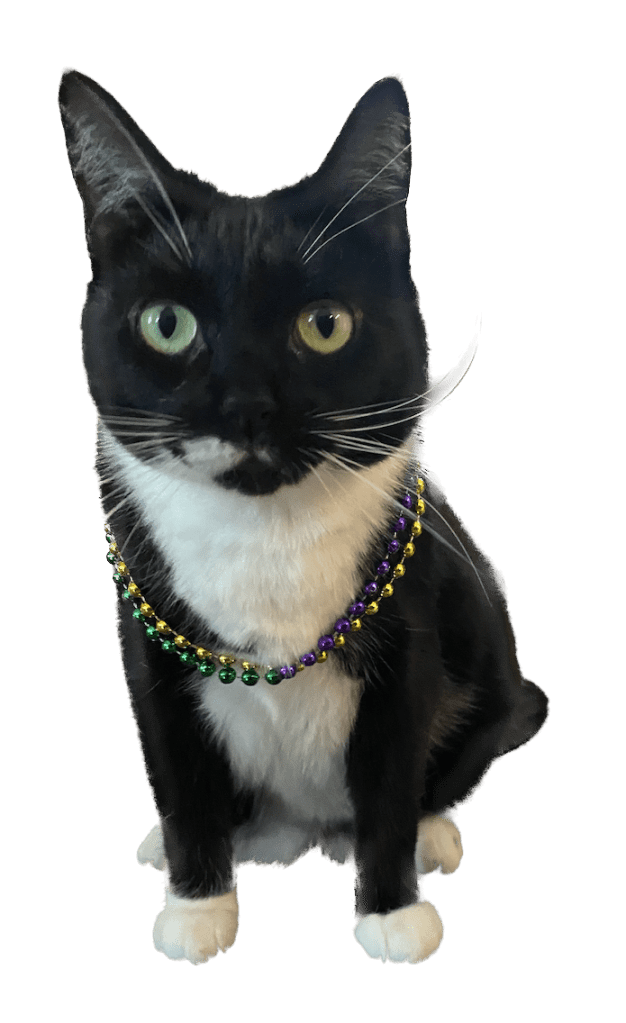
Miss Kitty knows that cool cats don’t read about Mardi Gras. They do Mardi Gras. Beginning with beads. Lots of beads.

Contrary to common belief, however, Miss Kitty believes that less is more. You’ll never see her draped with so many baubles that she can barely meow. She models her style on that of feline fashion icon Coco Cat Chanel, who said that before leaving the house, a feline should remove at least one accessory.

That’s why she sticks to a few strands of traditional Mardi Gras colors—purple, for justice; green, faith; and gold, power. She’s also a stickler for terminology. People often conflate Mardi Gras and Carnival.

Carnival comes from the Latin for flesh. It refers to the party and parade season that traditionally begins on the Feast of the Epiphany on January 6 and extends until Mardi Gras, which literally means Fat Tuesday. Mardi Gras is the day before Ash Wednesday, the Christian holy day that initiates the 40-day season of Lent that precedes Easter.

This year it is February 21.

The beads, cakes, and celebrations of Mardi Gras date back centuries to pagan rites of fertility. It grew out of the ancient Roman festival of Lupercalia. Observed in the dead of winter, it was an orgy-like festival of wine-induced madness that celebrated chaos, death, and rebirth.  

And it all began with a humble bean. An archetype of resurrection and reincarnation, the bean comes from a dead plant and grows into a new one.

For Lupercalia, a man was chosen to be a ceremonial king by being the one who got a bean that had been placed in a cake. (Sounds a bit like a contemporary king cake, doesn’t it?) For several days, he would enjoy as much sex, wine, and food as he could abide. Meanwhile, the peasants imbued in him all their failures and shortcomings. On the last day, he would be sacrificed to atone for their sins and his blood returned to the soil to ensure that the harvest would be successful.

Yikes.

Not coincidentally, it parallels the story of Jesus Christ. Knowing they could not destroy pagan conventions, the early Christians adopted the tradition—minus the orgies—as a prelude to the penitential season of Lent. That’s when the faithful traditionally give up sensual pleasures in preparation for the crucifixion, death, and resurrection of the Christ on Easter.

Speaking of Easter, Miss Kitty also reminded us that the precise date of Mardi Gras each year varies because it is determined by the complex calculations that determine the lunar feast: Easter is the first Sunday after the first full moon on or after the vernal equinox. Mardi Gras falls 47 days before Easter.

This year it is February 21.

Whew. That’s a lot to take in, Miss Kitty tells us. That’s why she keeps it simple. Like her Mardi Gras attire.

“Dress shabbily and they remember the fur,” she said, paraphrasing Ms. Chanel. “Dress impeccably and they remember the feline.”


Chick Stories

A memoir of adventures lived, laughter shared, and lessons learned with my girlfriends

Travesties, tragedies, and comical calamities abound
in a series of essays rich with historical and cultural context.

Learn More.

Buy Now.

Newsletter:
Come to Think of It

Stories are meant to be shared. So are fleeting thoughts, poetic musings, humorous anecdotes, and existential questions.

Come to Think of It is a forum to engage, inspire, and challenge. To gather with friends. Come to Think of It.

Subscribe at PattiMWalsh.com/newsletter.

Purr-fectly Understandable

John Caskey, an avid reader of this blog, shared with us the article, “Your Cats Can Tell When You’re Speaking to Them,” which appeared in the January 2023 issue of Scientific American.

The author, Tanya Lewis, reported on a study published in Animal Cognition that found cats, like dogs, can discriminate speech addressed to them when spoken by their owners. When hearing the same sentences uttered by strangers, however, cats did not appear to discriminate between adult-directed speech (ADS) and cat-directed speech (CDS).

According to Ms. Lewis, CDS is like babytalk, in that it is typically higher pitched and may have short, repetitive phrases.

Researchers Charlotte de Mouzon, Marine Gonthier, and Gérard Leboucher, at the University of Paris Nanterre, recorded 16 cat owners uttering phrases such as, “Do you want a treat?” in ADS and CDS. They filmed each cat before, during, and after playing the recordings of the owners’ and others’ speech. Then they used software to rate the cats’ reactions.

The researchers concluded that felines “reacted distinctively to their owners speaking in CDS, but not to their owners speaking in adult tones or to a stranger using adult tones or to a stranger using either adult- or cat-directed speech.”

Previous research has shown similar findings in dogs. “There are still some people who consider cats independent—that you cannot have a real relationship with cats,” said lead study author Charlotte de Mouzon, an ethologist and cat behaviorist.

Kristyn Vitale, a cat behavior scientist a Unity College in Maine, agrees.

“Although cats have a reputation for ignoring their owners, a growing body of research indicates that cats pay close attention to humans,” she said. “Cats can very much learn that specific vocalizations have certain meanings.” She noted that the study by de Mouzon et al. was small and that future work could expand the research.

The findings mirror those presented in the Netflix documentary Inside the Mind of a Cat, produced by Martin Shore and released on August 25, 2022.

In it, Ms. Vitale demonstrated that cats look to their owners for emotional advice. She attached paper streamers to a desk fan as a social referencing test. When she turned the fan on and the streamers fluttered, her cat Carl modeled his own response to her reaction.

When she acted frightened, Carl tried to hide from the fan, but when she acted happy, he was comfortable and confident. She concluded that 79% of cats look to their owners for clues on how to react to certain phenomena.

Inside the Mind of a Cat also reported that cats may exhibit cultural differences, depending on where they’ve been raised.

Dr. Saho Takagi at the University of Kyoto, noticed that cats from Japan appear less comfortable in unfamiliar environments than cats from the United States. She attributes this to the fact that cats in Japan are primarily kept indoors and rarely encounter strangers. After running these same experiments with Dr. Vitale, they concluded that these differences could be handed down through generations.

So, John, it seems that cats can indeed tell when you’re speaking to them.

Science simply has confirmed what feline aficionados have known for millennia. Communicating with cats is purr-fectly understandable.


Chick Stories

A memoir of adventures lived, laughter shared, and lessons learned with my girlfriends

Travesties, tragedies, and comical calamities abound
in a series of essays rich with historical and cultural context.

Learn More.

Buy Now.


Newsletter:
Come to Think of It

Stories are meant to be shared. So are fleeting thoughts, poetic musings, humorous anecdotes, and existential questions.

Come to Think of It is a forum to engage, inspire, and challenge. To gather with friends. Come to Think of It.

Subscribe at PattiMWalsh.com/newsletter.

All He Wants for Christmas

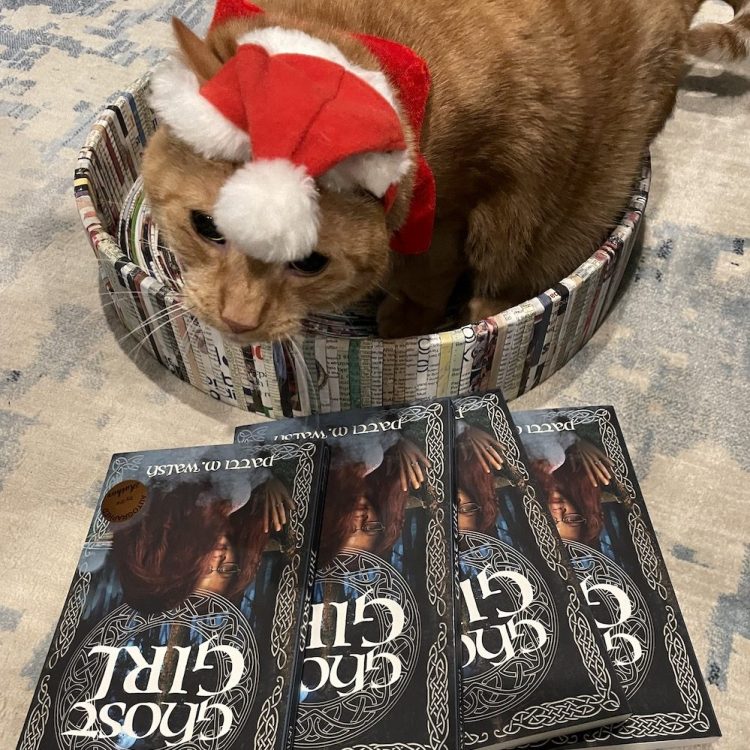
When Mickey Blanchette went snooping for Christmas gifts, he donned his Santa hat. Then he found a stash of unwrapped copies of Ghost Girl.

He pawed through the book and was delighted to read about the two felines that lived in Companion Moon, the haunted inn that served as the focal point of the novel. Pretending to be mousers, they had wheedled their way indoors to chase non-existent mice. What they really wanted—and readily found—was comfort and warmth. So did everyone who visited the inn.

A creature of nine lives himself, he appreciated a central theme in the book, that where there is no death—where past, present, and future are indivisible—one has the freedom to live.

Mickey liked reading about Mo, a gray tabby, who liked to slink around, offering her nose for a scratch; and Willy, a black cat, who purred his way out of dark corners at the mere mention of his name. Along with the dog, Angus, and 17 ghosts, they led Bonnie, the 12-year-old protagonist, on a journey of self-discovery.

But Mickey seemed to focus not on Bonnie’s self-discovery, but on the journey exemplified by the old proverb that explains cats’ nine lives. “For three they play; for three they stray; and for the last three, they stay.” Like Mo and Willy, Mickey knows a good thing. He relates to unconditional comfort and warmth. Why else would he deign to wear a costume?

It may have to do with being a creature of nine lives himself. He seemed to especially appreciate a central theme in the book, that where there is no death—where past, present, and future are indivisible—one has the freedom to live.

Mickey was so intrigued with the cats, the cozy setting, and the timeless theme that Ghost Girl offers, that he asked for his own copy.

He also suggested it would be a perfect gift for a pre-teen on your holiday shopping list. Or for that matter, any adult interested in Celtic mythology. He tapped his paw on the back of the book, noting the endorsement of George Cinclair Gibson, Ph.D., author of Wake Rites: The Ancient Irish Rituals of Finnegans Wake.

According to Gibson, a Celtic scholar, “Young readers will find Ghost Girl a relevant and positive guide for their own lives. Older readers will find Ghost Girl an attractive introduction to the deep and profound mysteries and spiritual precepts of the Irish Celtic tradition.”

“And cats,” Mickey purred, “Will find it deep and profound.”

As he snuggled into his favorite bed for a long night of reading, he alternated his gaze between the book and me. I understood he wanted me to read Chapter 1 to him, and share it with you.

So, with compliments of Mickey, Click here.


Chick Stories

A memoir of adventures lived, laughter shared, and lessons learned with my girlfriends

Travesties, tragedies, and comical calamities abound
in a series of essays rich with historical and cultural context.

Learn More.

Buy Now.

Dreaming with the Crawdads

My friend Reggie turned me on to Where the Crawdads Sing. Seems she did the same for her feline housemate GiGi.

GiGi seemed disappointed that the book wasn’t a cookbook. After all, crawdads is simply another name for crawfish. And since Reggie loves crawfish etouffee, turtle soup, and anything cooked ala Creole or Cajun, so does GiGi. Maybe she wasn’t disappointed, merely lost in another world—one in which she’d have crawfish for dinner.

So I closed my eyes and joined her. First for memories of crawfish, then for the marshes and swamps where they thrive. Then for the marshes and swamps themselves. I conjured the scene painted by the opening lines of both Delia Owen’s bestselling novel and its movie version. I wish I could have written them. I know I have experienced them.

Marsh is not swamp.
Marsh is a space of light, where grass grows in water, and water flows into the sky. Slow-moving creeks wander, carrying the orb of the sun with them to the sea,
and long-legged birds lift with unexpected grace—as though not built to flyagainst the roar of a thousand snow geese.

Then within the marsh, here and there, true swamp crawls
into low-lying bogs, hidden in clammy forests.
Swamp water is still and dark,
having swallowed the light in its muddy throat.
Even night crawlers are diurnal in this lair. There are sounds, of course, but compared to the marsh, the swamp is quiet because decomposition is cellular work. Life decays and reeks and returns to the rotted duff;
a poignant wallow of death begetting life.

Delia Owens

Critics praised Where the Crawdads Sing for its well-crafted plot, complex characters, and engaging mystery. For me, though, it was the setting that consumed my imagination.

Although the story was set in North Carolina, I read the book in Virginia, and watched the movie in Florida. But I experienced it as if I were in Louisiana, where critters emerge silently in flotsam-flecked swamps, blue herons noisily bark at any intrusion into their sunny marsh, and screech owls pierce the pitch-darkness of a thunder-filled night.

I got to know swamps and marshes up close. I could smell the difference.

Like Kya, I paddled, hiked, and fished the wetlands. I had a pirogue—a flat-bottom canoe—which was perfect for low-lying, muddy waters. I also had a friend with a small motorboat and a retreat on the Tangipahoa River. There, rustic camps still bury themselves among the hardwood forests, bald cypress groves, brackish marsh, and swampy bayous of the long, lazy river named after a local indigenous tribe. And though separated by a thousand miles and half a century, I pictured Kya’s cabin looking like one of them.

Thanks to my friend with the boat, I got to know the people who lived off the liquid land on that river. Names like Duke, Zelda, and Shelby were reminiscent of the Crawdads’ cast of characters—Chase, Mabel, Tate. Jumpin’ Bait & Gas could well have been the Bedico Marina 50 years back.

Imagine my delight to learn that the movie version of Where the Crawdads Sing was filmed in the same mysterious waterways I loved. That Kya really lived in a simple house like those on the Tangipahoa. That as Marsh Girl, she could indeed live there. That her environs looked familiar because they were. I know the remote reaches of Fontainebleau and Fairview-Riverside State Parks, Big Branch Marsh National Wildlife Refuge, and the Tchefuncte—and Little Tchefuncte—Rivers where the movie was filmed. I read that production was often disrupted by severe lightning storms, floods, heat, and bug bites. Been there, done that, too.

I didn’t know, but found it quite interesting, that the courtroom scenes were shot in the Historic St. Bernard Parish Courthouse in Chalmette, Louisiana, where the people are affectionately known as Chalmations. And Houma, known for its annual Shrimp and Petroleum Festival, was the site of the fictional Barkley Cove. It didn’t take much to transform the Cajun city into an early-60s fishing village.

While GiGi looks like she’s dreaming of crawdads for dinner, I’m dreaming of where they sing. That place, according to Owens’s character Tate, is “where critters are wild, still behaving like critters.” Where, according to Owens herself, marsh and swamp and water flow into the sky, where grass grows in water, and death begets life.

I opened my eyes. It’s time to read the book again.

Send your ideas and photos to
pat@pattimwalsh.com

Chick Stories

A memoir of adventures lived, laughter shared, and lessons learned with my girlfriends

Travesties, tragedies, and comical calamities abound
in a series of essays rich with historical and cultural context.

Learn More.

Buy Now.

Pickleball, Kitty?

While Kitty’s housemates Tania and Nancy were out playing pickleball, they had no idea that their feline housemate was practicing her own game.

That is, until they came home early one afternoon to find Kitty reading Pickleball Fundamentals and practicing her serves.

“Who do you think you are?” Tania asked Kitty. “Pickles?”

She was referring to the dog who has been credited with the name behind one of the fastest-growing sports in the United States. But Kitty corrected her.

“The dog was named for the game,” she purred, “Not the other way around.”

It all began, Kitty chattered, in 1965 when necessity, the Mother of Invention, met Joel Pritchard, the Father of Pickleball. Although Joel had been an army sergeant in World War II, a congressman, a member of the Washington Senate and House of Representatives, and the state’s lieutenant governor, he is renowned for his response to a hot day, bored kids, a welter of equipment—and perhaps a dollop of guilt.

As the story goes, Joel and his friend Bill Bell returned from a golf outing to a buzzkill chorus from their kids of, “There’s nothing to do.”

Kitty could relate to that. She loves to be played with. That’s why she took up pickleball. “That’s why a lot of people play,” she said.

According to Joel’s son Frank, in a story posted on the Pickleball Hall of Fame blog, Joel suggested making up a game to relieve the boredom. After all, that’s what he did as a kid. So Frank, being a hot, bored kid, challenged him to do just that.

Although the property on Bainbridge Island, Washington, had a badminton court, there were no rackets or shuttlecocks. But Joel found some ping pong paddles and a wiffle ball.

Joel’s wife Joan lightheartedly named the game “Pickleball,” a deliberate reference to the thrown-together leftover non-starters in the “pickle boat” of crew races.

But Joel and Bill were not to be deterred. They made paddles out of plywood, tinkered with the height of the net, and eventually replaced the wiffle ball with an injection-molded one. Thrown together or not, this pickle of a game needed rules. Dads (especially if they’re legislators) like rules. So, Joel and Bill enlisted another dad, Barney McCullum, to devise the do’s and don’ts.

Kitty thinks that since they were inspired by a game named after a food, they came up with silly rules, like, stay out of the kitchen, i.e., the non-volley zone, and “dink” your opponent.

“You must consider the strategic aspect of the game,” Kitty explained. “It’s like chess. You need to out-think your opponent.”

What began as a hybrid of badminton, tennis, racquetball, and ping pong to appease some bored kids evolved into a competitive sport just a few years later.

In 1968, Pickle-ball, Inc. was created, “to develop the game … [and promote it] in a lawful manner.” By 1972, the company sold paddles, nets, and balls that were created specifically for the sport. The organization also helped transition the game into a legitimate sport. To wit, it was named the official state sport of Washington in 2022.

Between 1972 and 2022, the number of players skyrocketed, thanks to enthusiasts who brought their paddles with them from the Pacific Northwest to California, Arizona, Florida, and other Sun Belt regions. In Hawaii, the game became known as pukaball. Puka (meaning hole) referred to the game ball but eventually became the name of the game itself.

Over the last six years, the number of pickleball players has increased by 650%, according to USA Pickleball Association (USAPA), the sport’s official organization. Likewise, the Sports & Fitness Industry Association (SFIA) estimated that in 2017 there were 2.8 million pickleball players in the United States. Earlier this year, SFIA estimated 4.8 million players, making it the fastest-growing sport in the U.S.

Ironically, the sport that was created for bored children is synonymous with retirees. Yet USAPA reports that players over 55 make up only 30% of total players; 29% of players are in the 18–34 category; and remarkably, 6–17 year-olds make up 21% of all players.

Alas, pickleball injuries have also increased. The Journal of Emergency Medicine estimated 19,000 pickleball injuries in 2017, with 90 percent of them affecting people 50 and older. Noting that she and her housemates live in an active-adult community, Kitty reminded them that many of those injuries can be prevented by stretching, staying hydrated, and not backpedaling.

“It was a niche sport that started in the sixties,” Kitty demurred. “But now that baby boomers discovered it, it’s the rage.”

Nancy and Tania agreed. One proof of its popularity is the availability of specialized equipment and clothing that incorporates fabric technology with style. Another is the number of tournaments offered, and the increase in venues where the game is played. It can be found in virtually every municipal parks-and-recreation program across the country.

The Florida community where Tania, Nancy, and Kitty live recently increased the number of pickleball courts from 6 to 12. The courts are in constant use. That’s because most people play the sport for fun, fitness, and to reduce stress.

Just ask Kitty.            

“If life hands you a pickle,” she said as she practiced a dink shot. “Start playing pickleball.”

Photos by Tania Batdorf

Chick Stories

A memoir of adventures lived, laughter shared, and lessons learned with my girlfriends

Travesties, tragedies, and comical calamities abound
in a series of essays rich with historical and cultural context.

Learn More.

Buy Now.

Stalking the Shadow of Giants

The last time I talked with my friend Sharyn Tufts, she told me that her feline housemate Louie was so enthralled with Gerald Ciccarone’s The Shadow of Giants that he insisted she share the premise of the book with our readers.

The Shadow of Giants is the first book in Ciccarone’s Millennium’s Gate trilogy, a collection of metaphysical and political thrillers that spans two hundred years. The protagonist, Ignatius “Iggy” Marcus, was raised to believe that a “proper philosophical operating system and motivation for living” was the only way mankind would thrive and survive in the future.

Iggy believes that an honest, genuine self-image can only come from individual achievement, and that self-image is the driving force behind man’s survival.

On the other hand, aberrant behavior emanates from a lack of information or mental acuity, deleterious self-aggrandizement, and immediate self-gratification. Such behavior is the driving force behind man’s destruction.

The Shadow of Giants opens with Iggy being struck by lightning, an incident the author refers to as a “bizarre accident by design.” Iggy awakens with heightened perceptions, expanded mental and physical powers, and a mission—to shepherd humanity away from aberrant behavior to redemption at Millennium’s Gate.

If he is successful, the world will be transformed and the old elitist power structure will be swept away and replaced by the power of the individual. If he fails, the parasites who have always run the world would unleash self-destruction on it through momentous tragedies and the consequences of corrupt schemes.

Of course, the powers that run the world must stop Iggy at all costs. The battle is epic and humanity’s survival hangs in the balance.

In conceptualizing Iggy, Ciccarone states that he wanted to create the epitome of integrity, bearing the standard for all honest men and women everywhere who abhor the destruction of America, which the author calls “man’s greatest political creation.”

According to Mick Tufts, Louie’s other housemate, the book is “phenomenal.” Writing in an Amazon review, Mick says The Shadow of Giants “puts a face on the demons we all know exist and flourish at our expense. The reader becomes immersed in a world we suspect exists behind the scenes, but are now shown how it operates, and why. The characters are brought to life in grand fashion. Anyone who reads this book will wish … that Iggy would step up and save our world. Make no mistake though, the world, as portrayed in this book, will ring genuine and frightening. It will remind [us] that we, and only we, as the citizens of that world, can save it. The scary thing is, Iggy and his actions, are the product of a genius imagination. The rest I’m afraid, is all too real.”

Louie, being a cat, likes to watch, more than he likes to read. Thus, he suggested watching this video clip of MILLENNIUM’S GATE: The Shadow of Giants on YouTube.

He also informed us that On the Shoulders of Giants, the second book of the Millennium’s Gate trilogy, was published July 15.

Chick Stories

A memoir of adventures lived, laughter shared, and lessons learned with my girlfriends

Travesties, tragedies, and comical calamities abound
in a series of essays rich with historical and cultural context.

Learn More.

Buy Now.

Newsletter:
Come to Think of It

Stories are meant to be shared. So are fleeting thoughts, poetic musings, humorous anecdotes, and existential questions.

Come to Think of It is a forum to engage, inspire, and challenge. To gather with friends. Come to Think of It.

Subscribe at PattiMWalsh.com/newsletter.

Succeeding at a Creative Challenge

When I visited neighbors Nancy and Vince Baclawski recently to share my May 25 feature in the Florida Weekly, co-bloggers Rocky (top) and Beamer insisted on reading the newspaper before Nancy and Vince could get their hands on it.

Editor Cindy Pierce had interviewed me in conjunction with a story I had entered in last year’s Florida Weekly Writing Challenge, an annual contest in which readers craft short stories based on photo prompts.

Although “Burned” didn’t win, it placed Number 10 out of more than 600 entries—enough to earn a write-up as a means to introduce the 2022 competition. The prompt was a photo of two sunburned men asleep on a beach in front of a mansion.

To read the interview and the story, click here.

Complimentary Copy

“Burned” is one of a dozen pieces of short fiction in All That Remains. The collection features ordinary folks—and a few odd characters—overcoming adversity in a variety of settings: mysterious Southern swamps, vast Western mountaintops, and unexpected crevices in between. “Patti sweeps you in,” says author G. P. Whelan.

A digital book, All That Remains is available on Amazon for $1.99, or FREE if you sign up for my newsletter, Come to Think of It, at PattiMWalsh.com.

Coming Soon!

One girl, two worlds, and 17 ghosts: What if an alienated 12-year-old girl could restore her family’s past and then lead it into the future?

Ghost Girl, a contemporary middle-grade novel based on Celtic mythology, will be published this summer.

Learn more and sign up for notice of its release at PattiMWalsh.com

All That Remains Is to Read

Mickey, who lives with Nancy and Rick Blanchett, is enjoying his copy of All That Remains, a collection of my short stories, now available on Amazon for $1.99.

But he got his copy free by visiting www.PattiMWalsh.com. That’s right. Free.

All That Remains is a book about ordinary—and some extraordinary—folks overcoming adversity. From the brokenhearted to the buoyant, they emerge from mysterious Southern swamps, vast Western mountaintops, and unexpected crevices in between. For example, there’s Penny, who is stuck in the swamp with the remains of her loved ones; Donna, who is trapped by a spider; and Stannum, who steadfastly loves Francesca.

Like Mickey, you can get a copy of All That Remains by visiting www.PattiMWalsh.com and subscribing to my newsletter, Come to Think of It.

Beginning June 1, 2022, Come to Think of It will invite you each month to grab a cup of coffee or a glass of wine for some musing, schmoozing, and amusing. To gather with friends. To come to think about things.

It will also include interesting facts about writing and publishing, coming events, and a link to What the Cats Are Reading. Yes, this blog will continue. For even though Ron and Nina are no longer with us, their spirit lives on through this blog. It serves to encourage adoption and promote Feline-Americans as family members whose antics, tranquility, and reading habits enrich our lives. So, keep sending pictures of your cats enjoying their favorite books.

And speaking of favorite books, get your complimentary copy of All That Remains by visiting www.PattiMWalsh.com and subscribing to Come to Think of It.