On Vacation with the Estrogen Club

Peanut Hartofelis. Photo by Patti M. Walsh

Peanut Hartofelis is surrounded by males—two cats and a dog as brothers; a cousin dog; and a cat and a dog who live with grandparents. She gets along quite nicely with the pack, but sometimes she craves female company. 

The Estrogen Club!” She purred aloud with anticipation of female companionship when she saw the novel by GP Whelan at her grandparents’ house.

The premise is simple. Five lifelong girlfriends started a book club when they were in high school. Calling themselves the Estrogen Club, they maintained the book club as a means of staying connected as they matured into womanhood, started careers, and married.

Peanut liked the idea and thought it would be fun to start a Feline Estrogen Club. But having been spayed, she didn’t have any estrogen. And after looking around and seeing no other female Feline-Americans, spayed or not, she put that thought on hold as she pawed her way through the book.

She read that the women not only continued the club, but also incorporated their husbands into it on an annual vacation to a small lakefront resort.

Peanut was excited.

“I’d like a vacation,” she trilled. “Especially on a lake.” She suddenly felt a bit guilty. Although she was on vacation at her grandparents’ house, and they treated her like a princess, it wasn’t a lakefront resort. She glanced out at the peaceful slough flowing beyond the lanai. Even though it was not a lake, and she would never, ever, dip a dainty paw into a lake or anything that resembled a lake, she was nonetheless inspired. Then she sighed her resignation. “A girl can dream.”

Tossing her head, Peanut returned to the book.

Despite the idyllic setting, she found that book club member Elaine and her husband Maurice are at the center of a twisty plot that involves deceit, accusations, and seductions. Peanut slipped her pink tongue around her mouth as if she had just eaten. The intimate setting spawned arguments and discontent among the five couples, with Maurice the most vexed.

His anger began with a misunderstanding.

Men—How to Torment, Tempt, Trap, and Terminate Them was the title of the last book the women had chosen. After reading only half of it, however, they laughed it off. Maurice, on the other hand, surreptitiously read the whole thing.

It was enough that he didn’t care for many of his companions and that he intensely disliked watersports—especially fishing and boating—but the ladies jokingly implied that Maurice could have been the model for the main character. He was, they hinted, a perverse, verbose, and vulgar bully desperate for attention and affection.

Maurice’s reaction to the book, as well as arguments, clashes, and run-ins with other characters, caused bitter arguments between him and Elaine.  

Peanut got into the action. She hissed, snarled, and growled as catfights among the characters ensued, culminating in an explosive fishing excursion.

Engrossed with the intricate plot, Peanut could not put the book down. But when she finally did, she considered her male companions. As much as she craved female camaraderie, they weren’t so bad after all. They would never hurt her, and, as a member of a club or not, she would never torment, tempt, trap, or terminate them.

With a satisfying purr, she decided against a Feline Estrogen Club, and instead, went searching for a treat.

Molly and the Feline Siam

When Siam arrived in our household, he let us know he didn’t belong.

“I want to be a terrifying tiger,” he mewed from what has become his favorite spot on the sun-drenched ottoman. His voice was so high-pitched I almost couldn’t hear it. Could it be that I imagined it? While I pondered that possibility, he continued. “Or a muscular Manx, or even a feisty domestic short-hair tabby. Anything but a pseudo-Siamese.”

I wanted Siam to accept himself in language he would understand, so I gave him a copy of Molly the Mockingbird, a children’s book written by Amy Pontius and illustrated by Barbara Falvey.

“Molly was disappointed that she wasn’t like other birds who can leap, dance, and swim,” I told Siam. “There’s nothing wrong with being Siamese, even a pseudo-Siamese. Maybe Molly will help you accept who you are.”

I consoled him with a history of his breed.

“It’s a regal line that can be traced to Southeast Asia.”

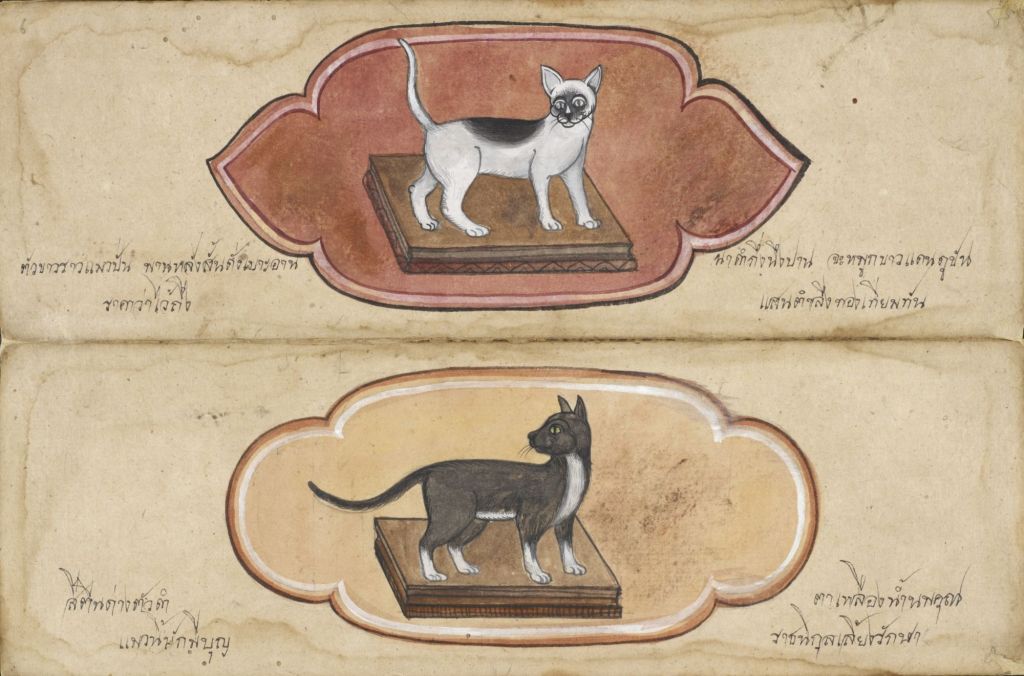
According to the Tamra Maew (Treatise on Cats, or Cat-Book Poems), the Siamese dates back to the Ayutthaya Kingdom, which was a formidable realm until 1767 AD, when it fell to Burma. It was then known as Siam until 1939, when a coup established a western-style government democracy and changed the country’s name to Thailand. Written in poetic verse and illustrated with painted pictures, the Tamra Maew is possibly the oldest feline breed catalog in the world. It featured 17 types of auspicious cats. Newer versions included as many as 22 breeds.

A pair of royal cats pictured in the Tamra Maew, which is in the public domain.

According to the Cat Fanciers’ Association, the Siamese is the personification of feline elegance. The modern breed has an elongated, tubular, and muscular body with a triangular head. The “old-style,” with a rounder head and body, is now known as the Thai cat.

The Tamra Maew also records superstitions, describing the Siamese as “rare as gold,” for example, and anyone who owned one would become wealthy.

“You’ve enriched our lives,” I told Siam, rearranging him on the ottoman.

The first Siamese to arrive in the United States enriched the life of President Rutherford B. Hayes. Also named Siam, he was a gift from the American consul in Bangkok in 1878. Ours arrived as a gift from our friend JJ Murphy in 2024.

“But what can I be?” Siam asked, echoing the words of Molly the Mockingbird. “I’m not a real Siamese. I’m not even a real cat.”

To address this dilemma, we read Molly the Mockingbird together. The book uses lovely watercolor pictures to encourage young readers to recognize their individual talents as they learn self-acceptance.

“Don’t you know,” I said, channeling Molly’s mother, “you have the special gift of merriment.” It’s true. My husband, Bob, and I often find ourselves startled into thinking a real feline is sitting on the ottoman. Then we laugh.

“You are a cute toy,” I concluded, “who reminds us of the real cats who shared their joyful lives with us.”

And there’s nothing fake about that.


What Other Cats Are Reading

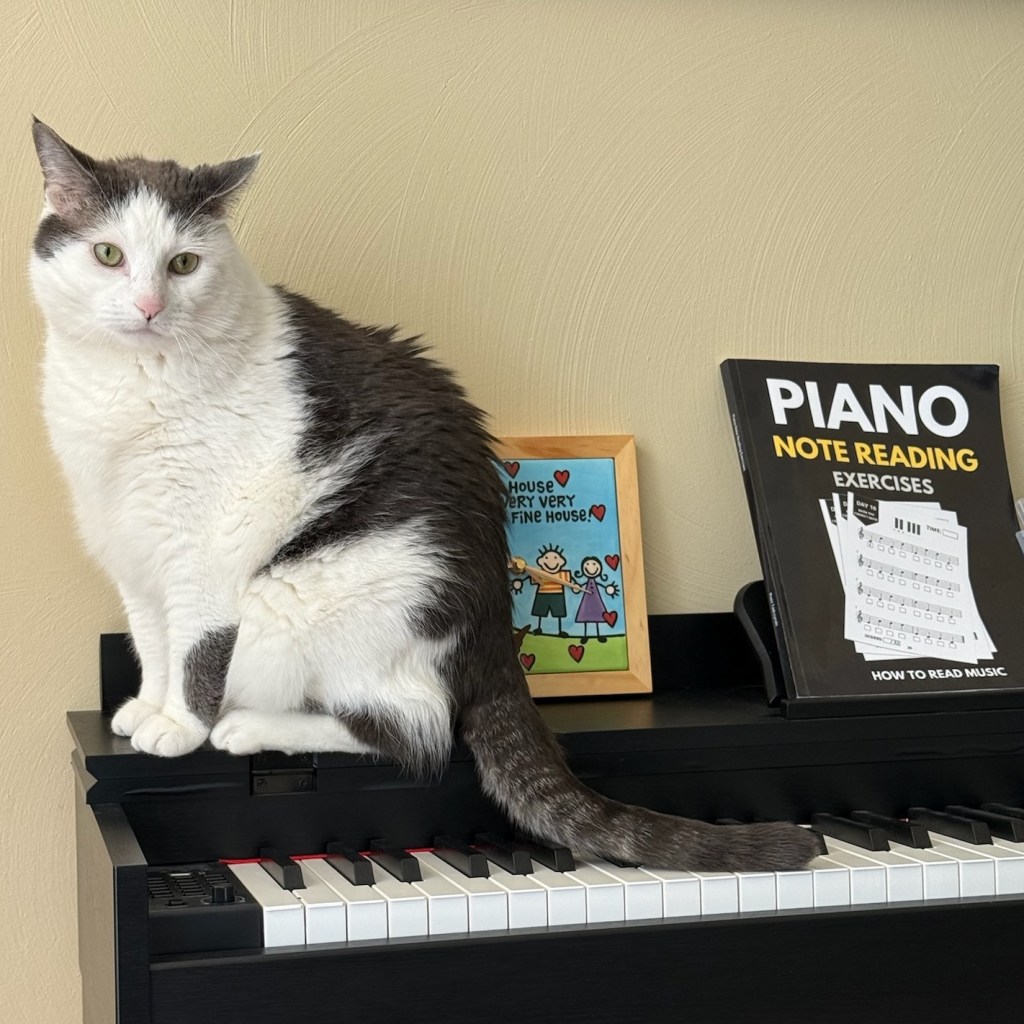
Archie Yengst is reading piano notes. Photo by Kathleen Yengst.

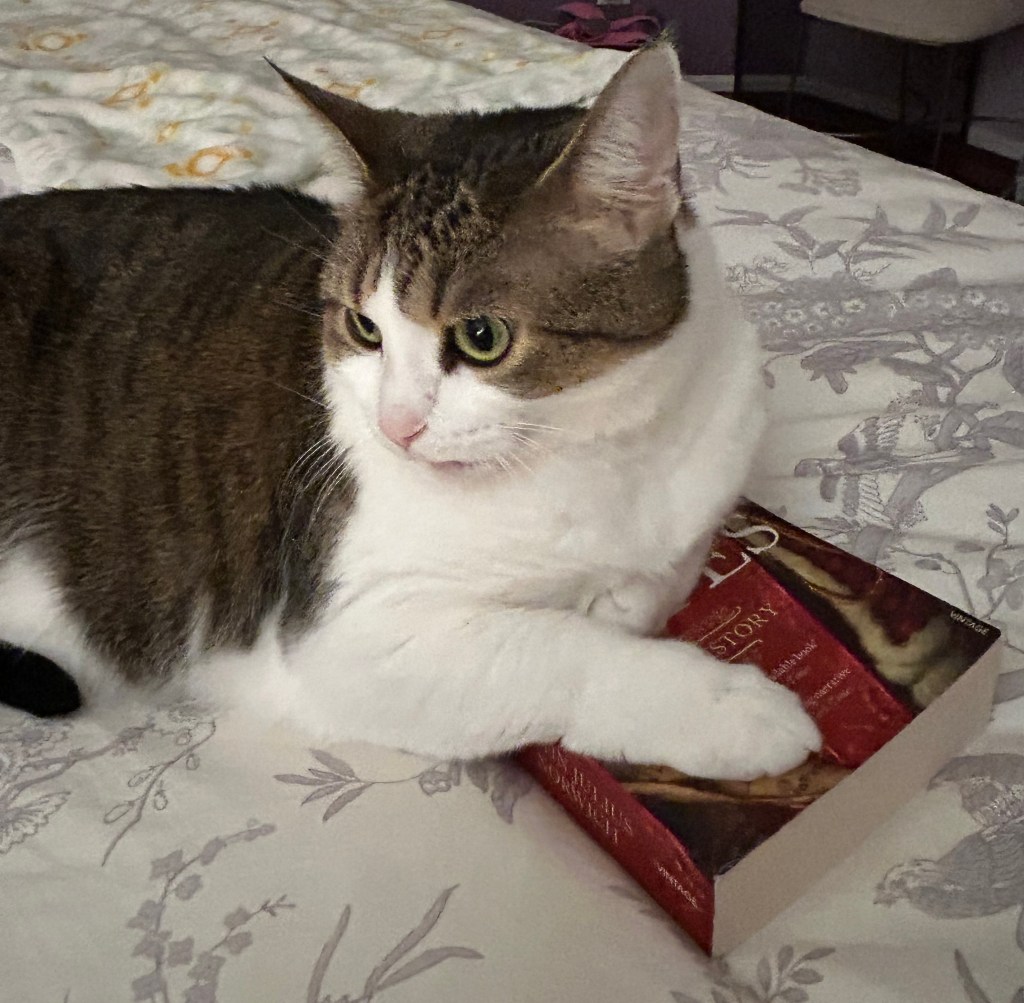
Indy is reading The Popes: A History by John Julius Norwich—a timely topic.
Photo by Kathy Sheehan

What is your cat reading?

Send book reviews, feline adventures, and cute pictures to Pat@PattiMWalsh.com

Best Children’s Fiction 2023
American Book Fest

Ghost Girl

“Young readers will find Ghost Girl a relevant and positive guide for their own lives. Older readers will find Ghost Girl an attractive introduction to the deep and profound mysteries and spiritual precepts of the Irish Celtic tradition.” –George C Gibson, PhD, Celtic Scholar
Learn more.

Buy now.

Gold Medal Winner
Florida Authors & Publishers Association
2025 Finalist
Florida Writers Association

Hounded

Being a Celtic warrior involves more than learning to fight.

Illustrated by William E. Green, Hounded is a contemporary middle-grade novel based on Celtic mythology.


Learn more.
Buy now.

Newsletter:
Come to Think of It

Stories are meant to be shared. So are fleeting thoughts, poetic musings, humorous anecdotes, and existential questions.

Come to Think of It is a forum to engage, inspire, and challenge. To gather with friends. Come to Think of It.

Subscribe at PattiMWalsh.com/newsletter.

Contact Us

← Back

Thank you for your response. ✨

CiCi Fancies a Rim Adventure

Cici Brannen judges Rim to Rim by its cover. Photo by Patti M. Walsh

At 19 years old, Cici Brannen may be slow, deaf, and nearly blind. To accommodate her limitations, her human mate, Pam, anticipates her every need, like a water fountain, a daily brushing, and a good book to read.

In return, the fragile feline accommodates Pam by watching her fish and photograph birds.

“Life is good,” CiCi purred, sitting under a chair on the shaded lanai. No longer up to chasing fish or birds, she prefers reading. So, she turned to a book Pam had left nearby. Rim to Rim, the first novel by Jeanne Meeks, reminded CiCi of her youthful days.

As she studied the chasms of red rocks that emblazoned the cover, she noted the book details death in the Grand Canyon and promises “danger at every turn.” CiCi imagined the thrill of jumping from one red rock to another above a 5,000-foot abyss. That, after all, is what cats do. Yes, she mewed, you can indeed judge a book by its cover. She was hooked.

Inspired by the author’s 2008 backpacking trip across the canyon, Rim to Rim features an engaging plot—Amy, a suddenly unmarried, middle-aged woman, embarks on the adventure of a lifetime even though her hiking buddy has bailed at the last minute. When she lands at the Phoenix Sky Harbor, Amy befriends Sarah, an experienced hiker who eventually doubles as mentor and foil.

Their trek spans 24 miles over five days and covers an elevation change of roughly 5,000 feet—first down, then up. Undaunting, perhaps, for an agile cat, it is nonetheless arduous for even seasoned hikers.

As she pawed through the book, CiCi anticipated descriptive passages of grandeur, campsite camaraderie, and the intrigue of a murder mystery. But it was the unexpected midnight howls, full-sun cliffhangers, and precipitous isolation that thrilled her.

Nor did she expect that the environs would evoke a debate of evolution versus creationism. But such existentialism is woven flawlessly into the story when one hiker observes, “If it turns out there is a God, this canyon is His gift to us.”

CiCi liked the ringtail cats, which are not feline at all, but relatives of the raccoon. Gazing at her reflection in the mirrored surface of a sliding glass door, CiCi admired her own black, brown, and white fur that resembled the ringtail’s dark brown coat with pale underparts. Although the ringtail’s body looked like that of a cat, its pointed muzzle and long whiskers are more akin to a fox.

However, like the cat, the ringtail is a nocturnal animal. Its short, straight, and semi-retractable claws are well-suited for climbing and hunting. Yellow eyes that shine menacingly in the dark are accompanied by clicks, chatters, squeaks, and chirps.

But not purrs, CiCi purred, again admiring her reflection and posh home. She was grateful that she no longer had to hunt for food.

Instead, she continued to read about the other animals who hunt for prey, work, and play secondary roles in the adventure—pack mules, bighorn sheep, condors, chipmunks, mice, squirrels, scorpions, bees, bats, pink rattlesnakes, and “trail rats,” another term for the hikers that move the plot forward.

Plagued by gear malfunctions, injuries, arthritic knees, and close calls, Amy and Sarah showcase strength, spunk, and humor as they make friends, dodge danger, and uncover clues in a mysterious death. 

Beyond the rocks, animals, and campsites, CiCi chirruped over subplots that included Colorado River rafters, resort staff, and park rangers—one of whom introduces an element of romance. Ah, yes, CiCi mewed. Romance sweetens any adventure.

CiCi did not expect romance in Rim to Rim. But once she found it, she groomed her fur in vicarious pleasure. She was old, she trilled, rechecking her reflection. Not dead.

What is your cat reading?

Send book reviews, feline adventures, and cute pictures to Pat@PattiMWalsh.com

Best Children’s Fiction 2023
American Book Fest

Ghost Girl

“Young readers will find Ghost Girl a relevant and positive guide for their own lives. Older readers will find Ghost Girl an attractive introduction to the deep and profound mysteries and spiritual precepts of the Irish Celtic tradition.” –George C Gibson, PhD, Celtic Scholar

Learn more.

Buy now.

Gold Medal Winner
Florida Authors & Publishers Association
2025 Finalist
Florida Writers Association

Hounded

Being a Celtic warrior involves more than learning to fight.

Illustrated by William E. Green, Hounded is a contemporary middle-grade novel based on Celtic mythology.

Learn more.
Buy now.

Newsletter:
Come to Think of It

Stories are meant to be shared. So are fleeting thoughts, poetic musings, humorous anecdotes, and existential questions.

Come to Think of It is a forum to engage, inspire, and challenge. To gather with friends. Come to Think of It.

Subscribe at PattiMWalsh.com/newsletter.

Catatonic Mafia Dreams

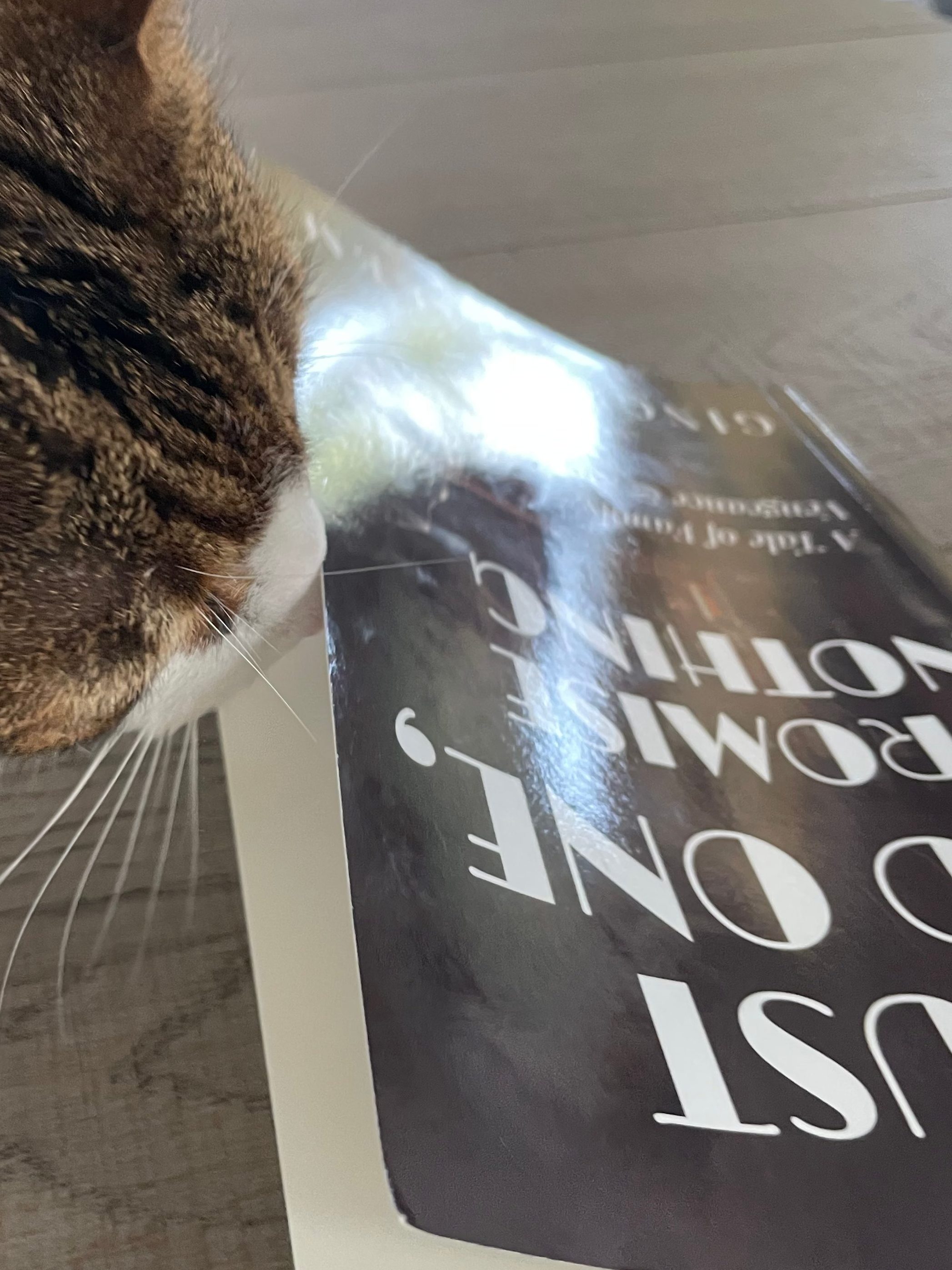
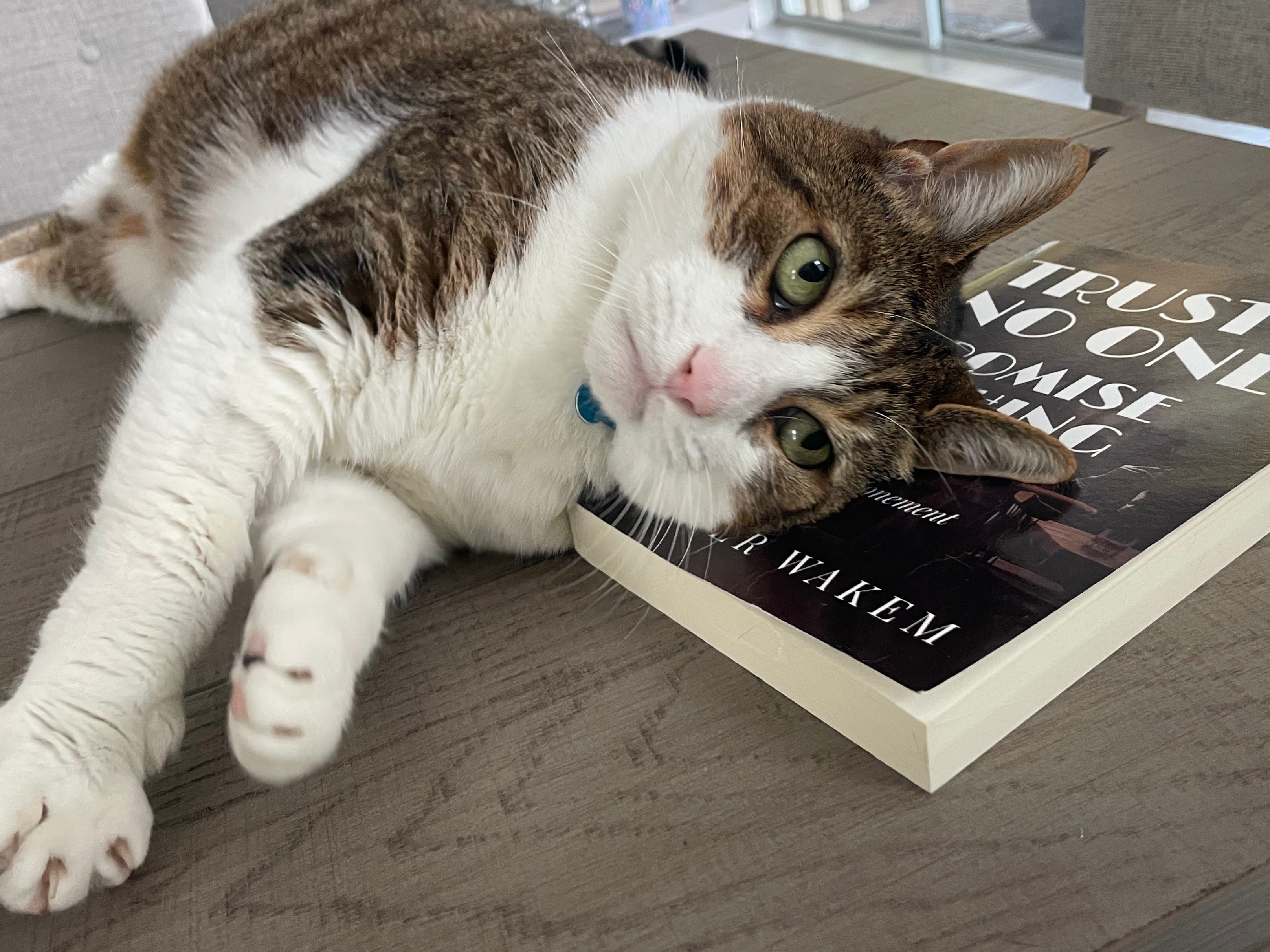
Beamer Baclawski gets into Trust No One, Promise Nothing, by Ginger Wakem.
Photo by Patti M. Walsh

Not that he wants to be an assassin or even a low-class goon, but when Beamer Baclawski heard that Ginger Wakem’s book, Trust No One, Promise Nothing features the mafia, he couldn’t wait to get his paws on it and nose into it.

Call it mafia envy. Or attribute it to the mouser’s fascination with a murder mystery—make that multiple murderous mysteries. Or his interest in historical fiction. Or the southwest Florida setting. Or even the steamy romances.

No. The novel centers on the Catanetti Family. And every good feline respects and fears the Catanettis.

The story opens with Ray Lewis’s initiation into the Cosa Nostra in 1938 in South Florida. He’s an Italian kid with what the author calls, “a spotless reputation and balls of steel.” Beamer first coveted, then glommed onto that characterization. Ready for action, he arched his back and swelled his tail. Channeling his alter ego Rocky (named in honor of his brother) D’Felinni (what else would a mafia cat call himself, “D” for short), he fancied himself a gumshoe. Flicking his tongue over his foot pads, Rocky D attacked the story.

Photo by Patti M. Walsh

After Ray’s initiation, the plot lurches ahead 42 years to the death of his son. Ray’s alcohol-infused state of mourning is interrupted by his mafia boss, who has called with the assignment of a lifetime. It requires Ray’s immediate presence in Denver. That’s where Carmelita, his lover and mother of his dead son, lives.

Like any reader, Rocky D wondered what had happened in the intervening years, why Ray would need to go to Denver, and how the boy died. Ray’s wife Grace wonders the same.

Ah, the feline’s intuition kicked in. That’s the mystery! Well, one of them, anyway.

With little forethought, Ray ditches Grace for Carmelita. As he reflects on his life of following dangerous orders, the man with a spotless reputation and balls of steel heads to Denver with every intention of leaving the life of omerta and vengeance behind.

Realizing that her husband has deserted her and their twin daughters, Grace picks apart Ray’s life, beginning with the contents of an antique chest and closet in his locked bedroom: old newspaper articles about unsolved crimes; tattered and worn receipts; cashmere sweaters; blood-stained clothes; lacy lingerie; weapons; and cash—lots of cash. Horrified, she concludes that Ray has been living a dual life.

Grace then seeks the help of an attractive detective. Rocky D sniffed out a subplot between those two that mirrors the love affair between Ray and Carmelita. However, as a mafia cat, he was more interested in tracking the criminal storyline from Florida to Denver, to Mexico, and finally to West Virginia.

Hissing at villains with heavily oiled, slicked-back hair, and yowling at the imagined scent of decapitated bodies, Rocky D was as hyper-focused as if he were stalking a mouse.

But he lost the trail from time to time. That’s not hard to do with a story that spans a continent and nearly half a century. Undeterred, however, he chattered and chirped.

“I’m a cat.” Focusing on his keen senses and filing his claws on a nearby scratching post, he reasoned, “I hunt. Mice, bad guys, plot points. They’re all the same.”

That’s when he would double back and fixate on the timeline and clues. Amidst phone calls from the living, there are letters from the dead. Two boys are switched at birth, and two girls are adopted in clandestine circumstances. Genealogies overlap, cargo is hijacked, orders are whispered, and people are killed.

Pouncing like a panther on the twists and turns, Rocky D followed the disparate plot lines until they finally converge. Beginning with a pivotal event at the Cat House (the Catanetti’s saloon and house of ill repute), and climaxing with a shoot-out at the Catanetti safe house, Rocky D, like Ray Lewis and the other main characters, learned to trust no one, and promise nothing—in Wakem’s book, anyway.

Trust No One, Promise Nothing, Rocky D concluded, is a kibble trail of intrigue that leads to the bloody details of inter- and intra-family honors and horrors; hostilities and blind allegiances; and forbidden relationships with consiglieris, unwilling witnesses, and fatal mistakes.

But in real life, Rocky D is Beamer. He trusts everyone and promises nothing but kitty hugs. Yet in his alternative universe, he goes catatonic with dreams of a sequel to the Catanetti legend that every cool cat can sink his claws into.

Catatonic dreams of a sequel. Photo by Patti M. Walsh

What is your cat reading?

Send book reviews, feline adventures, and cute pictures to Pat@PattiMWalsh.com


Gold Medal Winner
Florida Authors & Publishers Association
2025 Finalist
Florida Writers Association

Hounded

Being a Celtic warrior involves more than learning to fight.

Illustrated by William E. Green, Hounded is a contemporary middle-grade novel based on Celtic mythology.

Learn more.
Buy now.


Best Children’s Fiction 2023
American Book Fest

Ghost Girl

“Young readers will find Ghost Girl a relevant and positive guide for their own lives. Older readers will find Ghost Girl an attractive introduction to the deep and profound mysteries and spiritual precepts of the Irish Celtic tradition.” –George C Gibson, PhD, Celtic Scholar

Learn more.

Buy now.


Newsletter:
Come to Think of It

Stories are meant to be shared. So are fleeting thoughts, poetic musings, humorous anecdotes, and existential questions.

Come to Think of It is a forum to engage, inspire, and challenge. To gather with friends. Come to Think of It.

Subscribe at PattiMWalsh.com/newsletter.

Not-So-Messi Memoir

Messi, the newest member of the Blanchett household, shouldn’t be living the high life in Pelican Preserve. In fact, having been found ricocheting through a traffic maze in a frenzied dash, the weeks-old kitten shouldn’t be living at all.

“It wasn’t easy,” she mewed in a rare moment of quietude, curling into Nancy’s lap of luxury. A colleague had rescued the tiny orphan in a busy intersection and posted her picture on a bulletin board.

Nancy, who can’t resist a young feline in distress, claimed the cat without asking her husband.

“You what?” Rick was astounded. Or perhaps he was hurt, not having been consulted. Always a multiple-cat household, the Blanchetts had decided to simplify their lives and adopt a single cat three months earlier, after their last cat had died. Mittens, a mature feline, had reigned supreme since her arrival.

Messi messed that up.

But when Rick cradled the stubby-legged, spunky kitten, he was all in. He dubbed her Messi, in honor of the Argentine soccer player.

I mistook the name as “Messy.”

“Oh, that too,” Rick said, pointing to a tornado-like pathway of torn cardboard boxes and half-devoured toys. “But Messi is one of the greatest footballers of all time, even with his short legs.”

Born with a growth hormone deficiency, Leo Messi’s agility and strength caught people’s attention at an early age. He received treatment for his pituitary-gland condition and is now the most decorated player in the history of professional soccer.

Messi Blanchett, however, needs no hormones—just a nutritious diet—to develop legs in proportion to height. But she has needed human intervention to facilitate living with Mittens.

“It wasn’t easy,” Messi mewed again, telling Rick that she had finally been able to cozy up to Mittens. The interaction came with mixed results. Messi was now teaching Mittens bad habits, like jumping up on the kitchen counter.

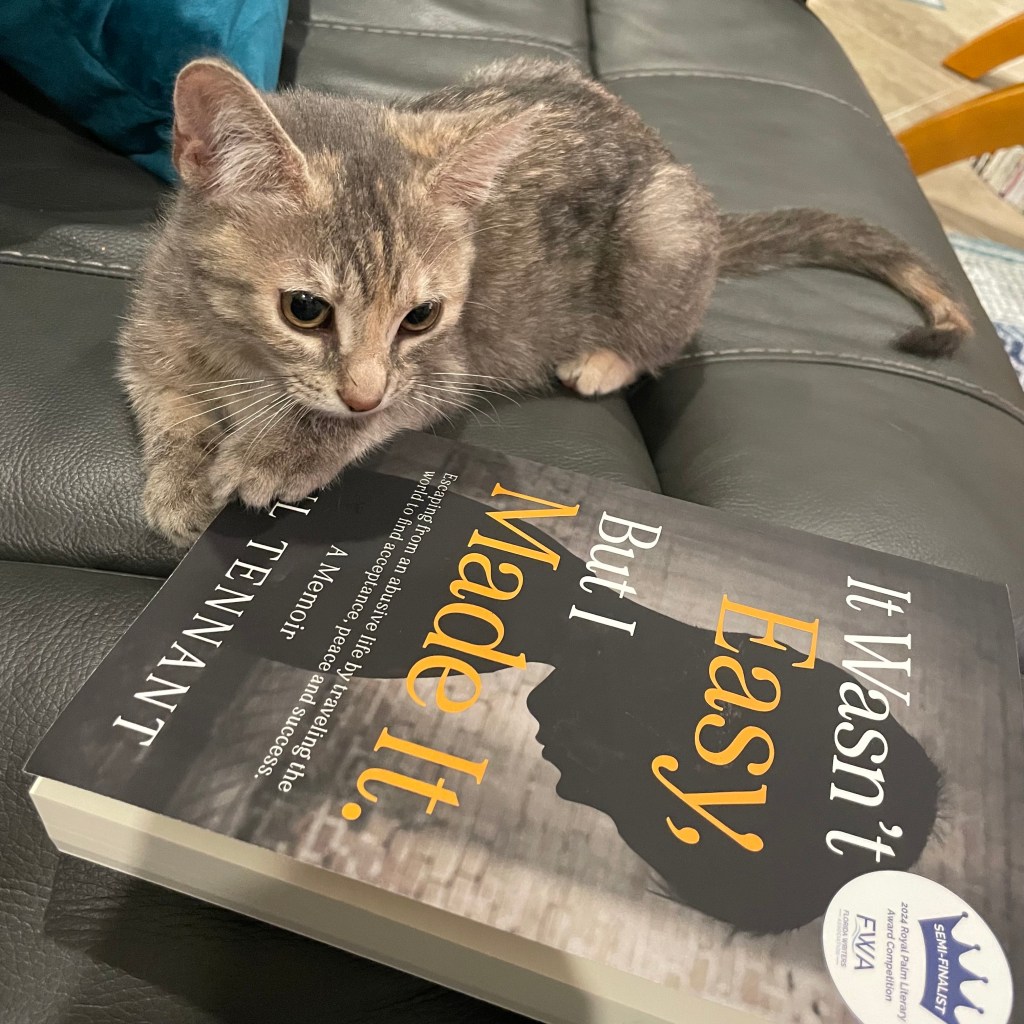
In the midst of this conversation about an impossibly onerous beginning, Messy landed—quite literally—on Paul Tennant’s memoir, It Wasn’t Easy, But I Made It, which was sitting on the sofa. Like most people who have read it, Messi was immediately sucked in.

See, Paul had overcome life’s odds, too.

The self-described “snotty-nosed kid” had caromed through the 1960s in an impoverished and crime-infested neighborhood in Nottingham, England. Like Messi’s legs, sometimes Paul’s didn’t work right, either. Indeed, he didn’t know until years later that he had spina bifida.

Unlike Messi, though, Paul wasn’t rescued. He survived an abusive childhood, took chances, and embraced good luck when it befell him. Significantly, he accepted a moment of grace that not only spared the life of an adversary but also saved his own soul.

While backpacking through the wine country of France, laden with supplies and all the money he had in the world, he was accosted by two thugs.

“As soon as I felt the man’s fingers inside my pocket,” Paul wrote, “I felt my anger rise. I remember reaching for my knife and starting to fight. … All I knew was fury pushing me to win at any cost.”

Amid his rage, Paul realized that one of the men had staggered away, begging him to stop. Paul had pinned the second man against a doorway with a knife pressed under his jawbone.

“A calmness came over me,” he recalled. “I slowly turned my head to the man trapped in the doorway and with a cold, justified urge I told myself, Kill him. The voice that told me to do this was rational and calm. I saw in the man’s eyes that he knew I was going to do it. He pleaded and begged.”

Realizing his position of control, Paul let the man go and the two robbers ran away. In reflecting on the incident as a visit to his “dark side,” Paul renounced his furious temper, refusing to become a tyrant like those who had molded his tormented youth.

Instead, he went on to secure a job on a cruise ship; earn a degree in hospitality management; and see the world as a sommelier, bartender, and tour director.

In the Cayman Islands, where he had abandoned ship to embrace the SCUBA life, he met and married Sue. They could have lived happily ever after in the paradise bungalow and life they had built. Instead, the couple moved to the U.S. to be closer to Sue’s parents.

After yet another successful career—in banking, no less—Paul retired. He and Sue moved to Southwest Florida, where his memoir caught Messi’s attention.

In the book’s introduction, Paul describes his new home as surrounded by sunny skies, palm trees, nice houses, and smiling neighbors. Messi looked up and saw the same.

“My life didn’t have a very promising start,” Paul wrote. Messi purred in agreement before once again zooming off in a kitten frenzy. No one would have predicted a happy ending for either of them.


What is your cat reading?

Send book reviews, feline adventures, and cute pictures to Pat@PattiMWalsh.com


Gold Medal Winner
Florida Authors & Publishers Association
2025 Finalist
Florida Writers Association

Hounded

Being a Celtic warrior involves more than learning to fight.

Illustrated by William E. Green, Hounded is a contemporary middle-grade novel based on Celtic mythology.
Learn more.
Buy now.


Chick Stories

A memoir of adventures lived, laughter shared, and lessons learned with my girlfriends

Travesties, tragedies, and comical calamities abound
in a series of essays rich with historical and cultural context.

Learn More.

Buy Now.


Newsletter:
Come to Think of It

Stories are meant to be shared. So are fleeting thoughts, poetic musings, humorous anecdotes, and existential questions.

Come to Think of It is a forum to engage, inspire, and challenge. To gather with friends. Come to Think of It.

Subscribe at PattiMWalsh.com/newsletter.


Contact Us

← Back

Thank you for your response. ✨

Waiting for Angels

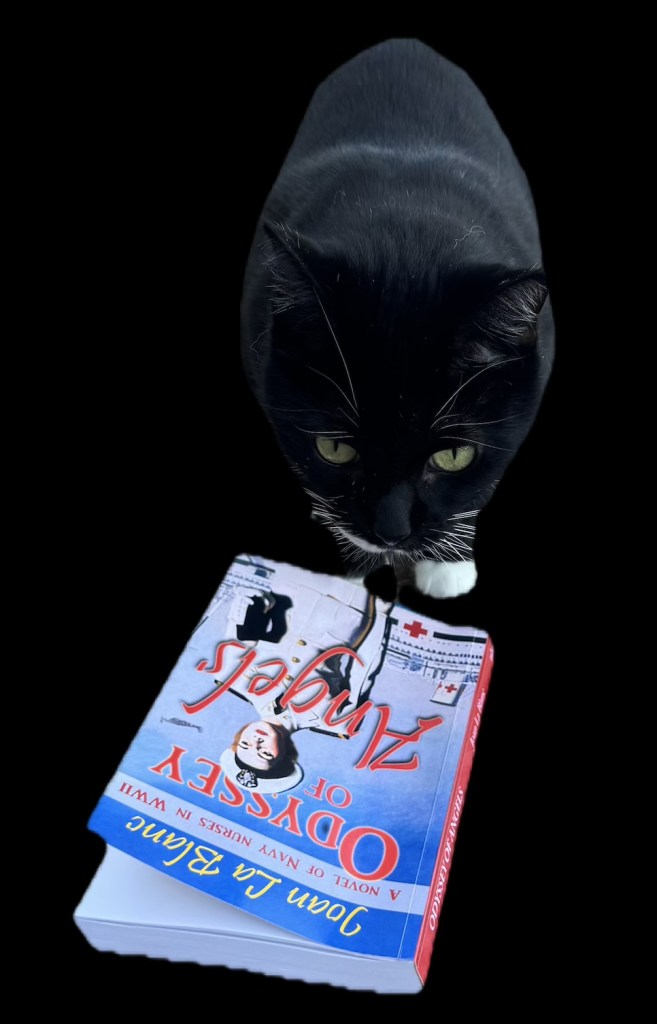
“Angels?” Miss Kitty asked when I suggested she might like Odyssey of Angels by Joan La Blanc. She accepted the book and then looked at me with more antipathy than confusion.

“I thought you meant the Christmas kind. You know, with wings and harps. I’m ready for mistletoe and holly. Not nurses on a mission.”

Subtitled, A Novel of Navy Nurses in World War Two, the story is set on a hospital ship in the South Pacific Theater of World War II. But it’s not entirely about nurses, the war, or angels of mercy.

“It’s a love story,” I explained to Miss Kitty.

“Well then,” she purred. “I like a good love story.”

“It’s set against the mundane minutiae of ship operations, gruesome details of maimed servicemen, and lush descriptions of tropical paradises marred with dank smells of creosote and urine,” I said. “Navy nurse Anna Donovan is a young and beautiful widow who is engaged to a doctor. Yet she falls for a married chaplain.”

“Aha!” Miss Kitty blinked. “That sounds more like it.”

Putting aside her initial reluctance, Miss Kitty stretched into a relaxed position and burrowed into the story. Minutes later, however, she was confused anew by characters who appeared without context.

“It’s the third book in La Blanc’s four-volume set,” I explained. “All those characters—family members, friends, a dead husband, the current fiancé—appeared in the first two books.”

Miss Kitty squinched her eyes and refocused them on the current tale of a Navy nurse aboard the USS Compassion. A hospital ship, the fictitious Compassion is modeled on the comfort-class hospital ships that evacuated and transported injured servicemen.

One such ship, the USS Comfort, was attacked in April 1945 when a Japanese kamikaze pilot crashed into it, killing 28 people, including six nurses, four surgeons, and seven patients. Not only did the crew of the Compassion react with horror to the news of that blatant suicide attack on a hospital ship, but they also lived through a terrifying moment when a kamikaze pilot nearly destroyed their own.

Maiden voyage of the USS Comfort, on June 21, 1944.
Photo courtesy of WW2 U.S. Medical Research Centre.

The romance thrives in stark juxtaposition to cynical observations about war and God’s role in human suffering. Anna grapples with her private fall from grace within a larger scheme of deceit that involves the clandestine transportation of troops and the black-market trade of morphine.

When Anna leaves the Compassion for the last time, it is with a sense of being “wrenched from a secure womb.”

Miss Kitty wondered if Anna’s rebirth would allow a transition from lover in an illicit romance to faithful wife in an honorable marriage.

“You’ll have to read Ordinary Angels,” I suggested, referring to the fourth and final book in La Blanc’s series.

“I don’t want an ordinary angel,” Miss Kitty yawned. “I want a Christmas angel.” With that, she snuggled into a catnap of wings and harps.


What is your cat reading?

Send book reviews, feline adventures, and cute pictures to Pat@PattiMWalsh.com

Newsletter:
Come to Think of It

Stories are meant to be shared. So are fleeting thoughts, poetic musings, humorous anecdotes, and existential questions.

Come to Think of It is a forum to engage, inspire, and challenge. To gather with friends. Come to Think of It.

Subscribe at PattiMWalsh.com/newsletter.

Gold Medal Winner
Florida Authors & Publishers Association
2025 Finalist
Florida Writers Association

Hounded

Being a Celtic warrior involves more than learning to fight.

Illustrated by William E. Green, Hounded is a contemporary middle-grade novel based on Celtic mythology.
Learn more.
Buy now.

Chick Stories

A memoir of adventures lived, laughter shared, and lessons learned with my girlfriends

Travesties, tragedies, and comical calamities abound
in a series of essays rich with historical and cultural context.

Learn More.

Buy Now.

Embracing the Ethics of a Feline Warrior

At six years old, Mittens recently joined the Blanchett household. Having come from a home with other pets, she was happy to be Nancy and Rick’s one-and-only. But she wanted to feel more confident, more like the hunter her instincts told her she was.

Nancy told her about the Tecosca Cormaic, otherwise known as the Instructions of Cormac Mac Airt.

“It’s an Old Irish wisdom text,” Nancy explained. In it, the legendary high king Cormac advises his son Cairbre on how to be a good man, an ethical warrior, and eventually, a wise king. “I think it could help you be a wise and ethical feline warrior.”

“But I’m not a king—or a queen,” Mittens mewed. “And I’m certainly not a warrior. I’m just a lowly rescue from the Humane Society.

“Oh, but you wear the crown in this house!” Nancy purred back, stroking her royal highness with a brush. Then she tempted Mittens with a twirly-bird toy. Mittens deigned to play for a few minutes, then shrugged off the toy.

“I’m a cat, not a warrior.”

With that, Mittens turned her large black body away from Nancy. After all, cats know if they can’t see you, you don’t exist.

Nancy, however, was not to be deterred. She sat down with Mittens and told her about the Cat Sídhe (which she pronounced as shee), otherwise known as the Celtic Cat.

“The Cat Sídhe is a fairy creature,” Nancy began. “She’s a big black cat with a white spot on her breast.” Mittens looked down at herself. She had to admit she was large—the humane society folks had called her obese. And she did have a large white spot on her chest—and little ones on her paws.

According to Celtic legend, Nancy continued, cat sídhes were magical creatures who were the symbol of fearsome warriors and guardians of the Otherworld. Independent, intuitive, and intelligent, cat sídhes have supernatural abilities that enable them to speak to humans, predict the weather, and foretell the future.

That got her attention. She knew that Nancy and Rick understood her. She had suggested to them that she had been an outdoor cat. For example, she could not help but see their pet bird as prey. They took that warning seriously. That same outdoor sensitivity had led Mittens to warn her new housemates that a major hurricane was brewing. Sure enough, a few days later the storm that would become Milton began lurking in the Gulf of Mexico, much like a jaguar ready to pounce.

Mittens had also predicted that her future with Nancy and Rick looked good. It was based on the number 3-3-3, a magical combination that meant she would acclimate to her new home in three stages: three days to transition from the shelter to a real home; three weeks to learn the daily routine; and three months to feel secure.

“I see,” Nancy said as she pulled up a copy of the Tecosca Cormaic on her tablet. Nancy related that the beloved and judicious Cormac ruled Ireland during the third century in peace and prosperity. Cairbre followed his father to the throne. “You may not be a king, Mittens, but like Cormac Mac Airt you have a lot to teach.”

The dialogue between the king and his son survived by oral tradition for centuries. First written in Old Irish in the ninth century, Tecosca Cormaic was translated into modern English by Kuno Meyer and published by the Royal Irish Academy. Todd Lecture Series. Volume 15, Dublin, Hodges Figgis & Co., in 1909.

Nancy then began to read the legendary set of questions and answers, through which Cormac taught his son how to live an honest, respectable, and successful life. The dialogue, sometimes referred to as the Code of Ethical Conduct for an Irish Warrior, is very simple.

“O King Cormac,” asks Cairbre, “What habits were with you in your youth?”

“Not hard to tell,” says the king. “I was a listener in woods, a gazer at stars, blind with secrets, silent in wilderness, talkative among many, stern in battle, ready to watch, gentle in friendship, a healer of the sick, strong toward the powerful, weak toward the strengthless, firm without anger, patient without strife, and affable without arrogance. For it is through these habits that the young become old and kingly warriors.”

Mittens nodded and closed her green eyes slowly. Opening them, she purred to acknowledge her supernatural abilities and responsibilities as a cat sídhe. Perched on the back of her favorite loveseat, she began to teach the humans the ethics of feline warriorhood, starting with being a listener and a gazer.

What is your cat reading?

Send book reviews, feline adventures, and cute pictures to Pat@PattiMWalsh.com

Read more about High King Cormac Mac Airt and the making of a warrior in Hounded, the latest middle-grade novel by Patti M. Walsh. Look for it on Amazon and pattimwalsh.com on October 29, 2024.

Contact Us

← Back

Thank you for your response. ✨

Reading and Relaxing at Cattyshack

Photo by Bob Markle

While June is National Adopt a Cat Month, sometimes, all you need is a quick kitty fix.

My husband Bob Markle and I get ours at the Cattyshack Café, where you can sip your favorite beverage, read a book or digital messages, and play with cats.

Lee County, Florida, is home to more than 250,000 feral cats, many of whom end up at the overcrowded Gulf Coast Humane Society. With such an endless supply of rescue and homeless cats from GCHS and kill lists at other shelters, Cattyshack has arranged the adoption of more than 2,000 cats since it opened in June 2020.

Although the first cat café, Cat Flower Garden, opened in 1998 in Taipei, Taiwan, Japan popularized the concept. Europe’s first cat cafe, Cafe Neko in Vienna, opened in 2012. With stricter zoning and foodservice rules, North America followed in 2014 when Cat Town opened in Oakland, California.

According to That Cat Life, as of May 2024, there are now more than 220 cat cafés in the United States.

Located in the Gulf Coast Town Center in Estero, Cattyshack Café takes in about 20 cats at a time. Before arrival, they are spayed/neutered, vaccinated, micro-chipped, and issued a clean bill of health.

Keeping with the golfing theme, the café gives them a mulligan, a second chance. And for $15, cat lovers get a 50-minute session in the Mulligan Room, where humans, cats, and kittens roam free, socialize, and express their unique cat-onalities.

The entry fee covers the expenses associated with providing a luxurious foster home, which includes but is not limited to A/C, lights, food, water, litter, toys, and comfortable furniture for climbing and sleeping.

Some patrons simply enjoy an unhurried kitty fix while others prefer getting to know a cat before offering it a fur-ever home. Adoption processing fees range from $70 to $150, which goes entirely to GCHS.

In addition to feline fun time, the café offers beer, wine, and a full espresso bar with kitty au lait, catpurrccino, and catte, as well as original concoctions like the Cat Nap, Cheshire Cat Lemonade, and Pink Panther Refresher, and snacks with names like ma-cat-roons. The café also sells merchandise like T-shirts, mugs, and soap.

With well over 200 cat cafes in the country, June is a good time to spend an hour in Purradise or to take the first step in providing a fur-ever home to a favorite feline.

What the Ek? Prey-ing for Birds

Photo by Kathleen Yengst

Jinx Yengst likes to read about the cardinals, finches, and other birds in his dog- (eh, cat-) eared Golden Guide: Birds.

Not only does he like to learn about them as he watches from his favorite cat seat, but he also likes to chirp—or is it chatter? chitter? trill? Or is he reading aloud to his fine feathered friends?

Not according to Jackson Galaxy, the cat behaviorist, author, and media presence, who also goes by Cat Daddy.

Of all the unconventional behaviors cats exhibit, Galaxy says this phenomenon is one of the most curious.

While his Cat Daddy Dictionary series covers a multitude of feline behaviors, the entry on Chattering is a solid yet humorous examination of this uniquely feline comportment. If nothing else, the illustrative videos that Galaxy includes in his lexicon are worth the 18-minute, 24-second watch.

According to Galaxy, all cats—big and small—are first and foremost predators. He attributes what he calls ek-ek-ek-ek-ing to three aspects of the feline hunting strategy, all related to the killer instinct.

They are:

Excitement. Having located potential prey, the adrenalin rush cannot be contained. In what is known as Pavlovian Conditioning Response—like our mouths watering when we see something delicious—chattering teeth may be the closest the cat can get to catching prey and vicariously snapping its neck.

Frustration. Unable to reach its quarry, a cat may chatter in defeat. But this seems unlikely, since most hunts are unsuccessful. It is more likely that the behavior is initiating a prey sequence. Because the most exciting part of the hunt is the chase, the chirping may activate the feline brain’s reward circuitry. 

Mimicry. Imitating the sound of a bird, squirrel, or chipmunk may lure the prey closer. Researchers in the Amazon have found that the margay cat successfully mimics tamarind monkeys to achieve its hunt. The sound may also mask the predator’s movement.

They may be predators, but cats have also been entertainers at our house. We call the ek-ek-ek-ek phenomenon Cat-holio, in honor of The Great Cornholio, a Beavis and Butthead episode that first aired on MTV in Season 4 (1994).

Having devoured 27 candy bars and drunk a six-pack of root beer, Beavis chatters nonsensically like a prey-watching cat, hikes his shirt hiked over his head, and shouts, “I am the great Cornholio!”

No, Jinx doesn’t do Cat-holio. He doesn’t yank anything over his already furry head or read anything aloud. Nor does it matter what his guide to the birds might say.

On the contrary, he’s simply prey-ing.


What is your cat reading?

Send book reviews, feline adventures, and cute pictures to Pat@PattiMWalsh.com


Chick Stories

A memoir of adventures lived, laughter shared, and lessons learned with my girlfriends

Travesties, tragedies, and comical calamities abound
in a series of essays rich with historical and cultural context.

Learn More.

Buy Now.


Newsletter:
Come to Think of It

Stories are meant to be shared. So are fleeting thoughts, poetic musings, humorous anecdotes, and existential questions.

Come to Think of It is a forum to engage, inspire, and challenge. To gather with friends. Come to Think of It.

Subscribe at PattiMWalsh.com/newsletter.


Contact Us

← Back

Thank you for your response. ✨

Puzzling the Pieces

Beamer Baclawski, by Nancy Baclawski

Like many puzzle aficionados, Beamer Baclawski spent January 29, National Puzzle Day, working on a jigsaw puzzle.

“Why would anyone cut up a perfectly good picture only to reassemble it?” he asked, though he didn’t pause his nifty paws work to puzzle an answer.

Anyone familiar with jigsaws would recognize the enigma of the puzzle—it is both frustrating and satisfying, depending on how the pieces fit together.

Although Beamer separates pieces by color and painstakingly finds all of the edge pieces first, he dreads misplacing a piece that almost fits into the wrong place so that the last piece doesn’t fit anywhere. Or worse—the bane of all puzzlers—a missing piece.

On the one paw, he agrees with Deepak Chopra, alternative medicine advocate, who believes, “There are no extra pieces in the universe. Everyone is here because he or she has a place to fill, and every piece must fit itself into the big jigsaw puzzle.”

On the other paw, he throws in with the approach taken by American author Virginia Wolff: “Arrange whatever pieces come your way.”

A Puzzling Word

The word’s etymology is nearly as puzzling as assembling a thousand pieces into a picture.

While the word puzzle is likely derived from the French word pusle, its original meaning is, “to perplex, puzzle, interrogate.” The alternative spelling, puzzel, however, means “harlot,” while pucelle means “a virgin.” And just to make the word even more puzzling, the English word pizzle meant “penis.”

That’s too contradictory for Beamer. He likes his words straightforward.

Nevertheless, Robert Dudley is credited with first using the word to describe a confusing problem that needed to be solved. In The Voyage of Robert Dudley, afterwards styled Earl of Warwick and Leicester and Duke of Northumberland, to the West Indies, 1594-1595, he, Abram Kendall, and Captain Wyatt recorded the earliest English attempt to occupy Trinidad and navigate the Orinoco, one of the longest rivers in South America.

Dudley, himself, was a puzzle, as was his tangled history with Queen Elizabeth I. Handsome and ambitious, the self-styled earl and duke may have failed to win the Queen’s hand, but not her affections. With a storied history of wives and lovers, he was suspected of murdering his wife to marry the queen. He ended up a failed political and military leader who died of a strange illness. Some historians suggest it was Elizabeth’s doing.

Gaining Popularity

According to Wentworth Wooden Jigsaw Company, map engraver John Spilsbury created the first jigsaw puzzle a couple of centuries later. In 1762, he mounted one of his maps onto wood and then cut around the countries to help school children learn geography. 

Spilsbury’s dissected map, courtesy of the Geneva (New York) Historical Society

Called dissected maps, the concept caught on with historical, religious, and landscape themes.

With the dawn of the 20th century, jigsaw puzzles experienced rapid growth because of:

  1. Lithographic printing techniques that allowed higher quality printing;
  2. Plywood, which made it easier and more affordable to cut puzzle pictures into intricate shapes; and
  3. The invention of the treadle jigsaw, which not only enabled puzzle makers to create intricate shapes, but also gave the trend its name.

Millie Jackson of Mrs. Blackwell’s Village Bookshop, wrote on her blog that the trend “menaced the city’s sanity,” at least according to a May 1908 New York Times headline.

Despite the sensational headline, puzzles were mainly for the wealthy, since they cost around $4 each, and the average laborer earned $12 per week.

In the 1920s, travel companies used puzzles to market their businesses. GWR with Chad Valley produced puzzles of their steam engines and destinations, while Cunard produced a large puzzle of the Queen Mary, even before it sailed.

In the midst of the Great Depression of the 1930s, puzzles dropped in price, giving the masses something to forget their hardships.

Similarly, interest in jigsaw puzzles resurged during the mandatory covid lockdowns of the early 2020s.

Today, in North America alone, an estimated 100 million people—and felines—enjoy jigsaw puzzles, and about 50 million American adults spend an average of three and a half hours a week on them.

Competitive jigsaw puzzling has also grown, with the establishment of the Annual World Jigsaw Puzzle Championships in 2019.

New Puzzles to Solve

In addition to traditional flat puzzles, puzzlers now enjoy 3D, spherical, and architectural recreations. A booming cottage industry of puzzle accessories offers tables, boards, cases, organizers, and roll-up mats, as well as glue and frames to create art from finished pieces. Also, apps exist to create custom puzzles and engage multiplayers near and far.

While some people do puzzles for socialization, others do them for “me time” or to take a break from the digital lifestyle. Some people also liken the pastime to meditation, because it may create a sense of peace and calm.

They’re even good for your health. Researchers have identified at least three benefits:

  1. By helping you relax, doing puzzles may reduce heart rate, blood pressure, and breathing rate. They can also improve and maintain fine motor skills.
  2. Puzzling can keep your mind sharp and combat cognitive decline because it involves problem-solving, memory, and visual perception skills.
  3. Concentration can ease stress, anxiety, and consequently, makes you feel good. Correctly fitting a puzzle piece may produce the hormone dopamine, which can lead to a feeling of accomplishment and fulfillment.

Jigsaw puzzles are also used to study cognitive and visuospatial abilities in young children.

Beamer wants to know if anyone has used puzzles to study feline cognitive abilities.

After all, he purred, felines have been known to follow the advice of Virginia Wolff, and arrange—or rearrange—whatever pieces come their way.