Galloping Across America

The other day I spotted Nina perusing my photo album of the early 1970s. I had  been doing some research before getting together with two friends I’ve known for 50-plus years. The reunion was at Disney World, which we had visited as 21 year olds. A year and a half later, we galloped across America on a whirlwind road trip.

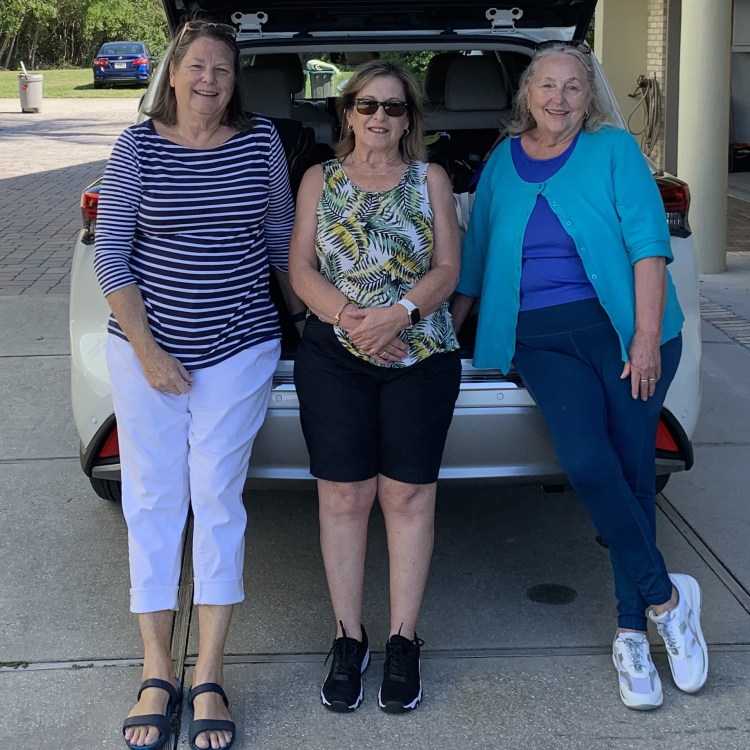
Nina was trying to comprehend how the three women on the left were the same ones on the right. She doesn’t understand things like the passage of time and how people can change so much and still remain the same. Frankly, I told her, neither do I. So I told her the story of our cross-country trip on a horse I now call Corolla.

In 1973, we posed on the Golden Gate Bridge in San Francisco, halfway through our cross-country road trip. I’m on the left, Mary is in the Middle, and Sue is on the right. In 2021, we headed to Disney World for a reunion. Mary is again in the middle with Sue this time on the left. We took more baggage for a three-day trip than a three-week one. Seriously.

A Horse Named Corolla

Six thousand miles, five visits, a four-speed Toyota Corolla, three weeks, two small bags apiece, and one argument. It was August 1973 when Sue, Mary, and I packed every square inch of Sue’s Corolla with carefully allotted square inches of clothes and provisions for a road trip across America. We were ready with everything from casual wear and cold weather gear to a spare tire and formal attire (for a show in Vegas, of course).

Born in 1950, we were boomers, true mid-century women who were destined to go places. We’d driven to Florida on spring break the year before, and, prior to that, Mary and I had been to Nantucket, Virginia Beach, and Europe. So this certainly wasn’t our first rodeo, but it was different. There was something epic about the clarion call to Go West.

We played off each other like cowgirls in a rodeo. Sue, the most practical, would be the tie-down roper whose horse sense demonstrated itself with a keen knowledge of her strengths, skills, equipment, logistics, and, of course, her ride. Mary, the self-reliant adventurer, would be the bull rider who could nimbly maintain balance astride a bucking brute with one elegant arm held aloft for balance. And I, the hippie, would be the bareback rider, practicing yoga while teetering between horse and sky, realism and idealism, mundane and spiritual.

Thus we saddled up, tied down, and drove off, eschewing hotels in favor of stays we had arranged with my brother in California and everywhere else with Sue’s wide-flung network of kith and kin.

 “I’m just along for the ride,” Mary would quip when asked if we were visiting anyone she knew. Never needing an intermediary to have a good time, she was our ringleader, our touch point. She and I had met in college; she and Sue at work. Sue may have lived around the world growing up, but Mary had the initiative to get us there. She would start an adventure with, “Hey, let’s go to…” She’d fill in the blanks and we’d pack our bags.

So across Interstate 80, the 88-horsepower Corolla sprinted. Paralleling the historic Lincoln Highway, which was built in 1913 as the first coast-to-coast road, I-80 passes by or through Cleveland, South Bend, Chicago, Des Moines, Omaha, Cheyenne, Salt Lake City, Reno, and San Francisco. We did the same (though we skipped Cheyenne), switching drivers every two or three hours, usually while gassing up—we’d each contribute one dollar to fill the tank—or driving through a McDonald’s or Taco Bell—Mary loved meat, I shunned it, and Sue would eat anything Mexican.

We pushed our limits—especially those pertaining to speed—from Connecticut, the first state to enact a speed limit; to the plains, where maximums rose incrementally; and astonishingly into Nevada, where the official welcoming sign cautioned visitors to drive safely. No limits.

No air conditioning, either. Just fresh breezes that floated long hair out fully opened windows. Nor GPS. Just paper maps folded and refolded into hand-fans, if needed. And certainly no CDs, eight-tracks, or even FM options. Just an AM radio that for three weeks incessantly played, “Horse with No Name.”

Hit the road in the morning, “Horse with No Name.” Drive for four hours with no radio reception, and when it crackles into tune, “Horse with No Name.” Stop for gas and lunch at a truck stop and, if we were lucky, “Rocky Mountain High.” Or when we came upon a couple who hade veered off the road with belongings strewn everywhere, there may have been random chords of Neil Young’s, “Heart of Gold.” But when we’d pull in at night to a town with no name, it was “Horse with No Name.” And when we’d hit the road in the morning, you guessed it.

The chart-topper written by Dewey Bunnell and recorded by America clip-clopped its way into the soundtrack of our adventure, so I’ve had to give that danged horse a name. Corolla, Sue’s car. And on that horse thus named, our journey weirdly followed the lyrics of the song.

Like, on the first part of our journey, we really were looking at all the life. It  teemed across the Ohio River Valley and the Midwest’s breadbasket. We were also looking at our lives. I had finished my first year teaching while Mary and Sue were climbing the corporate ladder at an upscale department store. I wanted to be a writer. Mary, a business executive. And Sue, we later learned, was quietly planning to marry CB.

We got along well—still do. Though there was that one argument. Having spent the previous year as housemates sharing a bungalow on the shores of Candlewood Lake, we had learned to budget expenses, share chores, and, of course, entertain guests. When we got back, we would be renting a flat in Danbury.

For two days, we oohed and aahed at boundless raw spaces that confounded our senses at dawn, drenched our eyes at noon, and set our mood at night. Lavender and clover drifted through amber waves of grain in their promises of purple-mountained majesties.

At one point, the trusty AM radio announced that visibility was more than five miles. I looked around. In all directions. On the horizon, I saw a lone tree. Its sole purpose it seemed, was to punctuate the vastness of that 360-degree sphere within which were all the plants and birds and rocks and things that Bunnell wrote about.

Somewhere east of where the West begins, we ditched I-80 and reined Corolla toward Boulder, Colorado. As we drew closer, clouds along the horizon confused themselves with snowcapped mountain peaks.

We stayed with friends of Sue’s, who treated us to real Mexican food and a daytrip to a ghost town in the foothills. There the magic of mountains seized my sensibilities. Or maybe it was the ghosts. Or the lack of oxygen. I don’t know, but for the first time, and certainly not the last, I was mesmerized.

No matter how high you go in the mountains, no matter how many rocks you examine, no matter how many different ways you photograph every last peak, against blazingly clear or torturously steel-clad skies, you can never get close enough to touch a mountain. I tried, I really did, first when Sue’s friends toured us through the foothills and then when we crossed the Continental Divide in Rocky Mountain National Park a few days later. All the way across the Great Basin, northern California, the western and southwestern deserts I tried. But to no avail. Massive and mountable, they remain mysteriously intangible.

From the Rockies, we headed toward Utah on U.S. Highway 40, which historians have dubbed the Main Street of America. Somewhere between the arid sprawl of Dinosaur, Colorado, and Vernal, Utah, lies Dinosaur National Monument. Although fascinated by the fossils discovered in 1909, I’m a Main Street gal, so I looked for the people. Although not as old as the dinosaurs, they are rare and far between. It was hard to believe that indigenous people had lived in these remote reaches of dazzling bluffs for at least 12,000 years.

They also lived in what’s now Salt Lake City. Founded in 1847 by Mormon pioneers led by Brigham Young, the city—in the early seventies anyway— maintained a Mormon ethos. That meant we could neither tour the Mormon Temple nor imbibe alcohol. But somehow, we finagled an invite to a private club for a few drinks during our one night there.

We hopped back on I-80, and rode past the Bonneville Salt Flats of the Great Salt Lake and across the Great Basin into Nevada, the state of no limits. In Reno, I won $12 in a slot machine—enough to pay for a Paul Revere and the Raiders show—or was it Mitch Rider and the Detroit Wheels?—then cantered to a stop in Sacramento to visit my brother Jim.

From his home base, Jim took us on a few day trips to see northern California. His car broke down on the Golden Gate Bridge, forcing us all—including my pregnant sister-in-law Nancy—to admire the view for an hour. Imagine such a travesty. Afterwards, we sampled chocolate at Ghirardelli Square, touched the redwoods of Muir Woods, and peeked at nude sunbathers on Stinson Beach.

Before commencing our loop toward home, I insisted on a detour to visit my boyfriend Krishna at Yogaville West. We were students of Swami Satchidananda, whose western ashram was tucked into the serpentine northern stretches of the Napa Valley. It was, after all, only about a hundred miles from Sacramento, and we were out to see America, right? Getting there, however, taunted our nerves and tested our friendship.

I don’t know how we found the place. For more than two hours, Sue clenched the steering wheel as she guided us up and down the tortuously steep grades, narrow roads, and twisty switchbacks—no changing drivers on this stretch. Mary, riding shotgun, grew queasier and queasier with each plummeting hairpin turn that scratched along chaparral-covered gorges that plunged into woodland, savanna, and grassland. I, on the other hand, careened between my friends’ growing angst; the breathtaking abysses; and longing for a little time with Krishna.

By the time we got to the ashram, Sue and Mary were apoplectic. While I basked in the glory of spirituality and love, they gawked at yogis silently tending to austere chambers and dusty gardens. After about an hour, my travel mates prodded me to leave—we needed to make it to Bakersfield by nightfall; Krishna prodded me to take his hiking boots—he would be hitchhiking home. They were an encumbrance for him and collateral for me. So I agreed, without consulting Sue. Thus ensued the argument.

She didn’t want the damned boots in the boot. A blight they were on an otherwise organized trunk. We traded glares and reached a silent truce in the serene shadows of Yogaville when I found a few crevices between our suitcases, provisions, and the furnishings she had bought in Boulder. Somebody else’s boots were my souvenir. Nothing more was said, but the unspoken detente tiptoed to the surface on every stop that required packing or repacking the trunk. Which was like every day.

Bakersfield was a six-hour haul. There we hydrated Corolla at dawn and filled lots of containers with water. Heading into the desert, we saw cars outfitted with water bags—a novel sight and an appendage we didn’t need. Slung across the hoods of cars, trucks, and farm vehicles, they kept water cool enough to drink while providing backup water for car radiators.

Just like the bad lyrics of our theme song, the heat really was hot (remember, no AC), the ground was dry (this was August), under a sky (in Nevada) with no clouds. By early afternoon, we pulled into Las Vegas in all its tacky glory.

Into our rationed trunk space we had packed formal attire for a night on the town. We gambled on and in our gowns, saw a show, and hit the road at daybreak. What happened in Vegas really did stay there—not one of us can remember anything else.

And then, hot damn, we headed to a dam called Hoover. Then the coolest of all cool stuff emerged from the sleepy town of Flagstaff, Arizona.

The. Grand. Canyon. Each word as supercharged as the other two. The sum of each syllable was amplified by the phrase in its totality. Just as mountains had blown my sensibilities, the erosive sway of water and the sculpting clout of wind stupefied my soul. We teetered on the edge of awesome as long as we could.

Then, tearing ourselves away, we clopped toward the Painted Desert and Petrified Forest, where our skin really did begin to turn red, like the song says. Only it was from eating lots of chili and hanging appendages out the wide-open windows. 

After three days in the desert fun (or are the lyrics dessert sun?), we crossed a river bed—the Rio Grande—then galloped on I-40 through Gallup, Albuquerque, and Amarillo, and clear across Texas. Ignoring Dallas, we dove headlong into the Deep South and landed in Texarkana, Arkansas. Named by some railroad guy for its proximity to the intersection of Texas, Arkansas, and Louisiana, the combined municipality is unique in name and idiosyncratic ambiance.

For in that quaint city tucked between the Cowhorn and Swampdoodle Creeks, dwelled Maw Maw and Paw Paw. Proper and genteel, they were lovely people who served us the tangiest taste of America of anywhere on our trip. And I’m not talking about the grits and greens at Bryce’s cafeteria. No, after a four-o’clock dinner there, we settled ourselves in for a nice evening in a lace-dollied parlor with Aunt Alice. From Dallas. She was on the loveseat (or was it a settee?) under the west-facing window framed with lace curtains. Maw Maw and Paw Paw sat to my left on either side of a Queen Anne table topped with a fringed lamp. Mary and I shared the sofa (or was it a divan?) across from Alice. Sue to the far right, closed the circle in a jacquard (or was it matelassé?) easy chair. I think we were drinking lemonade. Maybe iced tea. Certainly not mint juleps.

The family news that dominated the conversation was that cousin Herman was getting married. To a Catholic, or as Maw Maw said, “a Catlick.”

Maw Maw shook her bespectacled head slowly. It would be difficult enough accepting someone of a different religion into the family, but a Catick! Well, she just didn’t know.

“Maw Maw,” Aunt Alice slyly broke into the staid old woman’s lament. “You have two Catlicks sitting right here in your living room.” Despite her effort to maintain perfect composure, Maw Maw’s jaw dropped and her gaze settled on each of us in turn. “One’s I-talian,” Alice continued, “and the other’s Irish.” Mary and I exchanged sidelong glances and later pulled Sue aside to suggest we leave this stagecoach stop in the morning.

We did. Scrapping our original plan to swelter our way to New Orleans, we opted instead to swing north. Our first stop was Murray, Kentucky, where Sue was born. There we stayed a night with friends of Sue’s family, and then headed to KenTuck Lake on the Tennessee border for the vacation of our vacation.

Created by the Tennessee Valley Authority in 1944, it is the largest artificial lake east of the Mississippi River. Surrounded by lush green trees and refreshing blue waters, we cooled off, water skied, and ate lots of good southern food—thanks again to the hospitality of Sue’s kith and kin. And in another eye-popping taste of the South, the maid laundered our dirty clothes before we swung on home.

Each time we packed the car anew, however, that one argument flickered in the trunk. “Damned boots,” Sue would swear under her breath. I should have left my souvenir behind, I smile now in retrospect, for I gave their wearer the boot a few years later.

Cancel Patrick?

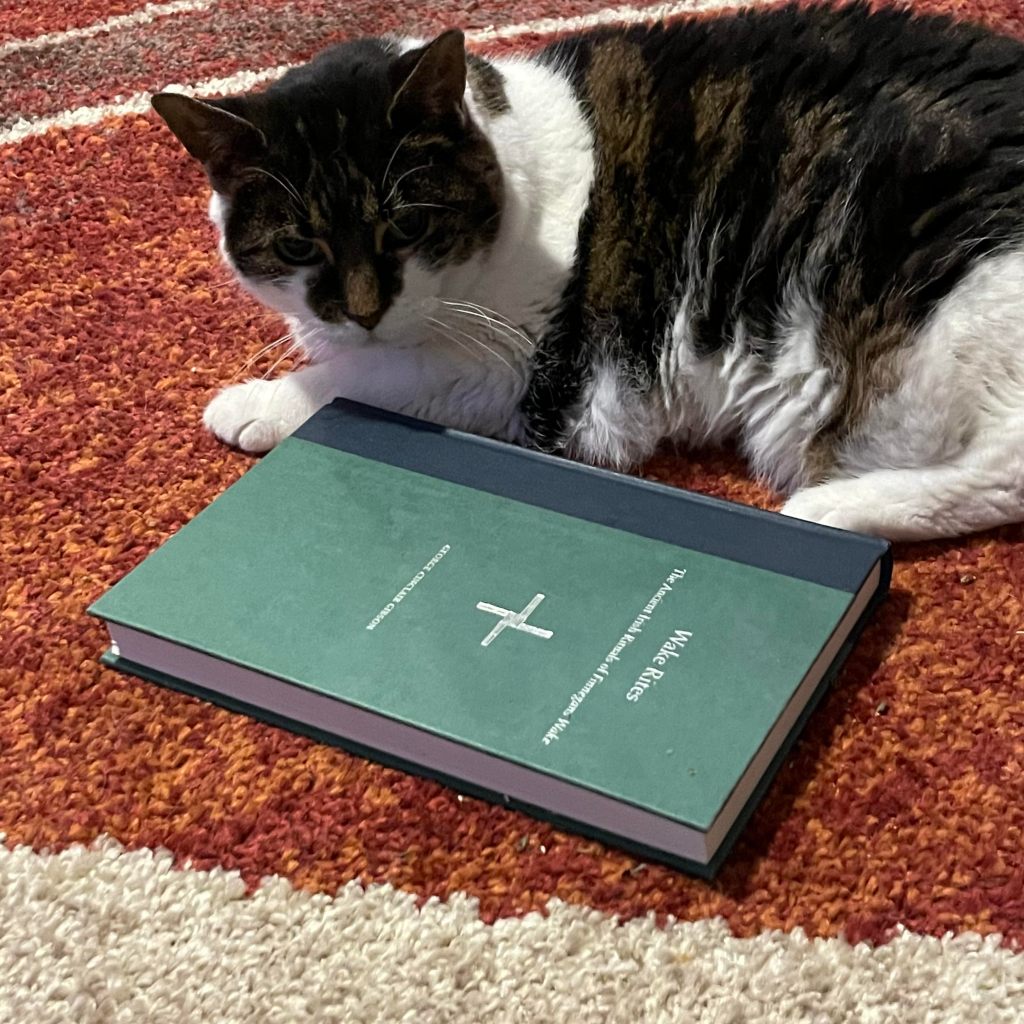
While the world at large plans to turn itself green on the 17th in honor of Saint Patrick, Nina focused on a different perspective of Ireland’s patron saint. I caught her perusing Wakes Rites, The Ancient Irish Rituals of Finnegans Wake, by George Cinclair Gibson. (Don’t go adding an apostrophe to Finnegans—more on that in a minute.)

For the record, George is a friend of mine. He thanked me in the preface of his book for having patiently acted as his foil—listening to, questioning, and evaluating each section of his work before it was written. I’d like to say that having abided George’s multi-year ramblings on language and lore, I now understand Joyce’s enigmatic tome. I don’t. I tried, but I just couldn’t plow through it. But I do understand George’s take on James Joyce and his final work.

Born into a country renowned for its literary genius, Joyce (1882–1941) is arguably Ireland’s greatest writer, perhaps even the most influential and important English-language writer of the 20th century. His other milestone works are the short-story collection The Dubliners, A Portrait of the Artist as a Young Man, and Ulysses. I have read them; although difficult, they are reasonably accessible.

Finnegans Wake, however, stymies most readers and confounds the critics because of a style that incorporates modern English, ancient languages, multilingual puns, double (and triple) entendres, portmanteaus, run-on sentences, onomatopoeias, and frankly—for lack of a fancy linguistic term—made-up words. It has been called a dreamlike stream-of-consciousness narrative, the postmodern poster child of deconstructivism, even a hoax. 

George will have none of that. In Wake Rites, he fervently and painstakingly delineates that the structure of Finnegans Wake is the Teamhur Feis (the Rites of Tara), Irish paganism’s most important and sacred event. He believes that the most significant performance of this historic spectacle occurred on March 25, 433 A.D., when Saint Patrick arrived at Tara just as the Rites were reaching their climax.

The event was widely attended and featured druidic and mystical rites, as well as historical reenactments. This pivotal celebration, George argues, provides the structure that clarifies much of the Weakean chaos and darkness. “For Joyce,” he writes, “the most crucial moment in all of Irish history and the climactic and talismanic point in his own magnum opus are one and the same: the momentous confrontation at Tara between Saint Patrick and the Archdruid of Ireland.”

Gibson refers to Patrick as a colonizer, invader, and usurper of pagan rites. “In the Wakean version of Irish history,” he writes, “the victory of Saint Patrick at the Teamhur Feis is hardly a cause for Irish celebration. At Tara, Patrick and his modus operandi suggest more the machinations of a manipulator and usurper than they do the work of a spiritual missionary for the dissemination of an enlightened religion.”

Joyce himself had likened Patrick to a con artist working the old shell game, calling him “pea trick” and his iconic shamrock a “shamwork.” In the current cancel-cultural vocabulary, Patrick appropriated words, ritual, and icons from a pre-Christian culture. To the ancient Irish, then, perhaps he was no saint.

Now the missing apostrophe makes sense. Given the book’s rich linguistics, historical context, and Joyce’s jaded view of Patrick, “Finnegans” can be understood not as one man, but as the collective Irish people. “Wake” can be an awakening, rather than a funeral. If so, then the book does not pertain to one man’s death, but to a cultural awakening from Patrick’s con game, in which he buried an entire people’s history in the guise of Catholicism.

“In this current World of Woke,” Nina asked me, “why is Patrick considered a saint? Perhaps he should be cancelled as just another old white guy who usurped an indigenous culture.”

Prato Pistoia Mardi Gras Parade

The Krewe of Prato Pistoia rolled through the neighborhood on Mardi Gras, February 16, 2021, with 34 carts, 3 bicycles, several dogs, and 1 community patrol officer to the delight of hundreds of revelers at driveway gatherings.

King (Cake) for a Day

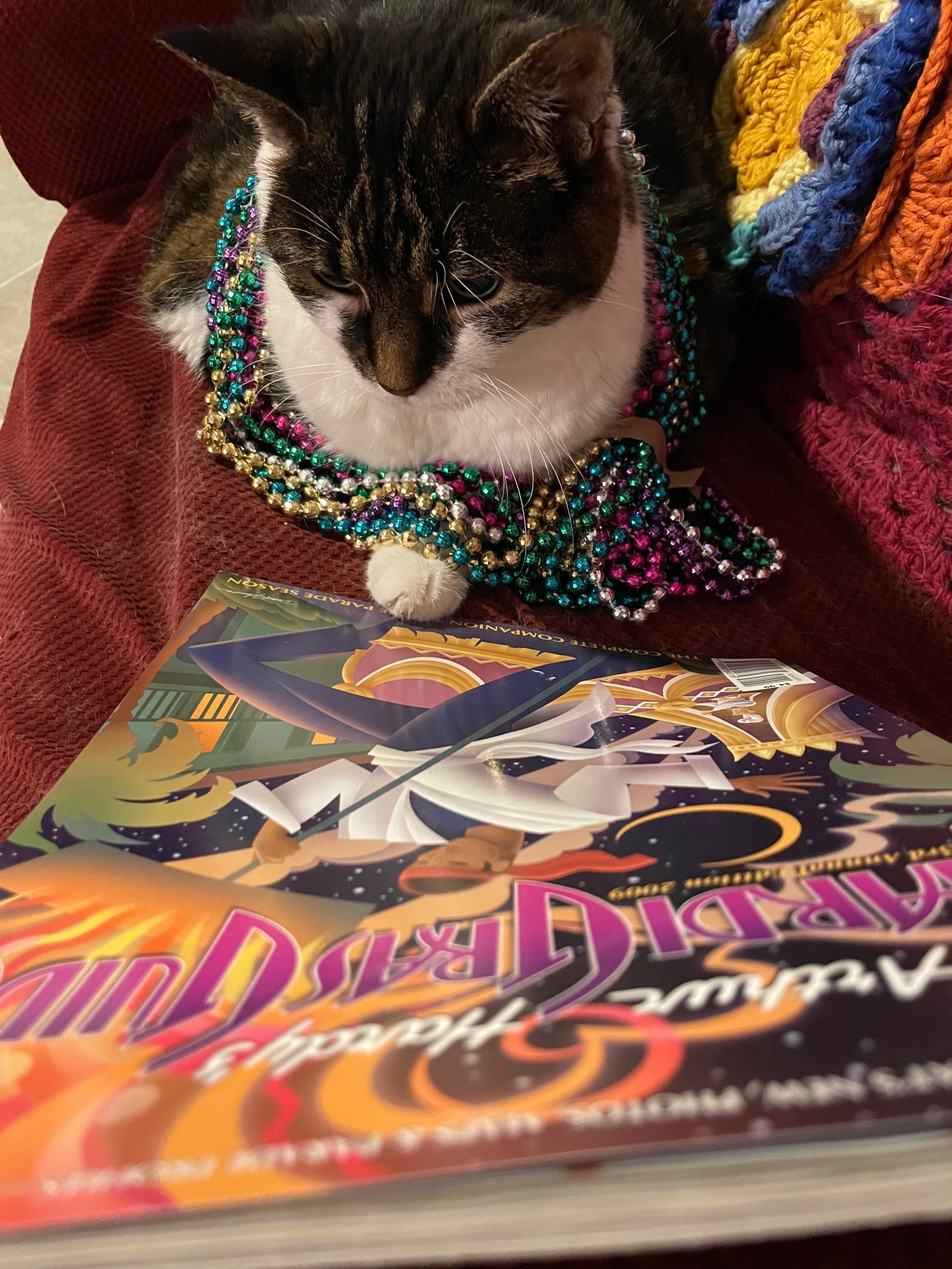
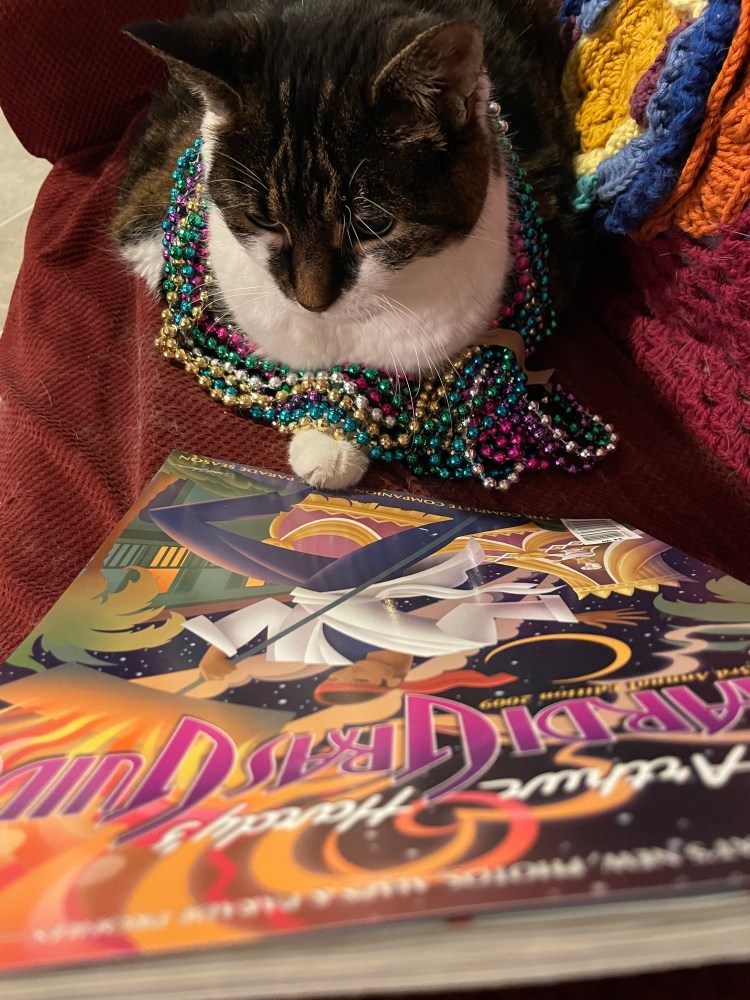
Even though there are no Mardi Gras parades in New Orleans this year, there is one in our neighborhood. So Nina decked herself out in beads and did a little research. She’ll tell you that if you want to know anything about Mardi Gras, there is no better source than the Arthur Hardy Mardi Gras Guide, the World’s Foremost Authority on Mardi Gras. Hardy, a New Orleans native and former high school marching bands musician, has been publishing the guide with his wife since 1977.

With or without parades, you can’t have Mardi Gras without king cake. Frosted in purple (representing justice), green (faith), and gold (power), we got one filled with pecan praline—and, of course—a plastic baby. Which leads us to the question of the day. Why the plastic baby?

Let’s go back a few thousand years to the pagan customs of Western Europe. Lupercalia, an ancient Roman fertility festival, honored the agrarian god Lupercus. Some anthropologists believe that during this time, men randomly chose women to be coupled with for the duration of the festival; others, that naked men ran around frivolously whipping woman, who welcomed the lashes and even bared their skin to receive the fertility rite. Go figure.

This practice was all based on the bean, the humble plant that is often the first to emerge from the earth after winter. It represents rebirth and a successful harvest. During Lupercalia, which was based on even earlier pagan rituals, a chosen man would be treated like a king. To select him, a bean was placed in a cake, and whoever got the bean got the honors. Worshipped like a king, the chosen one would enjoy sex, drugs, and rock-and-roll (so to speak) while the peasants imbued in him all their failures and shortcomings. Then he would be sacrificed to atone for their sins, and his blood returned to the soil to ensure that the harvest would be successful.

Perhaps the Romans got the idea from the Celts. The druids would sacrifice animals and people to ensure prosperity. The greatest of all sacrifices, of course,  would be the king. Since nary a king would opt for that, the druids came up with a king’s substitute, who would eat, drink, fornicate, and make merry. And then be sacrificed.

Either way, the Romans took over the Celts, and the Christians took over the Romans. Deciding it would be prudent to absorb pagan rituals rather than abolish them, the church established carnival as a period of merriment that preceded Lent, a period of penitence that commenced on Ash Wednesday and ended on Easter. During this time, participants ate, drank, and indulged in voluntary madness by donning masks and costumes.

So what does this have to do with a plastic baby?

While many people associate the baby in the king cake with the baby Jesus, it is his death that is pivotal to Mardi Gras. It is commonly believed that Jesus, mocked by the Romans as the “King of the Jews,” was sacrificed to atone for the sins of man (does this sound familiar?) on what has become known as Good Friday. Two days later, he rose from the dead on Easter Sunday.

Easter is a moveable feast. Modeled on the Celtic holiday Ostara, it is always the first Sunday after the first full moon that occurs after the vernal equinox (the beginning of spring), which can be anywhere from March 23 to April 25. It follows then, that Mardi Gras is also a moveable feast. It is the day before Ash Wednesday, the first day of the 40-day fasting period known to Christians as Lent. But just to complicate things, the early church forbade fasting on Sundays. Therefore, in order to have a full 40 days of fasting before Easter, Ash Wednesday (i.e., the day after Mardi Gras) falls 46 days before Easter.

Back to the baby. Jesus had to be born before he could die. Although historians he was born in the late summer or early fall, early Christians moved it to mid-winter to coincide with the Celtic winter solstice, a festival that coincided with  the ancient Roman fertility festival Saturnalia. Like Lupercalia, Saturnalia involved choosing a substitute king by placing a bean in a cake. Since Christians abhorred human sacrifice, the king cake evolved into a celebration of the three kings (the Magi) visiting baby Jesus twelve days after Christmas. January 6 is now called the Feast of Epiphany.

It is on January 6 that the official Mardi Gras—and King Cake—season begins. One of New Orleans’ oldest Carnival organizations, the Twelfth Night Revelers, in 1870 inserted a gold painted bean into the cake they served to the young women of their court. The girl who got the gold bean reigned as queen for the season. Another tradition began on January 6, 1878, when the Phunny Phorty Phellows rode the Saint Charles Avenue streetcar to announce the beginning of Carnival season.

Meanwhile in France, little charms called feves (i.e., fava beans), were baked into the French version of the king cake.  Germany mass produced tons of these elaborate porcelain figures from 1850 to about 1920. They made their way to New Orleans and in particular to McKenzie’s Bakery, where they were stuffed into king cakes. The bean became a baby in the 1950s when the bakery made a deal with a local supplier for cheaper plastic trinkets.

Thus, the humble bean became a painted bean, which became a porcelain figurine, and then a plastic baby.

Today, the Krewe of Prato (the name of our neighborhood), will kick off with a king cake party. Unlike the contemporary grand parades of New Orleans, ours will feature golf carts and walkers rather than floats. But it will be similar to the first New Orleans parade that had no floats and no marchers—just people in costumes walking to a masked ball. It was a parade of masks.

“So, let them eat king cake!” Nina exclaimed. “Laissez les bons temps rouler!”

The Assignment and the Fetish

Nina was beyond confusion.

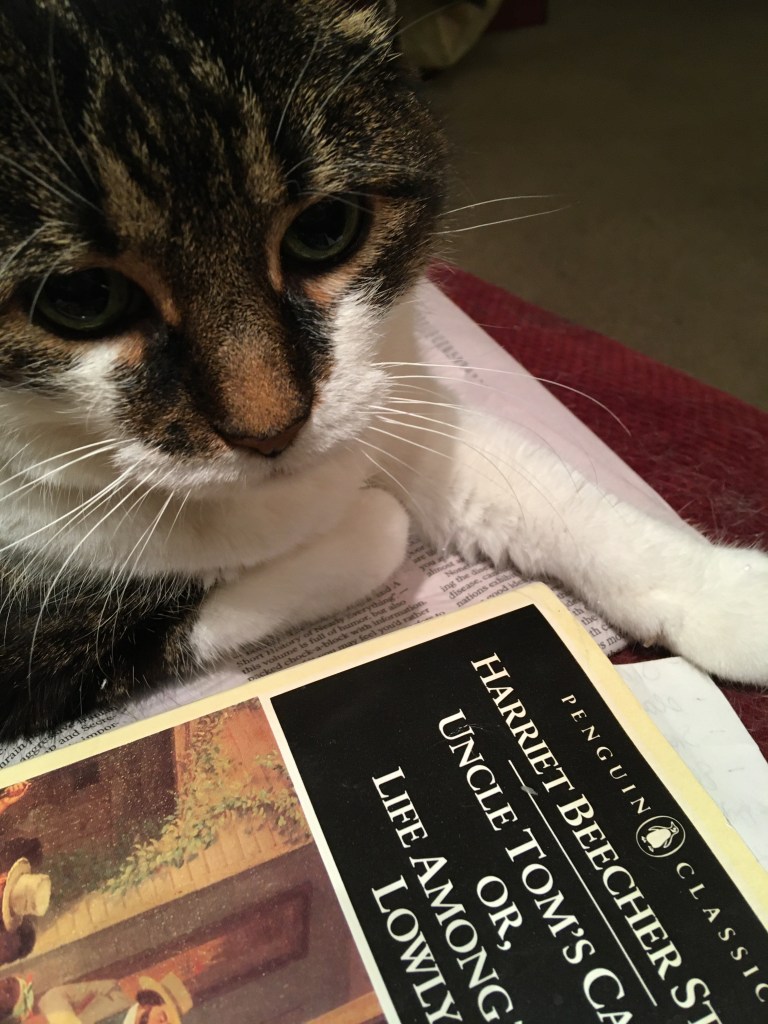
She had just read my story “The Fetish,” and demanded to know what on earth do a voodoo priestess and a missing man have in common with Uncle Tom’s Cabin?

I could have told her that many American slaves were influenced by the Caribbean practices known as voodoo that date back four centuries and encompass Catholicism and African spiritualism. Think Marie Laveau, the Voodoo Queen of New Orleans whose 19th-century followers included slaves. Or the original Doctor John. Born in Senegal and enslaved before becoming a prominent voodoo king and healer, also in late 19th-century New Orleans, he is credited with reanimation, leading to the myth of zombies.

But the truth is more mundane. I belong to the Pelican Pens Writing Group. Each week, we write a thousand words or so on a random topic. Last week, we were joined by author Diana Wagman, who also teaches fiction in Los Angeles. Her assignment: Go to your bookshelf or Kindle, pick the third book from the end, turn to page 22 and write a story using the 13th sentence of the book page as the starting sentence of your story. 

For me, that was Uncle Tom’s Cabin, by Harriet Beecher Stowe, p. 22, sentence 13:  “All this may happen to him yet.” My story is “The Fetish.”

The Fetish

“All this may happen to him—yet,” the priestess whispered, her voice as thick as the patchouli-infused room in which I hunkered. Surrounded by tattered arras, the creased woman slouched over a stubby candle divining disembodied souls and hideous beasts from strew gris-gris. . “But because you have sought my help, your lover may be spared.” In a chant to Damballa, we prayed for answers. I prayed for answers, anyway—I don’t know what the hell Zingara prayed for.

I needed to know what had happened to my husband. Ganon had disappeared seven years ago on a trek through the slot canyons of Utah. An experienced solo hiker, he planned to be gone three days. We needed a little time apart, he said. Our lives had taken divergent paths. He wanted adventure. I wanted a family. But we still loved each other, didn’t we? Now I had the option to declare him dead, but how could I do that without answers.

“Pay attention,” Zingara hissed me back to the present. Or maybe it was the caged snake in the corner. What was I doing here? I wanted to blame this ghoulish scenario on my best friend. A fortuneteller was her idea. But I willingly went along.

Sofia and I met in college. She was a New Yorker with a penchant for the occult; I, a high-desert realist. But we understood each other as if we lived in the other’s skin. When she suggested a girls’ weekend in New Orleans to help me make a decision, I readily agreed. But ubiquitous signs for fortune tellers and one too many Sazaracs landed me at the claw-like hands of Zingara.

 “Damballa,” she intoned. A soft whistle crept up my spine until my already spikey hair stood on end. “Stave off the horrors that may happen to an unfound man. Find him. Send her a sign.”

Yes. Please, I wanted answers, but a sign would do. Years had passed with no trace of Ganon. Park rangers said he never checked in, and no bodies were washed out by a flash flood. No car was abandoned. Finding no evidence of foul play, the sheriff intimated that Ganon had planned his own disappearance. Did he? Was there an accident? Murder? Or even, for God’s sake, an alien abduction?

Squirreling around in her billowing scarves, Zingara produced a small coarse object. A stale garlicky breath separated us as she leaned forward and placed it in my reluctant palms.

“Into a wilderness where the silenced night is light and gentle, you must go,” she instructed. “And at the foot of a lone mountain, plant this raccoon paw.”

Raccoon paw!

“Zingara, please…” I sought answers, not a mummified appendage.

Glaring away my attempt to speak, she stood up. “You came to me and to me you shall return. When your man responds—in spirit or flesh—return to thank Damballa.” She gestured toward the snake. “Now go.”

Needing no further encouragement, I scurried into the moist cobblestone streets of Faubourg Marigny, five blocks and a few dimensions downriver from the French Quarter. Jazzy notes from Frenchman Street clung to my pores, wisps of stale beer swirled at my feet, and a raccoon’s paw hung in my pocket. For this experience, I guffawed, I paid twenty bucks. At least it would make a good story.

Sofia waited in our rental car.

“Tell me, Abby!” My friend’s black hair slicked blue in the iridescence of  the streetlight, her eyes agog. “What happened?” I fished out the fetish and handed it to her. “What the…”

“It’s a freakin’ raccoon paw. I’m supposed to plant it at the foot of a lone mountain in a wilderness where the silenced night is light and gentle.” We laughed at the absurdity of it all. “Let’s get outta here.”

That night, foregoing sleep wracked by discombobulated bodies, serpents, and animal paws, I read and reread the legal documents concerning Ganon’s death. I didn’t need life insurance. I needed closure. What a dumb concept, I used to say. But now I needed something to help me accept what happened, even if I didn’t like it or didn’t know what it was.

Needing a mood change, I suggested over morning coffee that we head up river. After a full day of touring plantations, we ended up at a little eatery on Manchac Pass. Full of fried catfish and too lazy to head back to the city, we settled on a little bench to soak in the gentle bayou breeze and watch the sunset. A lone cypress atop a small hillock, silhouetted against a deep orange and purple sky, begged a picture. I reached into my pocket for my phone but instead pulled out the damned paw.

“Holy shit,” I muttered, ping-ponging my eyes from paw to tree. “I wouldn’t call that mound of dirt a mountain, but it’s higher than anything around here.”

“And I’d say the silenced night is light and gentle,” Sofia added.

I dug a little hole for the fetish with my hands. Wiping them on my jeans, I felt lighter. “Can you imagine explaining that to airport security!” Then we noticed a raccoon stalking the car.

“Maybe he’s looking for his paw,” Sofia laughed. But he looked right at me, convulsed, and dropped to the ground.

“He’s dead,” I said. Then after a long moment, I whispered, “He’s dead, Sofia. Ganon’s dead.”

Maybe I just wished it so. Maybe a rabid animal was a coincidence. But maybe, maybe, Damballa had found Ganon and through the raccoon, Ganon had found me. Maybe I was crazy, but maybe this was my answer.

“Let’s head over to Zingara’s,” I said, getting into the car. “I need to settle up with Damballa.”

2020 Hindsight

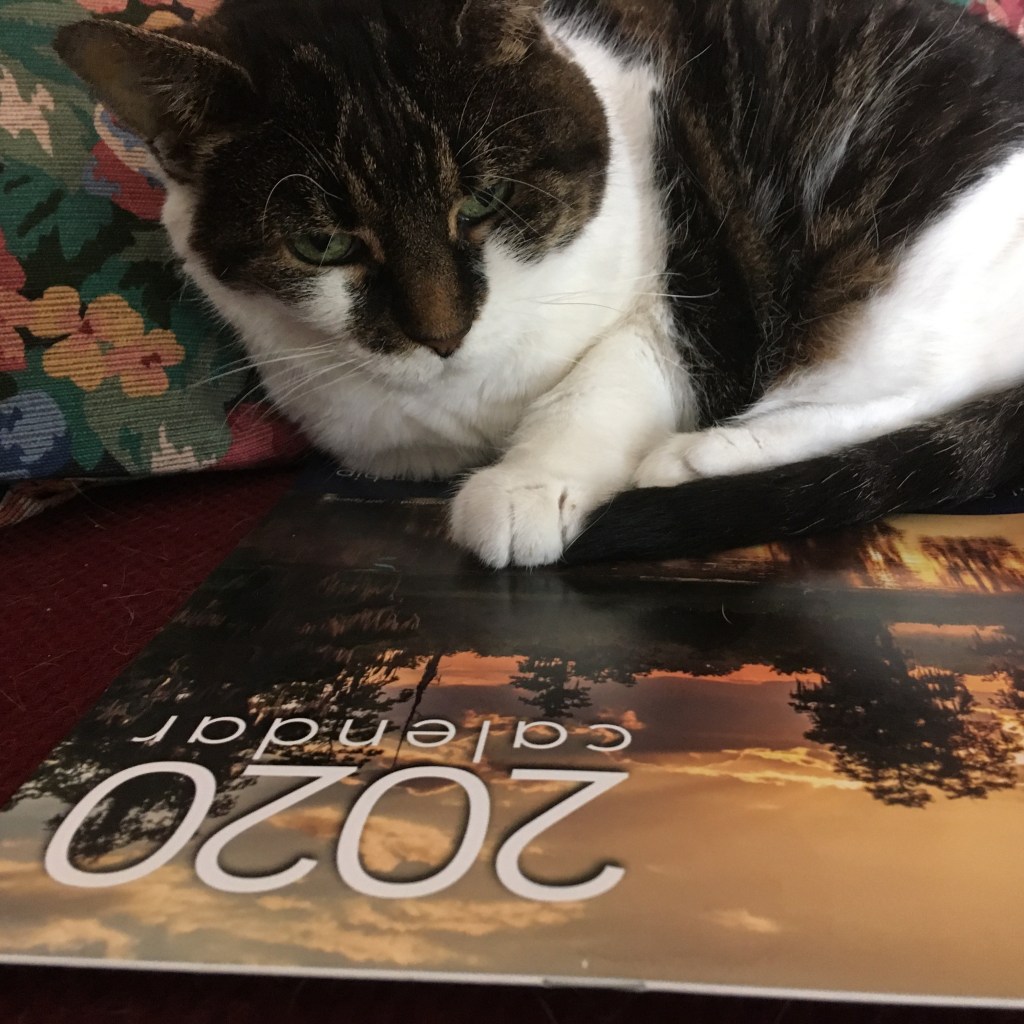
“Good riddance,” I quipped when Bob replaced a 2020 calendar with a 2021 version.  Before I could shred the old one, though, I stopped to marvel at the quiet beauty of the marshlands it depicted. Stunning landscapes and exquisite characters. Sunrises, sunsets. Spoonbills, panthers, tiger swallowtails.

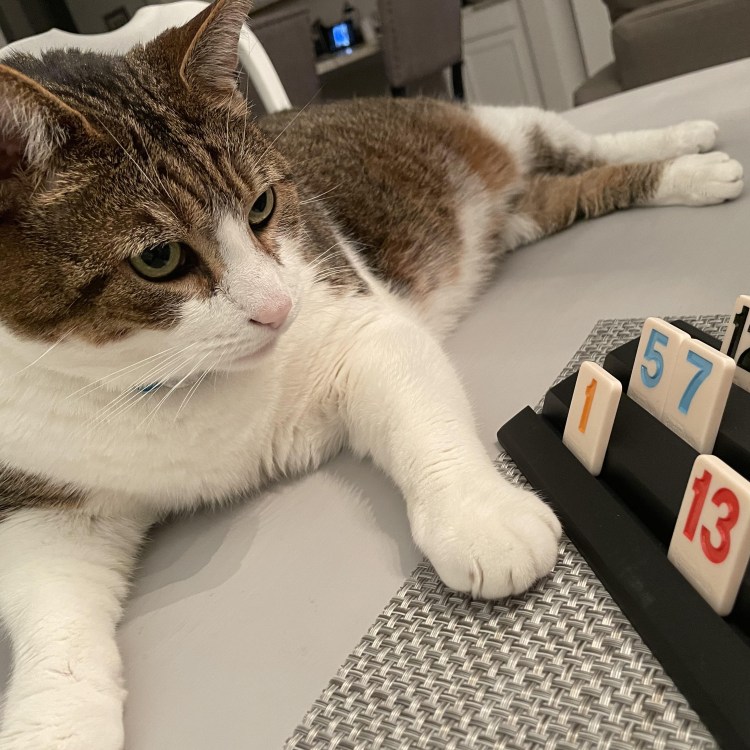
That’s when Nina stepped in, quite literally stopping my intentions with a gentle paw resting on a marsh scene that could easily be across the street. Was the year so bad, she seemed to ask with a drawn-out meow. Did 2020 not arrest as many moments of beauty as it did monumental crud? Despite the anxiety, isolation, and anger that tempted me and others to focus on the worst, Nina suggested it wasn’t all that bad. And she should know.

She—and we—lost our 18-year friend, Ron. But he exuded a lifetime of comfort and joy until he died painlessly in his sleep, cuddled into his favorite chair. Before that, we met an expert, compassionate vet who eased us through the farewell process and helped us find a good primary care vet for Nina. Oh, and we also found some good doctors for ourselves, too.

Yes, it was a year of change, that’s for sure. And change is good, I always say. After all—actually before all else—Bob successfully underwent a procedure that not only corrected a cardiac problem but is likely to extend his life and quality of life. I healed completely from a broken wrist. We both sighed relief when a friend recovered from COVID. And friends welcomed grandchildren.

Although we regret that we couldn’t bid a proper goodbye to our friends in Virginia, we nonetheless fulfilled the dream of building a new house and moving into a warm, active, and supportive community where we engage in driveway socials, ride around in golf carts, and try new adventures like putt-putt golf. The extremely active tropical storm season bypassed us. I took up water volleyball, discovered the magic of chalk paint, and rediscovered crochet. We zoom.

My writing has expanded and improved. After learning WordPress, I started this blog, finished a novel, had two poems published, and embarked on short fiction. I joined a new writers’ group as well as a couple of professional associations. An 80-year-old writer of historic romance lives around the corner. She reminds me that I’m still young and encourages me to keep writing. Daily.

My world’s orbit shrank—in a good way. I reunited with my two first roomies and travel mates after nearly 50 years of prowling unparallel paths thousands of miles apart. One now dwells a mere two hours north and the other retreats to a snowbird condo 40 minutes south. Then former neighbors announced that they are building a house an hour and a half from here; others settled three hours away. A high school friend also lives three hours away; a cousin, four hours; and one of Bob’s old friend, about five. Not exactly around the corner, but not that far, either, especially when the interstates act like expressways and not parking lots. I don’t feel isolated.

I recently told a niece that I couldn’t wait to wave 2020 good-bye. She suggested that a hand signal involving only one finger might be more appropriate. But this morning, Nina prompted yet another gesture—a better one—as she lifted a white paw from the calendar to her pink tongue. She eyed me slyly. Gratitude comes on little cat feet, to paraphrase Carl Sandburg. With palms together, head bowed, and fingertips to lips, I gave thanks.

Then I took a deep breath and bid good riddance to the detritus.

Nights Before Christmas

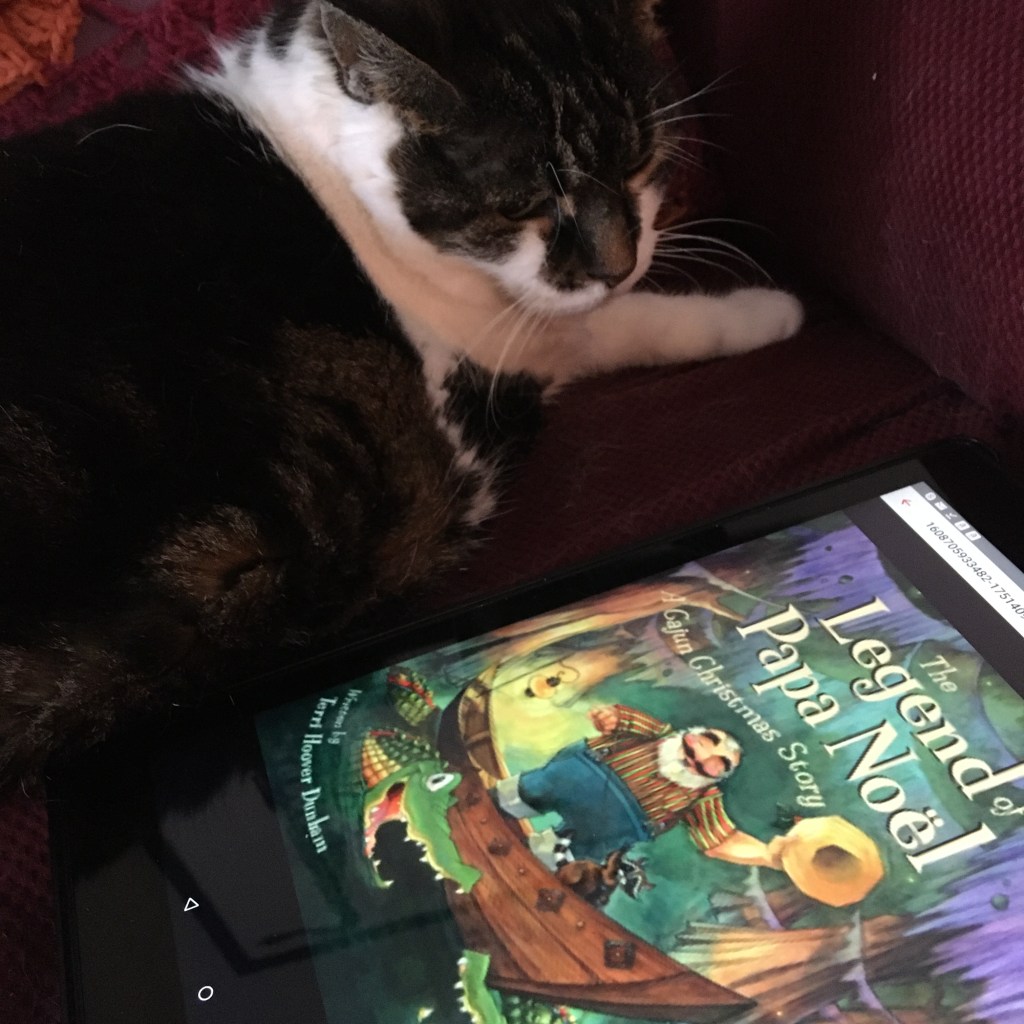
’Twas the night before Christmas when I found Nina browsing The Legend of Papa Noël. Written by Terri Hoover Dunham and illustrated by Laura Knorr, this children’s book is subtitled, “A Cajun Christmas Story.” Since Christmas appeals to the young at heart—and we’re both getting up there in years—I snuggled in with Nina to revisit Papa Noël, Santa’s Cajun alter ego, as well as my own relationship to both this story and alternative Christmas celebrations in general.

Hoover relates Papa’s midnight ride through the foggy bayous of Louisiana in a pirogue—a flat-bottomed canoe—pulled by eight alligators. After all, sleds and flying reindeer make as much sense in the swamp as its infamous Loup-garou monster would make at the North Pole. One night, the fog got too dense for even Nicolette, Rudolf’s counterpart. So the locals along the waterways helped Papa Noël find his way by lighting bonfires.

I told Nina about my own experience, long before she was born, with Papa Noël’s midnight ride down the Mighty Mississippi and how those bonfires helped me create my alternative traditions for Christmas.

It all started when Bob and I moved to New Orleans. We joined a few thousand of our closest friends to explore Christmas Eve along the Great River Road in Gramercy and Lutcher. There, neighborhood families organized block parties to welcome friends and strangers alike with banquets that featured everything from cochon de lait and deep-fried turkey, to homemade pralines and cafe au lait—and all the gumbos, jambalaya, and soufflés you can imagine in between. The banquet served as a prelude to the main event—the lighting of the bonfires.

The bonfires. You can’t imagine the sight, sound, and smell. The term derives from the Middle English bone fire—a “fire of bones.” In this case, the bones are lumber and scrap materials used to construct hundreds of towering masterpieces that depict everything from pyramids and trucks to miniature mansions and riverboats. Traditionally, there’s even a pirogue with Papa Noël and his alligators. Somewhere around 7 o’clock, a local fire chief signals the simultaneous torching of the wooden structures. Embedded in each are fireworks and sparklers that boom and flash for hours.

Although local lore attributes the tradition to lighting the way for Papa Noël, Emily Chenet Guidry presents a history that goes deeper. In “Bonfires on the Levee: A Christmas Eve Tradition along the River Road,” she dates their origins to the early 1700s when French and German immigrants settled in the area. They brought with them the ancient Celtic custom of building large ceremonial fires to honor the sun. Such a ritual would be quite appropriate on the winter solstice, when the waning sun begins to wax. In Cabanocey: The History, Customs and Folklore of St. James Parish, Lillian Bourgeois recounts that family and friends gathered not on Christmas Eve, but on New Year’s Eve, based on first-hand interviews with old-timers who remember ending the year with “a gumbo supper, eggnog and the burning of huge cone-shaped bonfires on the batture (i.e., levee).”

Regardless of their origins, a visit to the bonfires became a tradition. That is, until we moved to the Washington, D.C., area. There, a totally different tradition emerged.

Like the bonfires, the alternative was based on the local milieu. But unlike the communities along the River Road, D.C. was strangely deserted as most denizens headed elsewhere for Christmas, leaving the stately museums along the Mall nearly empty. I discovered this early on when I headed to the National Gallery on Christmas Eve and happened upon an intimate docent-led tour of the Madonna and Child through the centuries. Another year, Bob and I spent a few hours at the National Archives—something you just can’t do on most days when tourists line up for blocks for a 10-second peek of the Constitution and Declaration of Independence in the Rotunda.

My friend Catharine and I settled into a routine of visiting a different museum each year and then having lunch at one of the museum restaurants. We usually ended up at the Mitsitam Native Foods Cafe at the National Museum of the American Indian. We would sit by the window facing the rock-studded fountains, sometimes frosted with snowy flakes, and enjoy wild rice and watercress salad, cedar-planked wild salmon, or roasted wild mushrooms with smoked potatoes and fresh herbs. What’s Christmas Eve without good food?

When the temps reently plunged in Southwest Florida, a new tradition emerged. A few of the ladies on my street decided we needed a little Christmas. Having landed here seeking year-round warmth, we all knew real cold—Laurie’s from Michigan; Carol’s a native Chicagoan who arrived by way of Maryland and Colorado; and I’m a Connecticut Yankee who identifies as a New Orleanian, but who also has lived in Colorado and Virginia. In other words, 40 degrees is nothing. But it doesn’t take long for one’s blood to thin in Florida. So we bundled up and headed out in Carol’s golf cart after sunset to view the neighborhood displays of lights.

To set the mood, she downloaded a playlist of holiday favorites, decked her cart with a Bluetooth player, and donned her reindeer leggings. I hopped in with hot cocoa in thermal travel mugs. Laurie took up the rear to navigate and narrate—a logical role for someone who knows where everyone lives, previously lived, and the particulars of their decorations. Like the “holiday tree” that gets decorated for every holiday—not just Christmas, and the pink flamingos swaddled in pink scarves and hats.

Oh what fun it was to ride in a five-horsepower sleigh—Hey!

Somewhere between Jingle Bells and the Chipmunks, I found myself dreaming of a Green Christmas, where down the lane, palm trees glistened, and garage door expositions swirled Santa on his mission. We sang the old songs as we cruised along, passed out candy canes to evening walkers, and had ourselves a Merry Little Christmas time.

After an hour of oohing and aahing our way through several neighborhoods, we awarded our home base “Best in Show.” I shared that observation a few days later with a woman from another neighborhood. “Well, that makes sense,” she replied without hesitation. “That’s where all the young people live.”

The young people? Who knew? We moved to a 55-plus community, and ended up in a youthful enclave. Now that’s an alternative tradition I can live with. As I told Nina, Christmas is for the young at heart. She seemed to nod in agreement as she eyeballed her still-unopened presents.

Cat Nap

When I unpacked the yarn I had transported from Virginia to Florida, I found several granny squares left over from an afghan I made for a niece about 10 years ago. I knew there wasn’t enough for another afghan, and besides, who needs an afghan in Florida? But maybe a throw for the living room sofa would work. So I laid out the squares, and voila! They materialized as pillow covers that would freshen the decor. I not only used up eight partial skeins from the original project, but another three as well. Nina cared not a whit about my accomplishment. Amidst my books and hooks, she instead snuggled into the bright grannies.

Looking at both my cat and my enterprising use of scraps, I escaped into my lifelong love of crochet. Although a family friend taught me both to knit and crochet when I was about seven years old, I got hooked on crochet. Since then, I have made more pieces than I can count—everything from afghans and sweaters to necklaces and beaded snowflakes. But it’s more than making things. It’s a creative outlet, and, as frustrating as it is to rip out stitches or recount chains, crochet reduces stress.

Maybe it’s the tangible nature of the labor. Or the puzzle-solving quality of interlocking one color of yarn with another. Or the repetitive and meditative motion. I don’t know. But in surveying my work, I slipped into a trance in which a tangle of memories evolved like snarled skeins of yarn. Each untwisted knot revealed a moment when art imitated the life it reflected.

Like when my father was dying. I sat at his bedside and crocheted. He didn’t know I was there, but I did. And rather than feeling useless, I felt calm. And productive. Likewise, I once brought yarn on a visit to my mother-in-law as she slipped into dementia. I asked her to hold the skeins while I wrapped them into balls. We talked about color and texture—very concrete topics as memory fades.

In fact, according to the American College of Health Care Administrators, for persons with dementia, touch may be a vital vehicle for expressing emotions and making meaningful contact. Think about it: Everything you touch—silk, granite, kittens, or a hot stove—sends a message to the brain. Tactile stimulation is, in fact, brain inspiration.

No wonder, then, that as my fingers skittle through skeins, they fabricate the other yarns. Imagination overtakes the prosaic whether I’m waiting at the airport, sitting shotgun on a cross-country drive, or watching TV with my husband. We enjoy each other’s company while immersed in different worlds—his defined by dramatic suspense, mine by palpable artistry.

Crochet is an ancient art, though no one knows for sure where it started. Undoubtedly, it began as function, as early as the Stone Age. The word comes from Old Norse krokr, the Germanic croc, or the French croche. They all mean “hook.” The first hooks were the fingers of prehistoric hunters and gatherers who fastened together whatever they could find—plants, sinew, bone—to trap animals, fashion clothing, and prepare food.  As the Stone Age evolved into the Bronze and Iron Ages, so did the materials for hooking.

The Vikings perfected wire-knitting during the 7th or 8th century AD, when they wove long strands of silver and gold first into ropes, then body armor (known as chainmaille), and finally jewelry. According to The Book of Viking Myths by Peter Archer, their art was complex and impressive, reflective of a rich civilization known more for sacking the castles of medieval Europe and selling into slavery the monks who guarded their treasures. Having taken a class a few years ago on Viking wire-knitting, I can attest to its strength and beauty.

Centuries later, crochet developed into a decorative art, but archeologists and anthropologists differ on how that happened. Some say it was born in Arabia and followed the trade routes to Europe and Asia. Others, that it originated in China and followed those same routes to Europe. Yet others point to unrelated sites, like an isolated tribe in South America that has crocheted ritual garments for centuries. By 1300 AD, however, we know that hooks from brass, bone, ivory, and wood were being used in Turkey, North Africa, China, and India. Annie Potter, author of Annie’s Crochet Odyssey: History of Crochet, believes that the art of contemporary crochet evolved in Europe in the 16th century.

Being of Irish descent, I am fascinated by the role crochet played in the an Gorta Mór, The Great Hunger. From 1845 to 1849, the British took advantage of a potato famine to strip the Irish of their Catholic allegiance. Unwilling to capitulate, more than a million Irish men, women, and children subsequently died of starvation in less than 10 years, while the Brits exported tons of seafood, crops, and seeds. But Irish women created a means to survive and thrive—by day, toiling the barren fields; by night, crocheting lace. A practical alternative to lavish needlepoint lace, their work transcended their peat-smudged squalor.

Horrified by conditions under which the women worked, a coterie of altruistic ladies established a market for the delicate Irish lace and a means for Irish women to sustain their families. Sarah Reed details that history in “Irish Crochet and Clones Lace: Exploring Lace Making in Crochet.” She notes that, “When Queen Victoria promoted the lace at an arts exposition in London, the demand became so high that professional dealers took the place of the charities and the business of lace-making moved from a resourceful survival skill into an industry.” Although banned from wearing lace themselves, the scrappy Irish triumphed. So I tried my hand at the technique. You might say that “scrappy” was the result.

But not my memories of trying. From Aran sweaters and Spanish serapes, to Japanese amigurumi dolls and Tunisian afghans, my endeavors were more than projects. They form a crocheted memoir. And I remember each wedding, birthday, gala, and boyfriend, probably because of the tactile-brain-emotion connection.

Once, I incorporated that same tactile stimulation into a lesson plan I created for about 30 inner city, middle-grade students on a field trip from New Orleans to San Antonio. You have to do something to break up a five-day bus ride for kids whose attention span rarely exceeds an hour. So along the concrete highways, I threw in byways of Stone-Age sinew, Viking wire, and Irish lace. I taught boys and girls to first finger-crochet, then to hook-crochet scraps of colorful yarn into bracelets and headbands. One boy, Anthony, really got hooked, I smile every time I think of his exuberance.

Those bygone yarns returned me to the pillow covers laid out on the sofa. When I found that Nina had appropriated them, I asked if she had taken up a new hobby, perhaps something to reduce stress. Seeing no point in working hard to relax, she meowed, “No,” then simply purred herself into a cat nap.

Parting the Thin Veil

As Halloween dawned, I found a perplexed Nina reading The Celtic Book of the Dead by Caitlin Matthews.

Subtitled A Guide for Your Voyage to the Celtic Otherworld, the book and its accompanying tarot-like cards explore the immram—a mystical journey to find the meaning of life. Matthews lays out this path by first explaining the Otherworld, which she defines as “the storehouse of archetypes that inform and shape our own phenomenal world,” a realm that is contiguous to, and overlaps, the mundane one.

Nina sensed that, on Halloween, she perhaps could reunite—even momentarily—with Ron, who died earlier this month. Like Bob and me, she misses her companion of 17 years. For example, she wouldn’t sit on the chair where she had snuggled with him—after a spat about who got there first, of course. At first, she sniffed around it; then she avoided it completely.

Cats, indeed, experience grief. Lynn Buzhardt, DVM, a breeding specialist with VCA Animal Hospitals, relies on research to bolster what she considers signs of mourning, such as decreased appetite, unexplained howling, and hiding—all behaviors we had already noticed. So I had a sit-down with Nina on the meaning of Halloween and its association with the dead.

I explained that to both ancient Celts and modern Wiccans, the holiday is known as Samhain (pronounced sow-in, rhymes with cow-in). It’s a harvest festival and as such represents the end of a cycle, the end of life, the end of a year—New Year’s Eve.

According to History.com, the Celts believed that the barrier between our world and the world that exists beyond it is thin and thus breachable during Samhain. So while they encouraged the visitation of kith and kin, they also feared dreadful forces that might also pass over: scary fairies who might kidnap the living and dead; the vile sluagh who would steal their souls; the shape-shifting and mischievous Pukah; the headless Dullahan, whose appearance was a death omen; and the invisible kelpies that would drown the unsuspecting and eat them. Carved turnips and pumpkins embedded with Samhain fires protected families from the monsters. So the Celts dressed up in costume and offered treats to discourage such evil forces.

Can you say “trick or treat”?

Even though Saint Patrick brought Christianity to Ireland in the fifth century AD, the Celtic beliefs lived on both in Ireland and throughout Europe. In the ninth century, Pope Gregory usurped Samhain, transforming it into two liturgical events—All Saints’ Day (November 1) and All Souls’ Day (November 2). But the pagan roots of Samhain lived on. October 31 became All Hallows Eve, or Halloween. And in the 19th century, Irish immigrants brought their Celtic-based traditions to America.

Wiccans, who trace their practices to the ancient Celts, regard Samhain as the auspicious moment that is neither past nor present, neither of this world nor the Other. According to Eight Sabbats for Witches by Janet and Stewart Farrar, spirits of the dead may easily pass over to commune with those alive and yet unborn.

I shared with Nina two of my own very distinct celebrations of the dead.

In the late 1990s, my friend Karen and I attended a Samhain celebration in New Orleans. About a hundred people gathered after sunset to surround a priestess, a small fire, and a cauldron under a live oak in a far corner of City Park. Wearing a hooded cape, the priestess intoned some prayers and then explained the concept of the dead being able to pass from the Otherworld to ours through the thin veil of Samhain. She invited those gathered to call out the names of the dead. After a few evocations to parents, siblings, and friends, the incantations got political. “Martin Luther King,” someone called. Then the Kennedys. So I blurted out, “Mary Jo Kopechne.” Karen guffawed, but no one else seemed to notice. We were simply recognizing the presence of those who had passed over. Then the priestess blessed apples and pomegranates and passed them around for all to share.

Prior to that event, I had celebrated Le Toussaint, the Feast of All Saints, in Lacombe, Louisiana, several times. For more than 200 years, on November 1, families and friends have cleaned and decorated tombs with both candles and flowers to invite a communion with their dearly departed.

My first visitation was with my friend George. Although there was a well-marked entrance to the cemetery, we somehow missed it and ended up climbing over a fence into the graveyard. Coming in the back way, so to speak, proved to be breathtaking. Flickering votive candles hissed in the cool darkness, beckoning us to honor our own friends and family members who had died, even though they were buried a thousand miles away.

It’s no coincidence that Le Toussaint parallels both Samhain and the Mexican Dia de los Muertos, Day of the Dead. A quick review of history reveals that the Celtic culture encompassed much of Europe, including Spain. So it’s not surprising that when the Spanish missionaries arrived in the New World in the 16th century, they layered Celtic-Christian observances over the Mayan and Aztec harvest rituals, resulting in Dia de los Muerto.

This was all too much for Nina, who seemingly paid no heed to the meaning of life or its relationship to death. She simply missed Ron. So I followed Dr. Buzhardt’s advice and spent a little extra time with her. I placed a favorite pillow on what was her and Ron’s snuggling chair. Over the pillow, I layered pieces of an afghan I’m working on that she likes to cuddle into. Then I lifted her gently upon this throne. She settled in. Perhaps to commune—if only briefly—with Ron.

Rescued by Ron

Blogger Ron Cat died peacefully in his sleep October 2, 2020, after 18 wonderful years with us. Bob, Nina, and I miss him.

Nina seems perplexed by Ron’s absence. She sniffs around his favorite chair, hides in different parts of the house, and demands affection—she’s typically aloof. She found a little solace reading Rescuing Sprite: A Dog Lover’s Story of Joy and Anguish by Mark L. Levin. It’s a tearjerker that details the emotions behind the death of a dog. As Levin aptly wrote, “Goldfish, turtles, and hamsters are pets.  Dogs are family.” So, she insists, are cats!

Ron’s birth into a feral cat colony in our backyard prompted us to get involved with a TNR (trap, neuter, return) program. As with many issues, we didn’t get involved until the problem landed literally in our backyard. At the time, the Lakeview neighborhood of New Orleans had an out-of-control feral cat problem. According to the Feral Cat Project, 75% of feral kittens die or disappear by six months of age. They risk being hit by cars, injured by other cats, attacked by predators, or developing diseases. These factors lead to an average lifespan of three years. Thousands of others are euthanized in animal shelters every year. The most humane and effective way to control feral cat populations is through TNR. Controlling their ability to reproduce decreases the population and prevents disease from spreading.

Although we fed the ferals in our colony, Ron waited on our doorstep every day for his favorite treat—a piece of turkey. On a particularly cold evening in January 2003, he slipped indoors and stayed hidden for three days. Just when Bob thought that Ron had succumbed to life on the streets, he poked his little black head out from under a bookcase. “I guess we now have a cat,” Bob proclaimed as we headed to a local pet superstore for supplies. That was January 26, 2003. Football fans may remember the date as Super Bowl XXXVIII, when the Tampa Bay Buccaneers handily beat the Oakland Raiders 48-21. Or that during the halftime show, Shania Twain belted out, “Man! I Feel Like a Woman,” Gwen Stefani ad-libbed “I’m just a girl (at the Super Bowl),” and Sting delivered his “Message in a Bottle.” But we remember it as the first time we came home to our first pet.

We went on to rescue a dozen or so other cats, but about a year later, Nino and Nina knew a good deal and adopted us, too.

The five of us became a traveling road show. Together, we evacuated New Orleans in advance of Katrina, landing first in Mandeville, about 30 miles north of Lakeview, then Houston, six hours west. After three weeks, we found an apartment in Baton Rouge. Eight months later, we moved to Fairfax, Virginia. Our three feline companions flew as live cargo, even changing planes in Texas. Three months ago, Ron and Nina flew with us as carry-on baggage when we moved to Southwest Florida.

Nino died 8 years ago from cancer. Following that trauma, we doubled our healthy cat visits with our vets at Merrifield Animal Hospital to twice yearly. We caught several of Ron’s medical conditions early: feline odontoclastic resorptive lesion (FORL), subcapsular perinephric pseudocysts, kidney stones, kidney disease, heart murmur, high blood pressure, recurring nasal infections, and chronic constipation. When you add in his initial rescue and five moves, he far surpassed the legendary nine lives—all made possible by Bob’s love.

There’s a popular bumper sticker out there with a paw print that reads, “Who rescued who?” (That grates on the English teacher and editor in me, who always corrects the second pronoun to whom.) Ron rescued us. More specifically, he rescued Bob.

They were buddies. Ron tolerated me, since I provided food and medicine. But Bob was his main squeeze. He sat on no one else’s lap. In his pre-Katrina days, Ron would wait on the doorstep. Post-Katrina, it was in the hallway. Bad days at the office melted away. Anxieties disappeared. Stormy weather faded into sunshine. Retirement meant instant gratification. They had rescued each other.

We miss him.

2002-2020