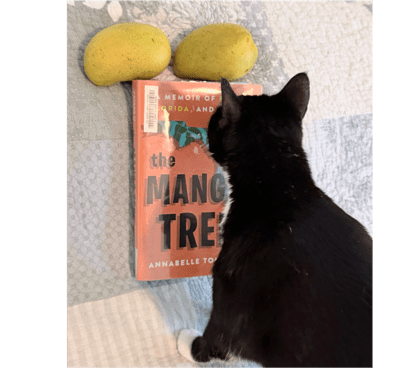
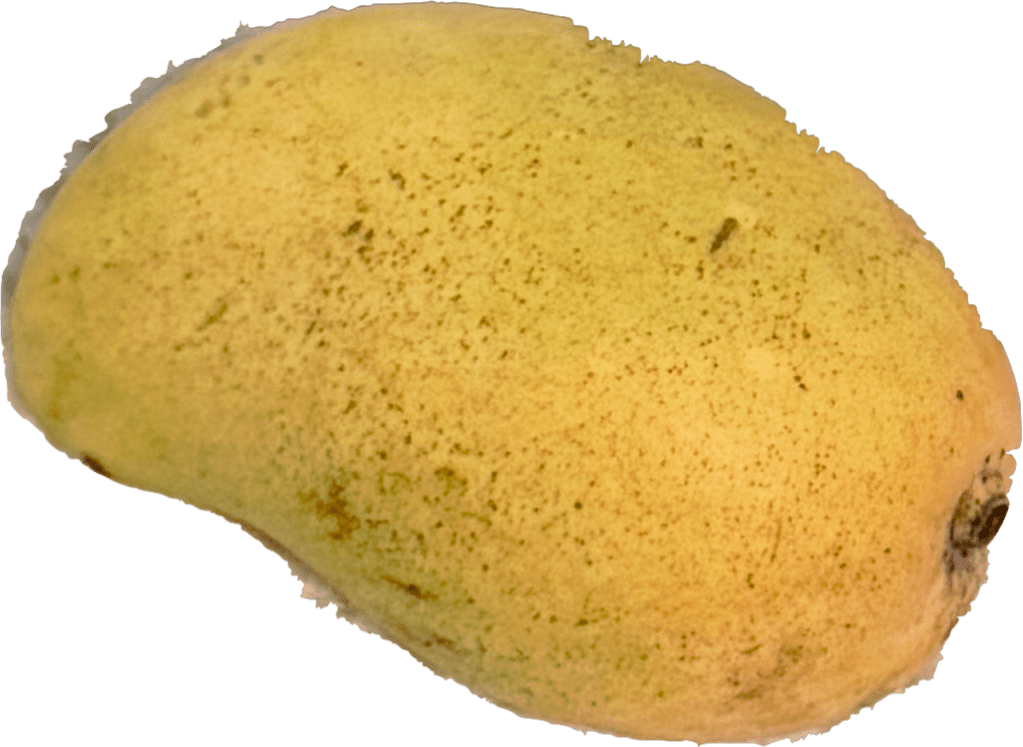
Miss Kitty loves mangoes. Not to eat, mind you, though they’re not toxic to felines. But having been tantalized by social media influencers sharing videos of their cats enjoying mangos, Miss Kitty admits that she simply likes the smell and texture—they’re so … exotic.
So, she grabbed a few to enhance her reading of The Mango Tree: A Memoir of Fruit, Florida, and Felony. Written by food critic and journalist Anabelle Tometich, the book flouts the fun in dysfunction.
In a prologue, the author’s mother is arrested for shooting a trespasser with a BB gun who was “messing with her mangoes.” It sets the stage for the “oh-so-Florida” scenario that is reminiscent of what Miami Herald columnist and satirical novelist Carl Hiaasen dubbed the “Florida Man” archetype of bizarre crimes.
Organized like a tree, the memoir starts, of course, with “The Seed” and concludes with “The Branches.” In between is the trunk—a tragicomedy of a mango-shooting mama from the Philippines, who married a ne’er-do-well son of Yugoslavian refugees from Boston, and raised their three children in the Baháʼí faith in Fort Myers, Florida.
“Nobody’s from Fort Myers,” the author says in the opening to Chapter 1.
“I’m from Fort Myers,” Miss Kitty mewed. “And I’m not a nobody!”
In truth, Miss Kitty is from Tampa, but she nonetheless identifies as a local. She also identifies with the author.
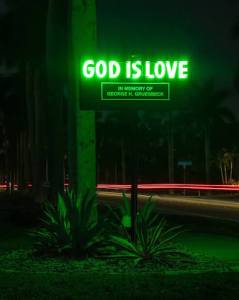
“I feel like Annabelle’s my friend, that I live in her neighborhood, and that I’ve sampled mangos from her mother’s tree,” Miss Kitty purred. “I even know the God is Love sign on McGregor Boulevard.”
With the scent of the sweet mango wafting through her bedroom, Miss Kitty nibbled her way through the memoir that begins in Fort Myers. It was a small, yet growing city of around 40,000 in the late 1970s. Known for citrus and strawberry farming, the city was best known as a winter destination for tourists and retirees.
Annabelle’s mother, Josefina, arrived there in 1978 as a nurse. Describing her as a “Filipina Eva Gabor,” the author says, “She was an IV pole that could speak [and] a crutch that could calculate antibiotic dosages.”
Lou Tometich, who played tennis and computer games, was smitten and married her, much to his mother’s chagrin. His mother, ironically named Josephine, called Josefina a “Chink bitch” and their children “mongrels.” Referring to herself as “the Eldest Mango,” Annabelle describes herself in the fourth grade as “the only student whose skin is darker than a Crayola apricot.”
Family life was tough. Lou and Josephina fought “like the tropical storms that brew in and around Fort Myers.”
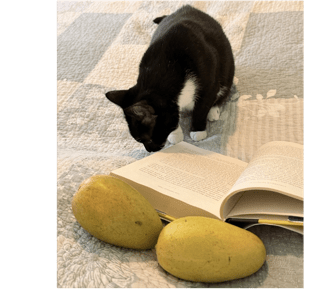
Miss Kitty paused when she read that, feeling grateful that she belonged in a loving family. It lulled her into a catnap, which she was jolted out of by, of all things, a mid-summer thunderstorm.”
Although Lou died when Annabelle was nine years old, he played a major role in her life. For example, he taught his daughter how to identify the local river like a native. “It’s Caloosahatchee,” he said, “Not Caloosahatchee River.” Hatchee, he explained, is the indigenous word for “River.” So, only the tourists would make such a mistake as calling it the Caloosa River River.
Miss Kitty made note of that, vowing to never call the nearby landmark a river-river.
Lou was also a foodie who followed Jean Le Boeuf, the pseudonym of a restaurant critic for The News-Press, the local newspaper. It was a position that played into Annabelle’s future—and the writing of her memoir.
But it was his death, poignantly and metaphorically told through the chapter “Wite-Out,” that led Annabelle ultimately to come to terms with her mother. Although fearful of becoming her, the Eldest Mango came to recognize her mother’s many strengths, which she later called her superpowers.
Beyond the story, Miss Kitty appreciated Tomitech’s writing technique. She found descriptions that were clever and distinct. For example, when the 11-year-old narrator arrived in the Philippines for her first visit, she found “the packed dirt [was] the same light brown as the smog.” And although Miss Kitty doesn’t like the beach, she liked Annabelle’s description of the family encampment that resembled a sandcastle with “most of the units … shaped like upside-down cups” and a blue gate topped with “curls of barbed wire snaking through shards of broken glass.”
Miss Kitty especially loved it when the family returned to the States and went through Customs in Los Angeles. In a scene that reminded her of Contraband Seized at the Border (her favorite reality show on the Discovery Channel), Annabelle was humiliated when Josefina caused a scene with the officers who confiscated several food items, including atis (sugar apple or sweetsop) seeds.
Yet Josefina laughed so hard that her shoulders shook when the family left the airport because she had a stash of atis seeds in her purse.
Josefina’s yard grew into an overgrown mini-orchard with thickets of fruit trees. But none was more cherished than the first mango.
In the end, the opening scene finally made perfect sense. Josefina shot a trespasser for stealing mangoes she had grown from seed some 30 years earlier. Afterwards, Annabelle overheard a stranger admiring her mother for defending her property, saying, “I need to get a BB gun.”
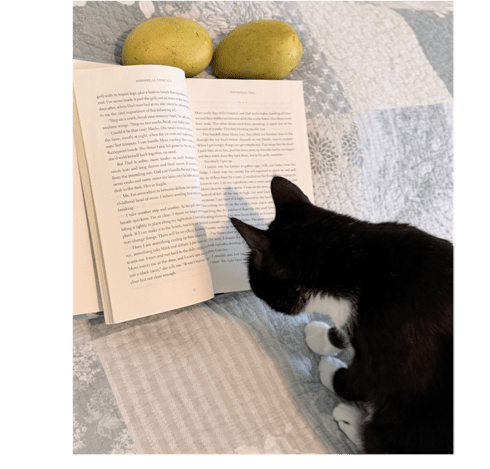
Miss Kitty understood that. Although she doesn’t have a gun—and probably couldn’t shoot one, even if she did—she would defend her property, too. With hairs standing on end, she growled and spread her claws.
Then satisfied that she faced no danger from strangers trying to steal her treasured mangos, she closed her eyes, yawned, and settled into a catnap.

What is your cat reading?
Send book reviews, feline adventures, and cute pictures to Pat@PattiMWalsh.com
2026 Silver Medal, Memoir
Florida Authors & Publishers Assn.
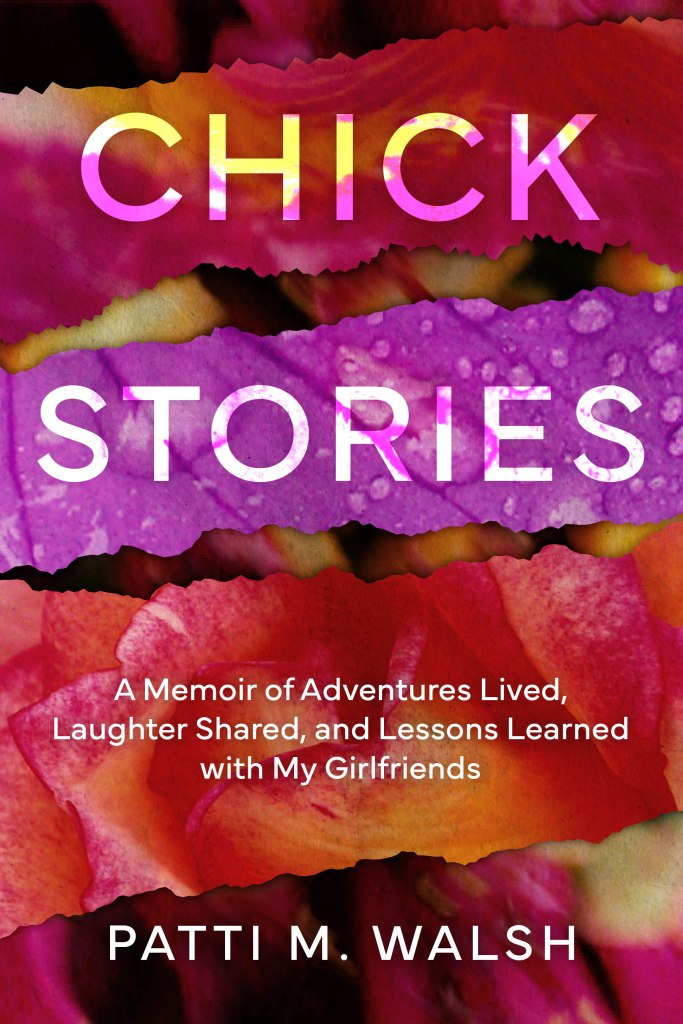
Chick Stories
A memoir of adventures lived, laughter shared, and lessons learned with my girlfriends
Travesties, tragedies, and comical calamities abound in a series of essays rich in historical and cultural context.

Best Children’s Fiction 2023
American Book Fest
Ghost Girl
“Young readers will find Ghost Girl a relevant and positive guide for their own lives. Older readers will find Ghost Girl an attractive introduction to the deep and profound mysteries and spiritual precepts of the Irish Celtic tradition.” –George C Gibson, PhD, Celtic Scholar
Gold Medal Winner
Florida Authors & Publishers Association
2025 Finalist
Florida Writers Association
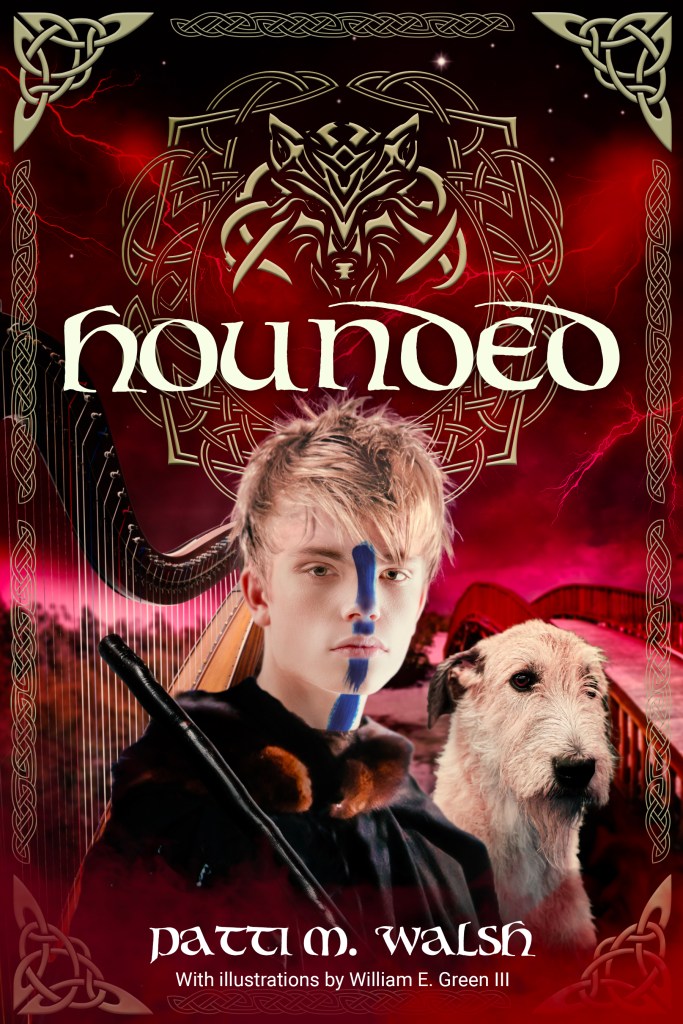
Hounded
Being a Celtic warrior involves more than learning to fight.
Illustrated by William E. Green, Hounded is a contemporary middle-grade novel based on Celtic mythology.

Newsletter:
Come to Think of It
Stories are meant to be shared. So are fleeting thoughts, poetic musings, humorous anecdotes, and existential questions.
Come to Think of It is a forum to engage, inspire, and challenge. To gather with friends. Come to Think of It.
Subscribe at PattiMWalsh.com/newsletter.
2026 Silver Medal, Memoir
Florida Authors & Publishers Assn.
Chick Stories
A memoir of adventures lived, laughter shared, and lessons learned with my girlfriends
Travesties, tragedies, and comical calamities abound in a series of essays rich in historical and cultural context.


HI Patti, Love this story! So refreshing Kathy
LikeLike