When a neighbor recently invited me to play mah jongg, I balked. Having played once, more than a decade ago with my friend Claire, I didn’t want to appear foolish. So, I sought out Mr. Beamer Baclawski. He’s a fanatic, doesn’t suffer fools quietly, and did teach me to play Rummikub.

I started with the basics. What is the correct spelling of the traditional Chinese game of luck and strategy?
“Mah jongg,” my feline friend trilled. “That’s the way the American Mah Jongg League (NMJL) spells it. And if it’s good enough for them, it’s good enough for me.” But he added that it’s capitalized only when referring to items copyrighted by the NMJL.
To begin our lesson, Beamer had me dump 152 colorful, domino-like tiles onto the table between us. He carefully pawed through them, creating groups of suits, winds, dragons, flowers, and jokers. He then quoted actress Julia Roberts.
“Mah jongg,” he said, “is creating order out of chaos based on the random drawing of tiles.”
That order, he quickly added, is determined in the U.S. by the official NMJL Hands and Rules Scorecard. Studying it, I suspected more chaos than order.
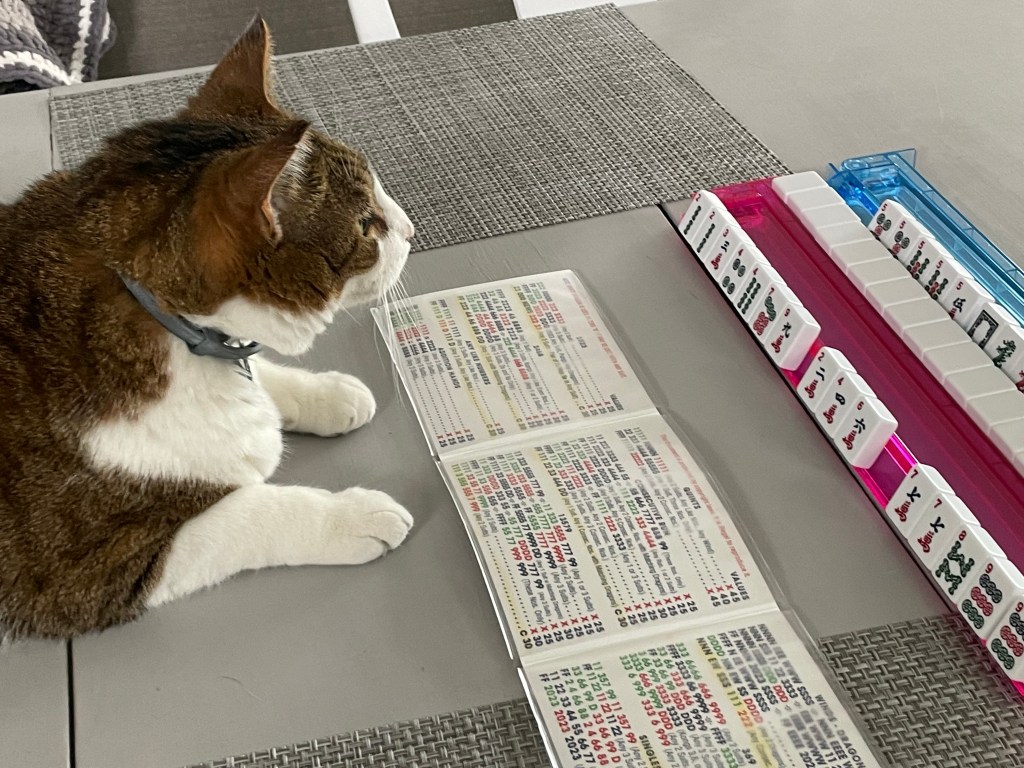
Beamer would have none of my cynicism. To illustrate, he culled three suits and divided them into crak (characters), bam (bamboos), and dot (stones), noting that each suit has four sets of nine tiles.
We moved on to winds, flowers, and dragons.
There are four of each wind—east, south, west, and north; and two sets of four flowers—plum, orchid, chrysanthemum, and bamboo. Together, he said, the flowers are known as the Four Gentlemen because they represent traits of a good character. I like that.
I also liked that the dragons represent sincerity, filial piety, and benevolence. There are four sets of three dragons—red (zhong), green (fa), and white (bai). But they don’t look like dragons. For example, a white dragon might be called “soap” because it looks exactly like a fancy bar of soap.
Add the eight jokers found in the American version, and you get a total of 152 tiles.
He instructed that the goal of mah jongg is to be the first player to form a valid hand by grouping (melding) sets of tiles according to the NMJL scorecard. While that may sound simple, it’s not. NMJL changes the rules every year.
Julia Roberts was right. This was chaos, and we hadn’t even started playing.
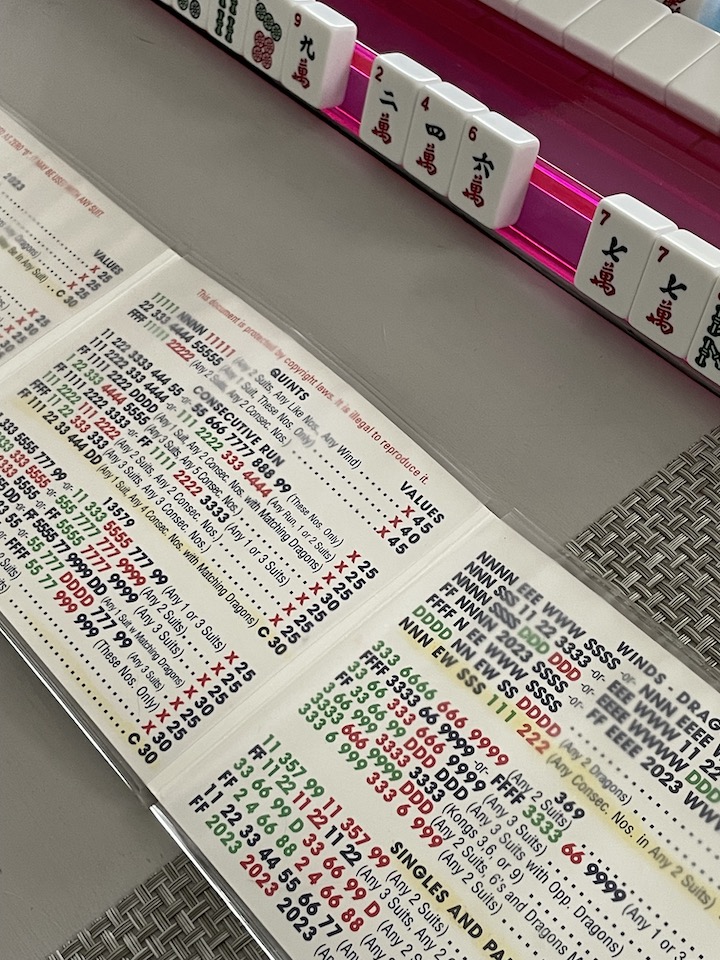
Under Beamer’s direction, I washed all the tiles, meaning I mixed them, face down, with both hands, churning like a washing machine. Then I built a wall by stacking the tiles face down in two rows, 19 tiles long. The dealer, who is always referred to as East, then distributes tiles in a specific order, taking 14. Everyone else gets 13.
Because this was American mah jongg, we started with “The Charleston,” an elaborate scheme of passing tiles to the right, across, left, and then left again, across, and right. There are also optional passes and blind passes, but Beamer told me not to worry about them for the time being.
East begins by discarding one tile. Moving clockwise, each player takes a tile from the wall and discards one. Other players may steal it to complete a meld.
When I thought I understood all this, Beamer added a caveat—individual groups may add new combinations, eliminate old ones, or otherwise adopt the rules.
“Is all this necessary?” I asked, referring to the washing, stacking, passing, and changing rules.
Beamer pooh-poohed my frustration by explaining that the game was—and in many places, still is—a form of gambling. These rituals evolved to prevent cheating. And as anyone familiar with feline history and philosophy will attest, cats do not abide cheaters.
“Who devised this confusing game?” I asked. “Confucius?”
As a matter of fact, Beamer conceded smugly, the famous Chinese philosopher (c. 551–c. 479 BC) may have invented it, but probably not. Yes, the three dragons parallel his three noble virtues, and the clacking of tiles during shuffling sounds like the chattering of sparrows—and Confucius did love birds.

As if to prove his superior knowledge of the game’s name, Beamer chattered the game’s Chinese name—麻雀. It means “sparrow.” His pronunciation and enunciation were perfect. You know it as the sound cats make when fixated on, well, sparrows.
Beamer likes to think the game evolved during the Meow Dynasty. But experts have other theories. The most likely is that it developed from several similar games.
All agree, though, that one day in 1860, in Ningbo, China, Chen Yumen was playing Peng He Pai, when the wind blew the sailor’s cards into the sea. That prompted him to carve a deck of playing tiles. An English speaker, he used them to teach the game to Frederick E. Harvey, British Consul to Ningbo, in 1861.
Harvey’s accounts of mah jongg are the earliest chronicles of its history, although the Chinese did not call it mah jongg. That name was not used until 1920 when Joseph Park Babcock introduced it to the United States.
An American executive with Standard Oil in Shanghai, Babcock learned the game along with thousands of Western expatriates, including Russian Jews who had escaped the Bolshevik Revolution in 1917.
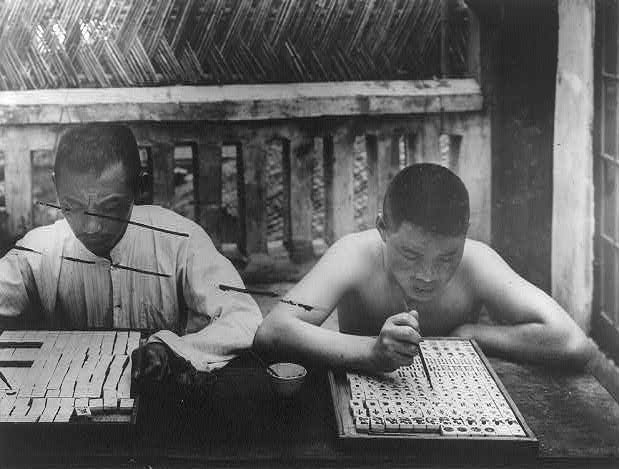
Photo courtesy of the Library of Congress, Prints and Photographs Division
Having witnessed its international appeal, Babcock imported the game. He gave it a name that he could trademark and that sounded Chinese. He wrote it as Mah-Jongg and published a set of rules. Eventually, his heirs allowed the trademark to fall into public domain.
Presumably due to its gambling nature, mah jongg had been popular among Chinese men. But when Babcock introduced his version to New York, the game caught on with women of distinctly different demographics.
World events had forced two disparate groups to converge in New York City—poor Chinese peasants and Jews escaping both Stalin’s antisemitism and the Nazi Holocaust. Many came by way of Shanghai. The refugees lived in crowded and insulated, yet overlapping, communities in the Lower East Side. With a surplus of time and a dearth of money, the Jews adopted mah jongg as easily as their neighbors’ foods.
In 1937, four Jewish women formed the NMJL. Viola Cecil, Dorothy Meyerson, Herma Jacobs, and Hortense Potter took the best of Babcock’s version, simplified scoring, and compiled winning hands.
The Chinese don’t have cards; they have set combinations. In fact, in Amy Tan’s 1989 novel and subsequent movie, The Joy Luck Club, Chinese women make fun of Jewish women who use cards.
According to Annelise Heinz in Mahjong: A Chinese Game and the Making of Modern American Culture, the NMJL wanted the game to become a national phenomenon. Instead, it spread through their networks, cementing it as a symbol of cultural identity and assimilation. Decades later, however, their goal is coming to fruition, as men and women of diverse backgrounds enjoy the game. Heinz contends that mah jongg always has been a way to find community.

Photo courtesy of the Library of Congress, Prints and Photographs Division
Not so in China, where the story began. An opposite scenario evolved.
There, as popularity soared among the privileged, resources dwindled to make tiles from ivory, bones, and bamboo. In the early 20th century, demand was so high that slaughterhouses in Kansas City and Chicago shipped cow bones to China to keep up with demand.
Yet by the late 1940s, tiles were nearly worthless. In the wake of the Communist takeover of China, Mao Zedong, chairman of the Chinese Communist Party, forbade peasants—but not elite CCP members—from playing mah jongg. The rationale? It was a capitalist game that encouraged gambling and independent thinking, according to The Private Life of Chairman Mao, by Zhisui Li.
Incidentally, although Mao’s prohibition was lifted in 1985, officials in China’s Jiangxi province outlawed unlicensed mah jongg parlors as recently as October 2019.
Neither Confucius, Babcock, nor Mao foresaw the craze that swept the world. The World Mah Jongg Organization estimates more than 600 million people play. NMJL counted more than 350,000 American players in 2019.
I suggest you not mention online mah jongg to Beamer. He hissed it away as simply a matching game that requires no strategy.
“On the advent and spread of the game Mah-Jong,” an article published by The Yale Review of International Studies in January 2019, reports that between 60% and 70% of all American players are Jewish. Thus, they comprise the largest demographic of mah jongg players in the U.S. The authors conclude that this supports the stereotype that mah jongg players are usually Jewish grandmothers.
Beamer deems that a fair conclusion. After all, Jewish grandmothers also carry a reputation for fabulous baked goodies. Incidentally, the four older women in Joy Luck Club—all Chinese immigrants—also met to play and eat.
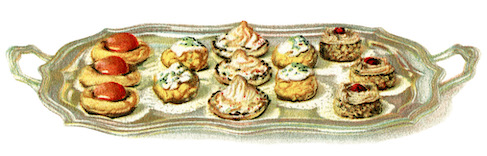
So, it seems edibles are as integral to mah jongg as the click, click, click of tiles. Many a player will confess to buying and baking elaborate goodies that family members are prohibited from sampling—at least until after the game, when they may get leftovers.
On cue, an eclectic group of Jewish and Gentile grandmothers and non-grandmothers gathered at Beamer’s residence to start their weekly game. With their brightly wrapped cakes and cookies, they instantly generated chaos from the order he had just created, proving Julia Roberts right.
Well, half right.
Mah jongg may create order out of chaos, but mah jongg players proceeded to create chaos out of his colorfully ordered tiles.
Beamer suggests these additional readings:
- Gooen, Karen Searching for Bubbe Fischer: The Path to Mah Jongg Wisdom
- Museum of Jewish Heritage, Project Mah Jongg
- New York Times, “Recalling the Craze for a Game of Chance”
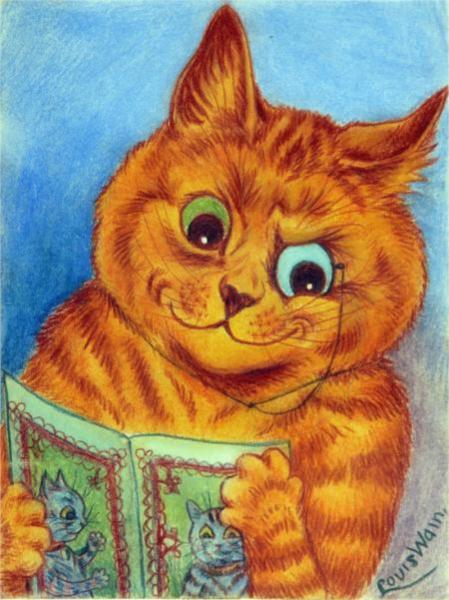
What Is Your Cat Reading?
Send book reviews, feline adventures, and cute photos to:
Pat@PattiMWalsh.com
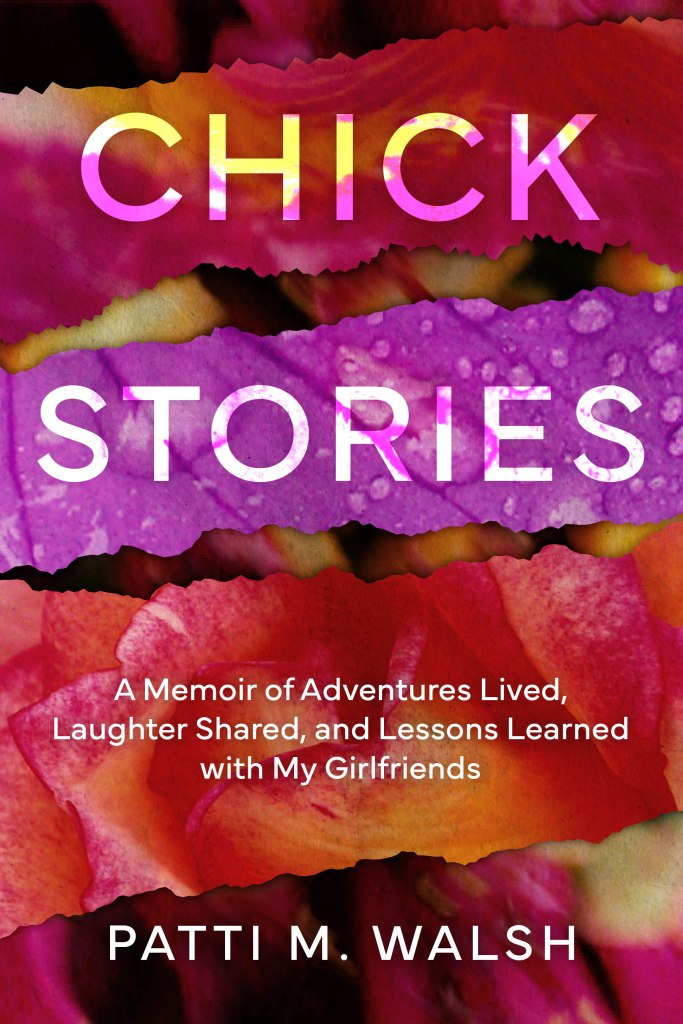
Chick Stories
A memoir of adventures lived, laughter shared, and lessons learned with my girlfriends
Travesties, tragedies, and comical calamities abound
in a series of essays rich with historical and cultural context.

Newsletter:
Come to Think of It
Stories are meant to be shared. So are fleeting thoughts, poetic musings, humorous anecdotes, and existential questions.
Come to Think of It is a forum to engage, inspire, and challenge. To gather with friends. Come to Think of It.
Subscribe at PattiMWalsh.com/newsletter.
 What the Cats Are Reading
Hi! Couldn’t access it, so I subscribed. Still can’t. Tried “Manage Subscriptions,” nothing there to access either. Isn’t tech great?
LikeLike
Loved this and starred it but could not get access either. After seeing The Joy Luck Club I decided I would play one day and did not find a group using tiles until right before leaving Florida . Up here in the solitude of our Great Northwoods, I play Mahjong as solitaire on my laptop while I listen to my spoken emails. Thank you for your incredible amount of research and writing talent that goes into each blog.
LikeLike
Loved your essay on Mahjong…very funny and informative. I, too, now love the game 🀄️ Hope your enjoying summer!
LikeLike
Thanks for the great article! I really enjoyed reading about your journey of learning to play mah jongg with the help of your feline friend. I think it’s great that you find it to be a game of both luck and strategy. I’m so glad that you took the time to learn more about how to play the game properly and the importance of the NMJL’s Hands and Rules Scorecard. I’m sure it will help you to become a great mah jongg player! Thank you to the author for teaching me more about this traditional Chinese game.
LikeLike