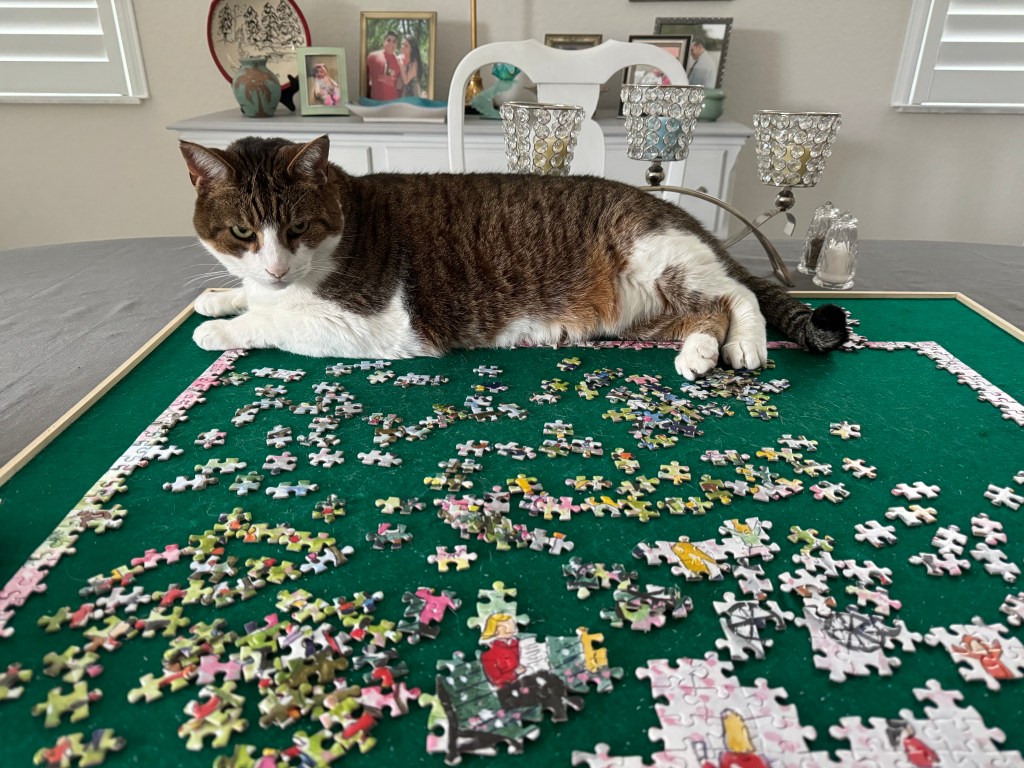
Like many puzzle aficionados, Beamer Baclawski spent January 29, National Puzzle Day, working on a jigsaw puzzle.
“Why would anyone cut up a perfectly good picture only to reassemble it?” he asked, though he didn’t pause his nifty paws work to puzzle an answer.
Anyone familiar with jigsaws would recognize the enigma of the puzzle—it is both frustrating and satisfying, depending on how the pieces fit together.
Although Beamer separates pieces by color and painstakingly finds all of the edge pieces first, he dreads misplacing a piece that almost fits into the wrong place so that the last piece doesn’t fit anywhere. Or worse—the bane of all puzzlers—a missing piece.
On the one paw, he agrees with Deepak Chopra, alternative medicine advocate, who believes, “There are no extra pieces in the universe. Everyone is here because he or she has a place to fill, and every piece must fit itself into the big jigsaw puzzle.”
On the other paw, he throws in with the approach taken by American author Virginia Wolff: “Arrange whatever pieces come your way.”
A Puzzling Word
The word’s etymology is nearly as puzzling as assembling a thousand pieces into a picture.
While the word puzzle is likely derived from the French word pusle, its original meaning is, “to perplex, puzzle, interrogate.” The alternative spelling, puzzel, however, means “harlot,” while pucelle means “a virgin.” And just to make the word even more puzzling, the English word pizzle meant “penis.”
That’s too contradictory for Beamer. He likes his words straightforward.
Nevertheless, Robert Dudley is credited with first using the word to describe a confusing problem that needed to be solved. In The Voyage of Robert Dudley, afterwards styled Earl of Warwick and Leicester and Duke of Northumberland, to the West Indies, 1594-1595, he, Abram Kendall, and Captain Wyatt recorded the earliest English attempt to occupy Trinidad and navigate the Orinoco, one of the longest rivers in South America.
Dudley, himself, was a puzzle, as was his tangled history with Queen Elizabeth I. Handsome and ambitious, the self-styled earl and duke may have failed to win the Queen’s hand, but not her affections. With a storied history of wives and lovers, he was suspected of murdering his wife to marry the queen. He ended up a failed political and military leader who died of a strange illness. Some historians suggest it was Elizabeth’s doing.
Gaining Popularity
According to Wentworth Wooden Jigsaw Company, map engraver John Spilsbury created the first jigsaw puzzle a couple of centuries later. In 1762, he mounted one of his maps onto wood and then cut around the countries to help school children learn geography.
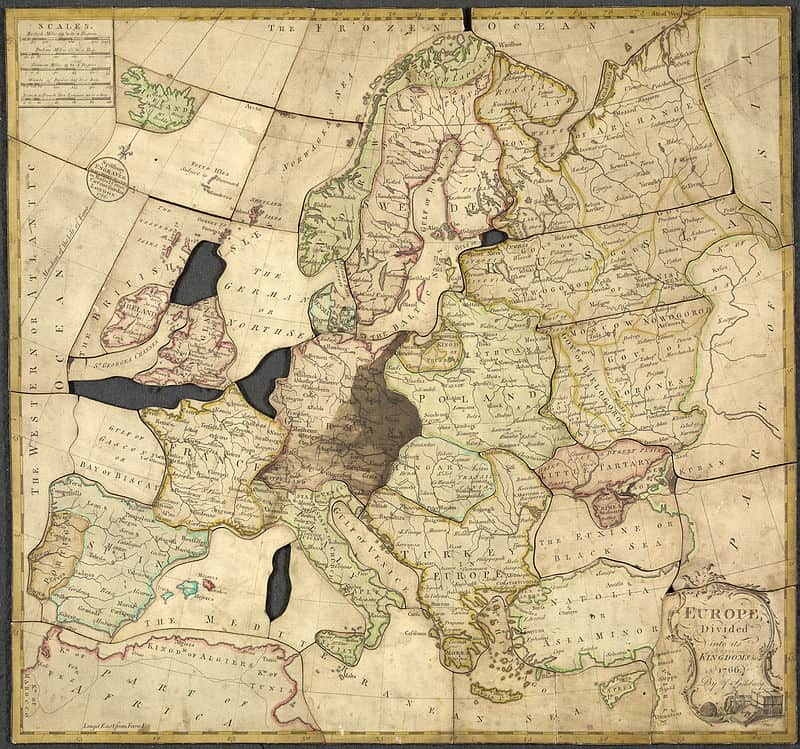
Called dissected maps, the concept caught on with historical, religious, and landscape themes.
With the dawn of the 20th century, jigsaw puzzles experienced rapid growth because of:
- Lithographic printing techniques that allowed higher quality printing;
- Plywood, which made it easier and more affordable to cut puzzle pictures into intricate shapes; and
- The invention of the treadle jigsaw, which not only enabled puzzle makers to create intricate shapes, but also gave the trend its name.
Millie Jackson of Mrs. Blackwell’s Village Bookshop, wrote on her blog that the trend “menaced the city’s sanity,” at least according to a May 1908 New York Times headline.
Despite the sensational headline, puzzles were mainly for the wealthy, since they cost around $4 each, and the average laborer earned $12 per week.
In the 1920s, travel companies used puzzles to market their businesses. GWR with Chad Valley produced puzzles of their steam engines and destinations, while Cunard produced a large puzzle of the Queen Mary, even before it sailed.
In the midst of the Great Depression of the 1930s, puzzles dropped in price, giving the masses something to forget their hardships.
Similarly, interest in jigsaw puzzles resurged during the mandatory covid lockdowns of the early 2020s.
Today, in North America alone, an estimated 100 million people—and felines—enjoy jigsaw puzzles, and about 50 million American adults spend an average of three and a half hours a week on them.
Competitive jigsaw puzzling has also grown, with the establishment of the Annual World Jigsaw Puzzle Championships in 2019.
New Puzzles to Solve
In addition to traditional flat puzzles, puzzlers now enjoy 3D, spherical, and architectural recreations. A booming cottage industry of puzzle accessories offers tables, boards, cases, organizers, and roll-up mats, as well as glue and frames to create art from finished pieces. Also, apps exist to create custom puzzles and engage multiplayers near and far.
While some people do puzzles for socialization, others do them for “me time” or to take a break from the digital lifestyle. Some people also liken the pastime to meditation, because it may create a sense of peace and calm.
They’re even good for your health. Researchers have identified at least three benefits:
- By helping you relax, doing puzzles may reduce heart rate, blood pressure, and breathing rate. They can also improve and maintain fine motor skills.
- Puzzling can keep your mind sharp and combat cognitive decline because it involves problem-solving, memory, and visual perception skills.
- Concentration can ease stress, anxiety, and consequently, makes you feel good. Correctly fitting a puzzle piece may produce the hormone dopamine, which can lead to a feeling of accomplishment and fulfillment.
Jigsaw puzzles are also used to study cognitive and visuospatial abilities in young children.
Beamer wants to know if anyone has used puzzles to study feline cognitive abilities.
After all, he purred, felines have been known to follow the advice of Virginia Wolff, and arrange—or rearrange—whatever pieces come their way.
Want to make your own jigsaw puzzle?
Check out this video by the Art Historian,
a program for young artists interested in the history of art and culture.
 What the Cats Are Reading
In some communities, “Pizzelle” is a small, flat, round Italian cookie that looks like it was baked in a waffle iron.
LikeLike